Purification & Purity — study notes
Squeeze a muddy puddle through a paper towel and the grit stays behind while clear water drips through — a five-year-old could explain why. Every separation technique a chemist reaches for is built on that same idea, just dressed up with fancier glassware: find a physical difference between the substances in front of you, then design a step that only one of them can get through.
Reading Purity Straight Off a Thermometer
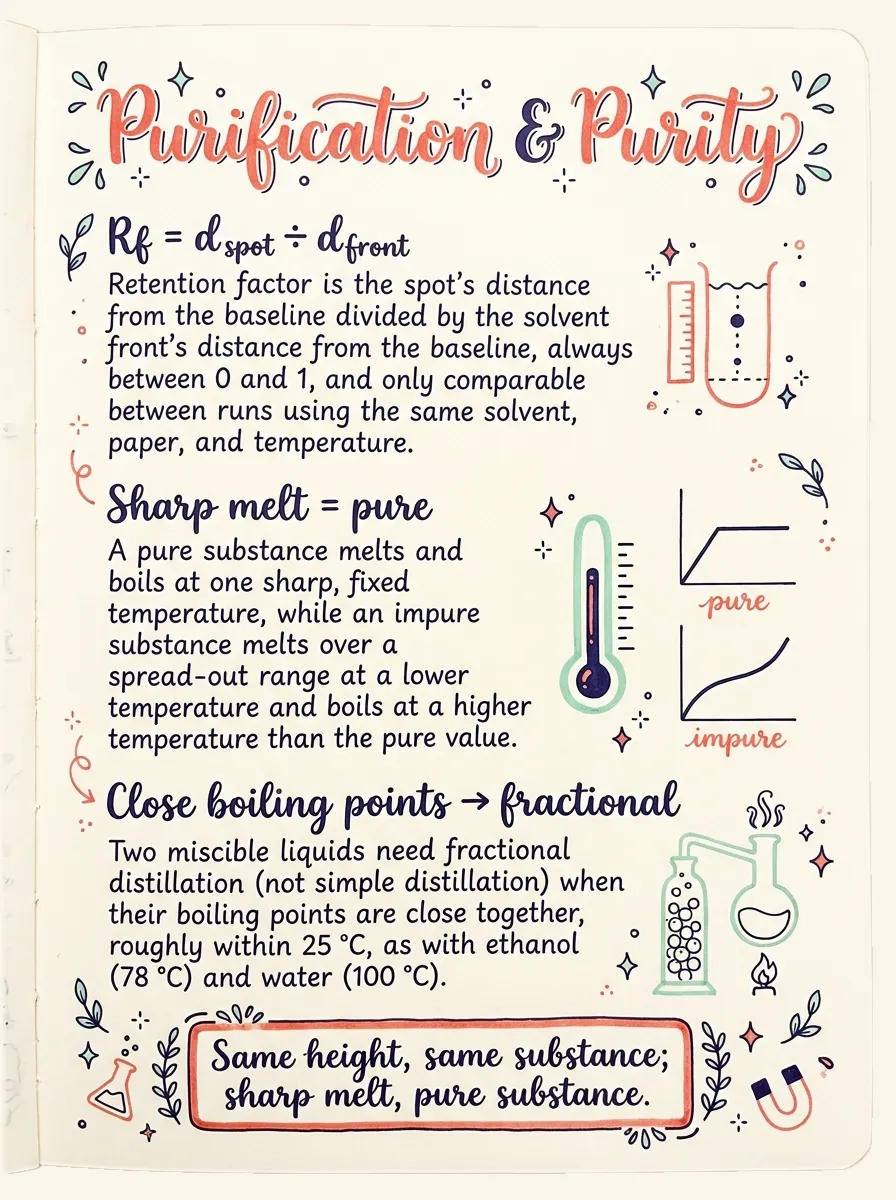
Here's a fact worth trusting completely: a genuinely pure compound always melts at one exact, repeatable temperature, and boils at another. Look that number up in a data table and a match is strong evidence you've correctly identified the substance. Contaminate the sample with anything else, though, and two tell-tale things happen together — the melting point drifts below the textbook figure, and instead of flipping from solid to liquid in an instant, the sample smears across a band of temperatures as it softens. Both symptoms trace back to one cause: foreign particles wedge themselves into the orderly, repeating arrangement a pure solid naturally forms, so less energy is needed to shake that structure apart, and different regions of the sample give way at slightly different moments rather than all at once. A wide, depressed melting reading is therefore a verdict about purity, never a verdict about identity — the compound in front of you could still be exactly what the label claims, just carrying an unwanted passenger.
Worked Example — Testing a Vitamin Tablet
- A data table lists pure ascorbic acid (vitamin C) as melting sharply at 190 °C.
- A student crushes a supermarket vitamin tablet and heats a small sample slowly, recording melting starting at 179 °C and finishing at 186 °C.
- Both warning signs show up together: the reading is spread across seven degrees rather than a single sharp point, and even the earliest onset, 179 °C, still sits below the pure reference value.
- Conclusion: the tablet is impure ascorbic acid. Binders, coatings and fillers added during manufacture behave exactly like the "foreign passengers" described above — this result does not mean the tablet lacks vitamin C, only that other substances are mixed in with it.
Nine more named techniques — including how a fractionating column pulls apart liquids with close boiling points, and how a spot's position on chromatography paper becomes a precise number — plus the audio walkthrough and a printable worksheet, are waiting in the full lesson below.
Keep going — unlock the whole topic
Notes, audio and the worksheet for this topic, plus every other topic in the subject.
Claim a free seat →