Binomial Expansions — Study Notes
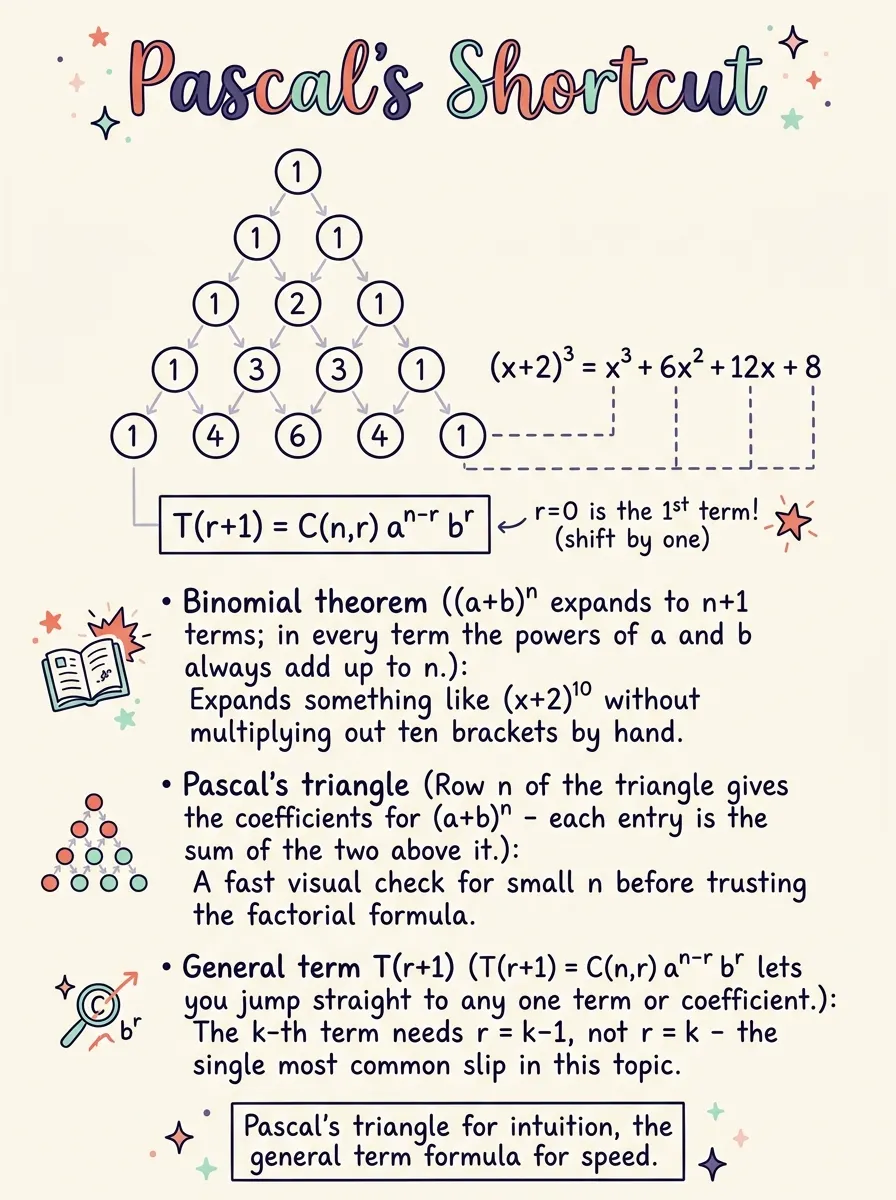
Multiply out (x + 4)² by hand and it takes seconds. Try the same brute-force approach on (x + 4)⁶ and you're juggling six brackets and dozens of terms before you've even started tidying up. There's a faster route that skips the multiplying entirely, and it's built from a pattern you can literally draw with a pencil.
Reading Off Coefficients Instead of Multiplying Brackets
Every expansion of (a + b) raised to a whole-number power has the same underlying shape: a run of terms where the power on a counts downward while the power on b counts upward, and each term carries its own coefficient out front. Those coefficients aren't random — they sit inside a triangular number grid where each row starts and ends with 1, and every other entry is built by adding the two numbers sitting above it. Once a row is built, reading off an expansion is just copying numbers across and attaching the matching powers of a and b — no bracket-multiplying required. This grid scales to any power you're asked for; the only extra work for a bigger power is one more row of additions, never a bigger multiplication.
Worked Example — Expand (3x − 1)³ fully
- Identify the row you need: power 3 gives coefficients 1, 3, 3, 1.
- Match the bracket to the pattern with a = 3x and b = −1, keeping the whole "3x" together since it's raised to a power as one unit: (3x)³ + 3(3x)²(−1) + 3(3x)(−1)² + (−1)³.
- Evaluate each piece in turn: (3x)³ = 27x³; 3 × 9x² × (−1) = −27x²; 3 × 3x × 1 = 9x; (−1)³ = −1.
- Combine the pieces, watching the sign flip on every odd power of the negative term: (3x − 1)³ = 27x³ − 27x² + 9x − 1.
Notice the sign pattern along the way — plus, minus, plus, minus — a direct consequence of raising a negative number to climbing powers, not a rule to memorise separately.
This is only the entry point: turning that same coefficient pattern into a one-line formula, pulling out a single term without expanding everything, and hunting for the term where the powers of x cancel completely are all covered with a listen-along audio walkthrough, a printable worksheet and several more worked examples in the full lesson below.
Keep going — unlock the whole topic
Notes, audio and the worksheet for this topic, plus every other topic in the subject.
Claim a free seat →