Coordinate Geometry in Two Dimensions — Study Notes
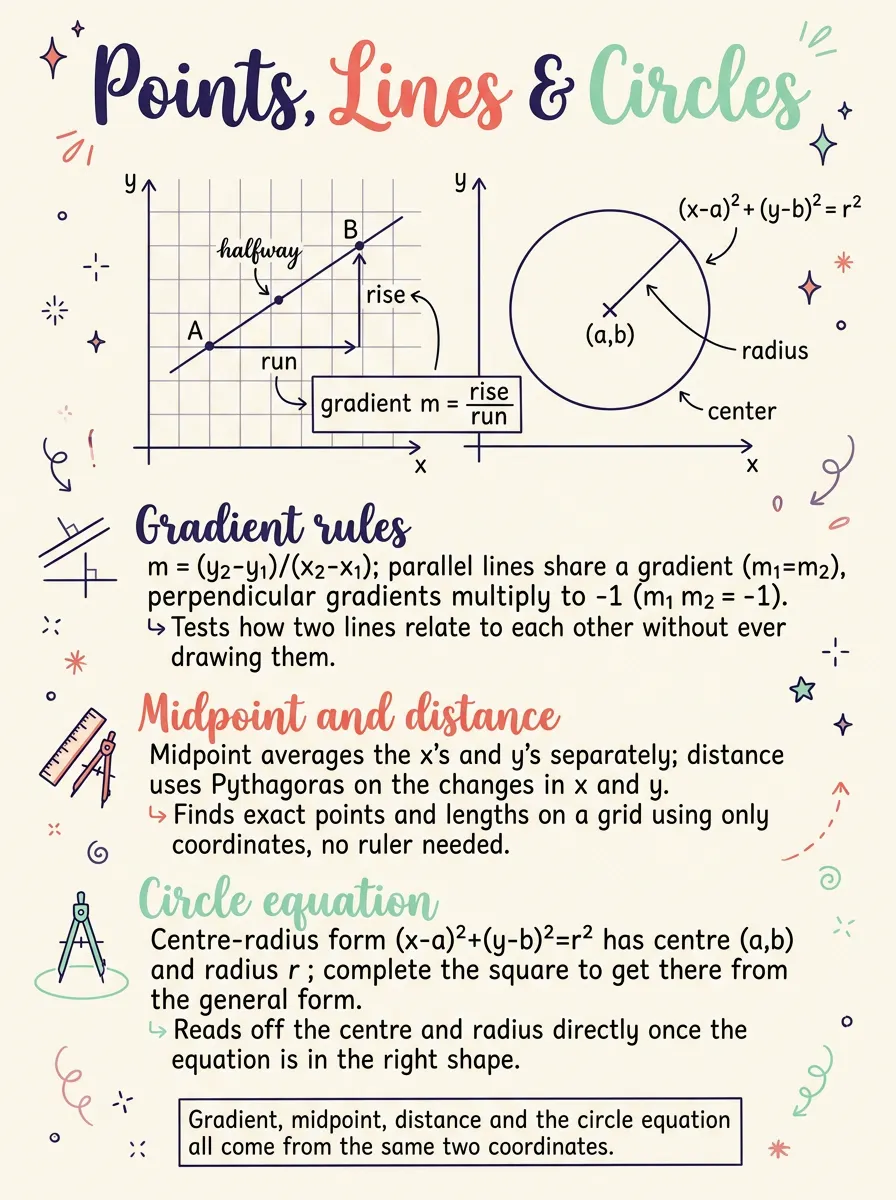
Cycling up a gentle ramp feels nothing like grinding up a steep hill — and the difference between the two can be captured in a single number. Coordinate geometry turns that number into pure arithmetic: pin two points down with coordinates, and how steeply the line between them tilts drops straight out of a short calculation, no drawing needed.
Reading Steepness Straight From Coordinates
Every point on a graph carries an x-value fixing its left–right position and a y-value fixing its height. A line joining two such points has one number describing its tilt: the gradient. To get it, take the difference in height between the two points and divide by the difference in their horizontal position. Written with labels x₁, y₁ for the first point and x₂, y₂ for the second, that's height-change over sideways-change — nothing more mysterious than "rise" shared out across "run".
A tilt climbing from left to right gives a positive number; one falling away gives a negative number; and a line running dead flat scores exactly zero. One quiet rule keeps the arithmetic honest: label the points however you like, but once you've decided which is first and which is second, use that same labelling on both the top and the bottom of the fraction — swap it halfway through and the sign comes out backwards.
Worked Example — Gradient of the line through (−1, 4) and (5, −2)
- Label (−1, 4) as the first point and (5, −2) as the second, so x₁ = −1, y₁ = 4, x₂ = 5, y₂ = −2.
- Find the height-change: y₂ − y₁ = −2 − 4 = −6.
- Find the sideways-change, using the same point order: x₂ − x₁ = 5 − (−1) = 6.
- Divide: gradient = −6 ÷ 6 = −1. The line falls at 45°, losing one unit of height for every unit it moves right.
Gradient is only the opening move — from there, coordinate geometry builds up to naming a whole straight line with an equation, pinning down midpoints and lengths, sizing up flat-sided shapes, and even writing circles from their coordinates alone. The audio walkthrough, the practice worksheet and the remaining worked examples are waiting in the full lesson below.
Keep going — unlock the whole topic
Notes, audio and the worksheet for this topic, plus every other topic in the subject.
Claim a free seat →