Equations and Inequalities — Study Notes
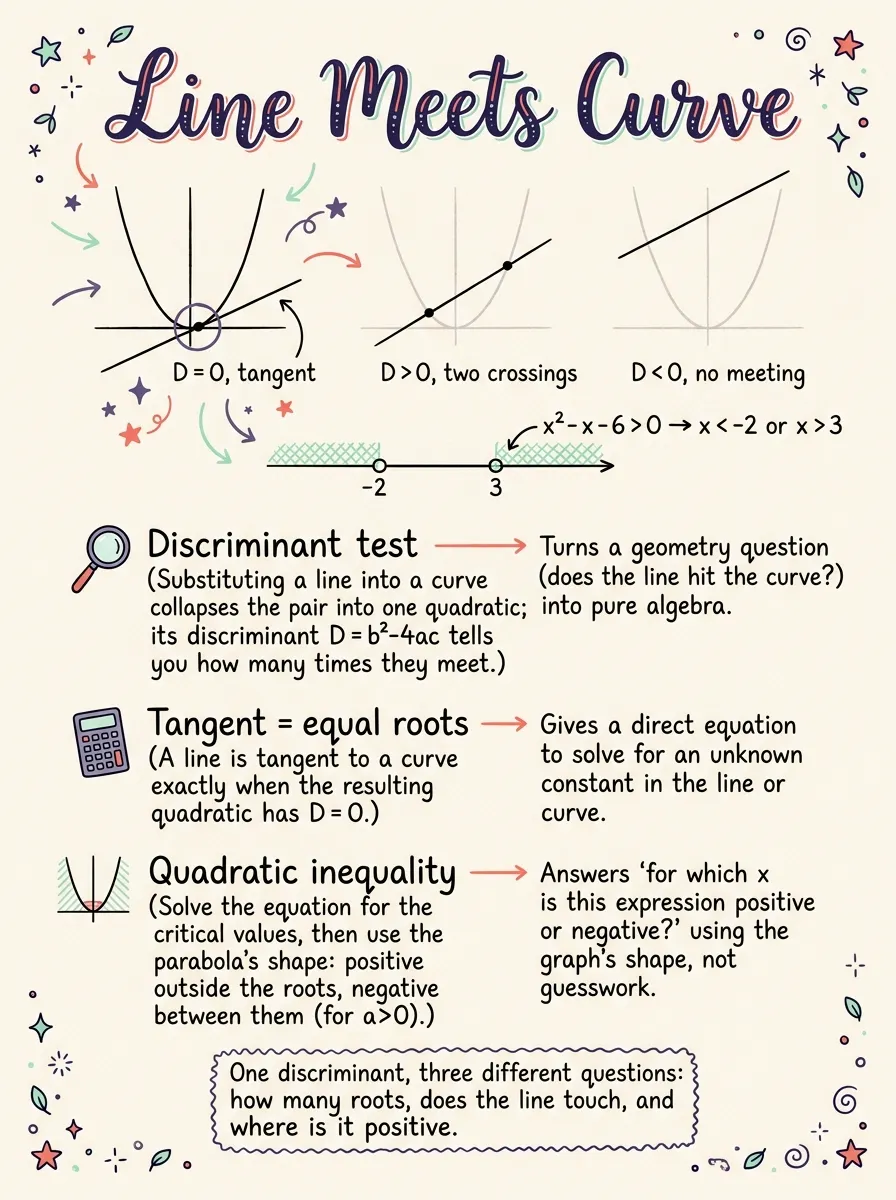
Some quadratic equations hand you two neat answers, some give you a single repeated answer, and some give you nothing real at all — and you can tell which situation you're in before you finish solving. That's a genuinely useful exam skill: no wasted working on an equation that was never going to produce a tidy answer.
Reading the Root Count Off the Formula
Every quadratic ax² + bx + c = 0 solves through the familiar formula, and buried inside it is a single expression that decides everything about how many solutions exist: b² − 4ac. Mathematicians call this the discriminant. It sits under the square-root sign in the formula, so its sign controls what that square root can actually produce.
If b² − 4ac comes out positive, its square root is a genuine, non-zero number, so adding and subtracting it gives two different answers — two distinct real roots. If it comes out to exactly zero, adding and subtracting zero changes nothing, so both answers collapse into one — a repeated root. If it comes out negative, there's no real number whose square gives a negative result, so the square root itself breaks down — no real roots exist at all. No graph-sketching or trial solving is needed; reading the sign of one expression settles the question immediately.
Worked Example — How many roots does 2x² − 3x − 5 = 0 have?
- Match the equation against ax² + bx + c = 0 to read off the coefficients: a = 2, b = −3, c = −5.
- Substitute into the discriminant: (−3)² − 4(2)(−5) = 9 − (−40) = 9 + 40 = 49.
- 49 is greater than zero, so this equation has two distinct real roots — and because 49 is itself a perfect square (7²), those two roots will even turn out to be neat fractions rather than surds.
Notice the sign check alone answered the question — nothing here required completing the actual solving process.
That's just the starting point: the discriminant test also decides whether a straight line touches, crosses or misses a curve entirely, and it turns quadratic inequalities into a fast pattern once you know it. Those worked examples, plus a listen-along audio walkthrough and a practice worksheet, are in the full lesson below.
Keep going — unlock the whole topic
Notes, audio and the worksheet for this topic, plus every other topic in the subject.
Claim a free seat →