Exponential and Logarithmic Functions — Study Notes
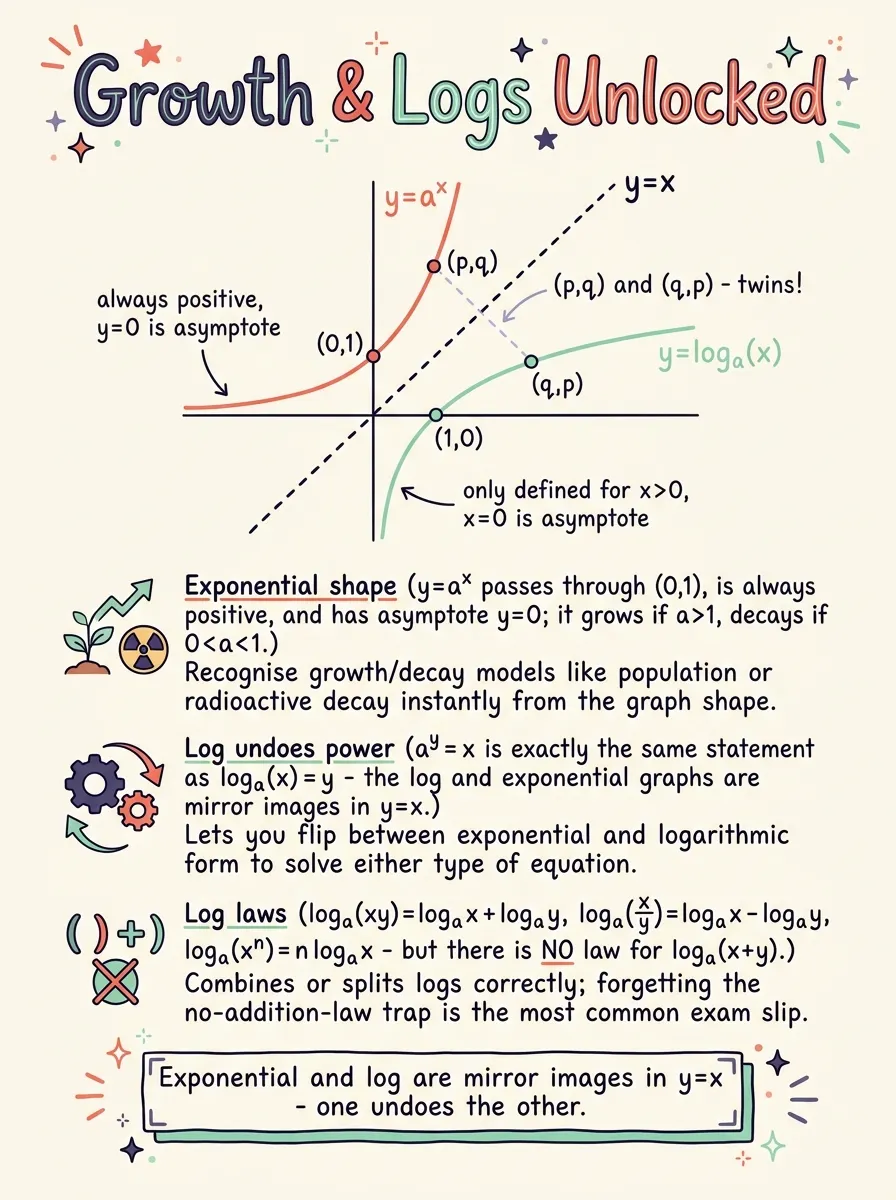
Some quantities don't grow by a fixed amount each step — instead they grow by a fixed percentage, which just means multiplying by the same factor over and over. That repeated-multiplication pattern is an exponential function, and its reverse — the question "which power lands on this number?" — is answered by a logarithm.
How a Logarithm Relates to a Power
A logarithm is really a power, just written a different way round. Saying that a raised to y equals x is the very same fact as saying log base a of x equals y — one version puts the power on top of the base, the other pulls that power out on its own so you can work with it directly. Because a log is secretly a power, the index rules you already trust resurface as three handy log laws: adding two logs together matches multiplying their numbers inside one log; taking one log away from another matches dividing instead; and a number sitting out front of a log becomes a power tucked inside it. Every one of these only fires when the two numbers are joined by a multiply or a divide — there is no shortcut for a log of a sum, so an addition or subtraction sitting directly inside the brackets can't be split apart this way.
Worked Example — Combine log_a 15 + log_a 2 − log_a 3 into one logarithm
- Turn the addition into a multiplication inside a log: log_a 15 + log_a 2 becomes log_a(15 × 2), which is log_a 30.
- Turn the subtraction into a division: log_a 30 − log_a 3 becomes log_a(30 ÷ 3).
- Work out what's left under the log: 30 ÷ 3 = 10, so the whole chain collapses down to log_a 10.
Keep the order straight: every plus sign in front of a log turns into a multiply once it moves inside, and every minus sign turns into a divide — you never touch the actual numbers with a plus or minus themselves.
That's the groundwork for handling logarithms — the full lesson below goes on to line up matching bases for solving exponential equations, bringing in logs when the bases won't line up, working through logarithmic equations safely with the check that rejects impossible answers, and modelling real growth and decay, all alongside a listen-along audio walkthrough and worksheet.
Keep going — unlock the whole topic
Notes, audio and the worksheet for this topic, plus every other topic in the subject.
Claim a free seat →