Polynomials and Partial Fractions — Study Notes
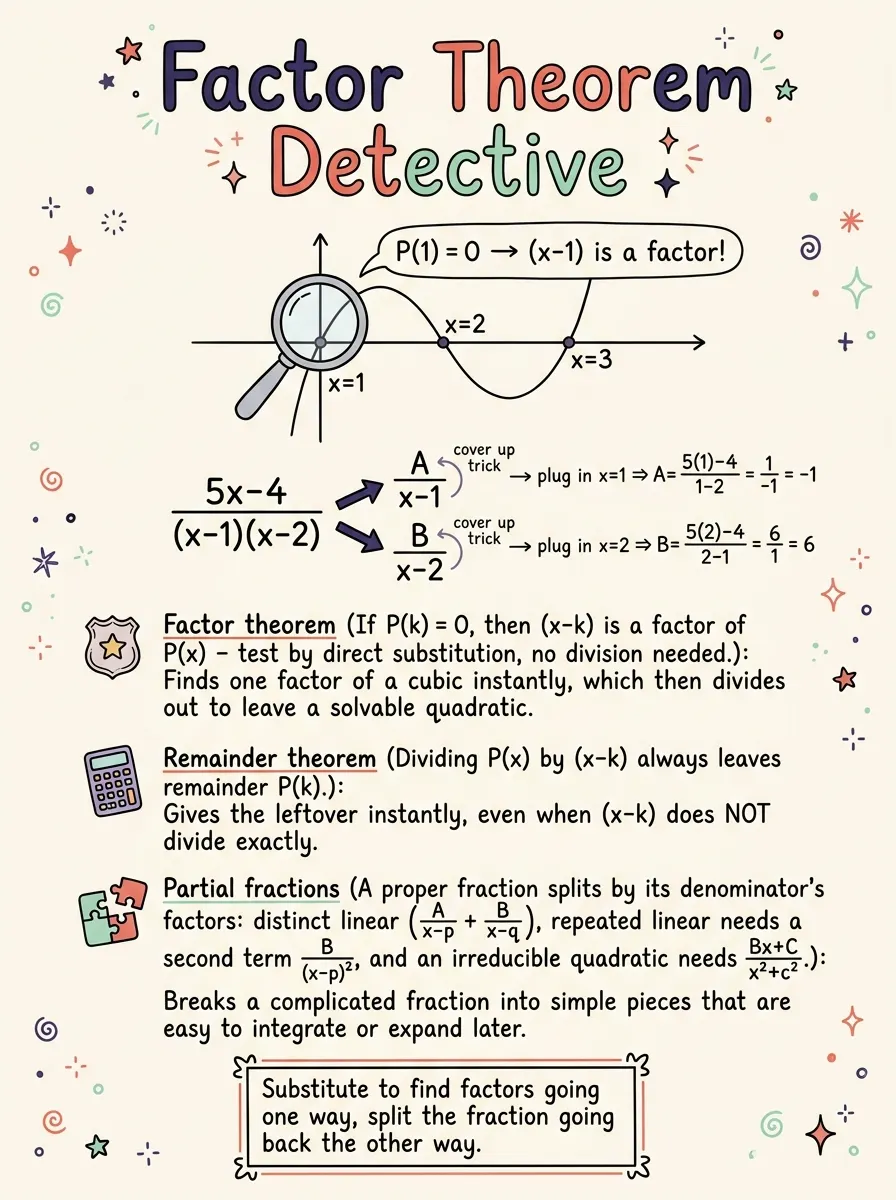
A cubic like x³ − 6x² + 11x − 6 = 0 has no ready-made formula the way a quadratic does. O-Level A-Maths gives you a shortcut instead — a fast way to find out what's left over when one polynomial doesn't slot neatly into another, without setting out a full division.
Why Substitution Can Replace a Division
Whenever you divide a polynomial by a linear bracket such as (x − k), the result can always be written as: original polynomial equals (x − k) times some quotient, plus whatever is left over. Because the bracket is only degree one, that leftover piece can't still contain x — it collapses down to a single number. Now try putting x = k into that whole statement. The first chunk becomes (k − k) times the quotient, and since k − k is zero, that entire chunk vanishes no matter what the quotient turns out to be. All that survives is the original polynomial evaluated at k, sitting equal to the leftover number. In other words, one substitution hands you the leftover value directly, with no division layout required at all.
Worked Example — Evaluating a Leftover Value by Substitution
- Take the polynomial x³ − 5x² + 4x + 7, and imagine dividing it by (x − 3). Because the bracket is (x − 3), the number to substitute is x = 3.
- Evaluate the polynomial at that value: 3³ − 5(3)² + 4(3) + 7 = 27 − 45 + 12 + 7.
- Combine the terms in order: 27 − 45 + 12 + 7 = 1.
That single number, 1, is the leftover value — found without ever writing out a division.
Watching what happens when that leftover lands on exactly zero, matching the bracket's sign correctly every time, and running the whole idea in reverse to split a messy fraction back into simple pieces — all of that gets a listen-along audio walkthrough and a full practice worksheet in the full lesson below.
Keep going — unlock the whole topic
Notes, audio and the worksheet for this topic, plus every other topic in the subject.
Claim a free seat →