Proofs in Plane Geometry — Study Notes
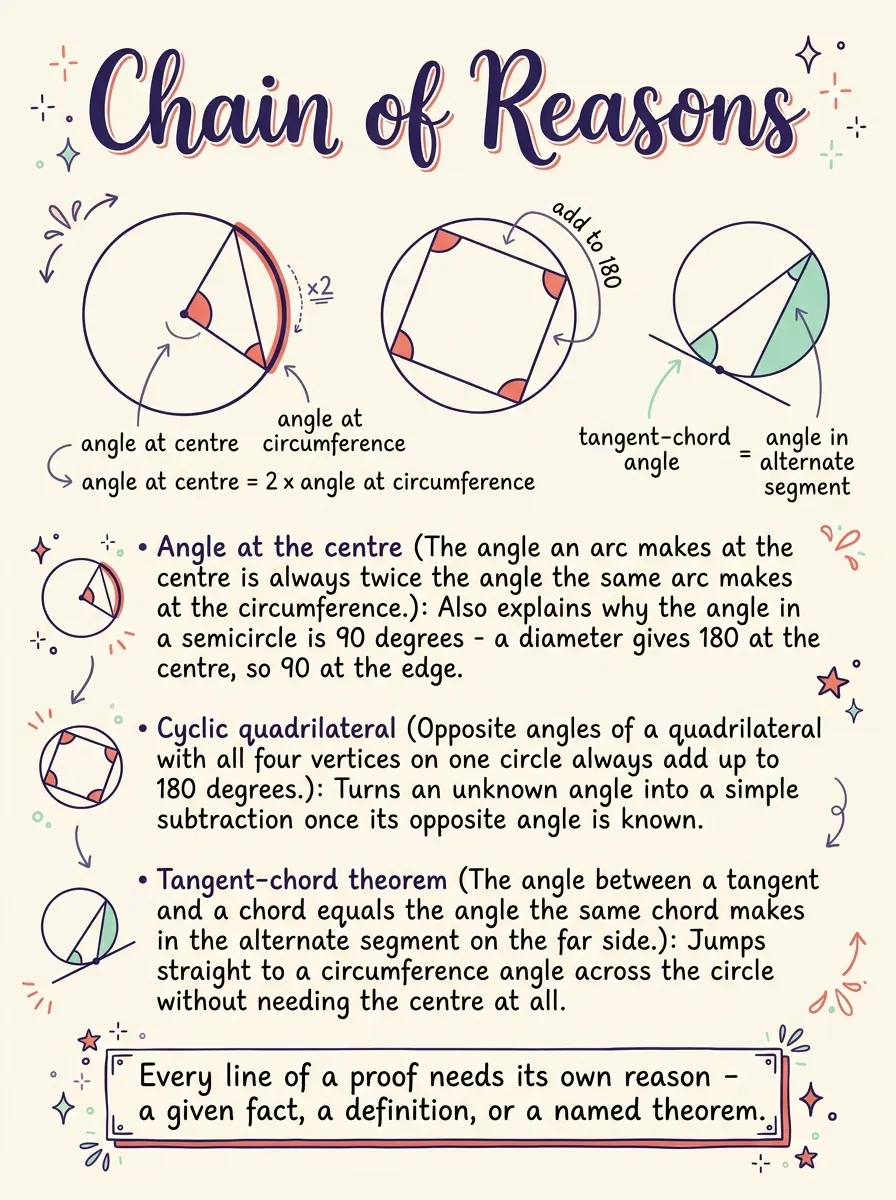
A courtroom lawyer can't win a case by shouting "trust me." Every claim needs a piece of evidence attached to it, named out loud. Geometry proofs run on the exact same rule: you can't just state that two angles match — you have to say why you're allowed to state it. Miss the "why" and the marker crosses the line out, even when the answer itself is correct.
Why Every Line Needs a Reason
A proof is a ladder of small, justified steps that climbs from what you're told (the given facts) to what you're asked to show (the to prove line). Each rung is a statement paired with its reason — a fact you were handed, a definition, or a named result you're allowed to quote without re-deriving. Skip the reason and the rung isn't load-bearing; it's just a guess dressed up as a step. Before writing anything, glance at the "to prove" line: wanting an equal length usually points you toward matching up two triangles; wanting an equal angle usually points you toward parallel lines or an isosceles shape. That glance tells you which tool to reach for first.
Worked Example — Proving Two Triangles Match
In parallelogram WXYZ, the diagonal WY is drawn. Prove that triangle WXY is congruent to triangle YZW.
- WX = ZY — opposite sides of a parallelogram are equal (given property of the shape).
- XY = ZW — opposite sides of a parallelogram are equal (same property, the other pair).
- WY = WY — common side, shared by both triangles even though it wasn't handed to us directly.
- Triangle WXY ≡ triangle YZW — SSS: all three matched pairs of sides are equal, so the test applies cleanly.
Three matching sides is enough on its own — no angle needed — because SSS never asks where an angle sits. Once congruence is locked in, any pair of corresponding angles or sides in those two triangles can be declared equal in a single line, without proving each one separately.
Spotting which test fits — SSS, SAS, ASA or RHS — and chaining that into circle theorems and the midpoint result is exactly what the audio walkthrough, the remaining worked examples and the practice worksheet cover in the full lesson below.
Keep going — unlock the whole topic
Notes, audio and the worksheet for this topic, plus every other topic in the subject.
Claim a free seat →