Quadratic Functions — Study Notes
Fire a firework into the night sky and follow the spark: it climbs, hangs for an instant, then arcs back down. Graph its height against time and that shape is a parabola — the picture behind every quadratic function you'll meet on the A-Maths paper.
Reading Off the Turning Point Without Drawing Anything
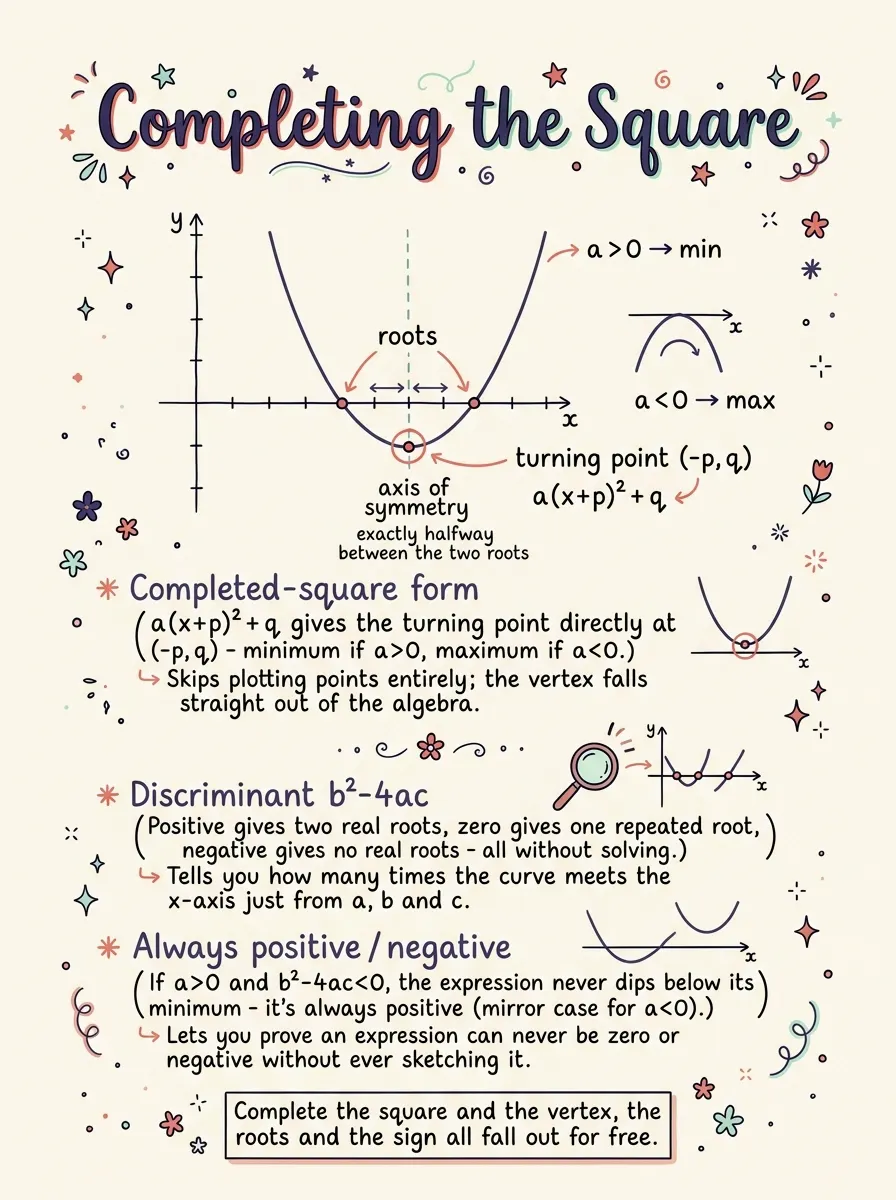
Every parabola has one spot where it stops climbing and starts falling, or the reverse — its turning point. Spot that point directly inside the algebra and you know the biggest or smallest value the expression can ever take, no sketching needed. That's the payoff of rewriting a quadratic in completed-square form, a(x + p)² + q.
A squared bracket such as (x + p)² can never dip below zero — it bottoms out at exactly zero when x = −p and climbs everywhere else. So once your quadratic sits in that shape, the squared part only ever adds something on top of q (when a is positive) or takes something away from it (when a is negative). Either way, q itself is the extreme — the smallest value the whole expression can reach if a is positive, the largest if a is negative — landing precisely at x = −p. Getting an ordinary expression like x² + bx + c into that shape means asking which square, once multiplied out, would reproduce the x² and x terms already there — then tidying up whatever leftover number that square drags in with it.
Worked Example — Completing the Square on x² + 12x + 5
- Reproducing x² + 12x needs the square built by halving 12 to get 6, since (x + 6)² multiplies out to x² + 12x + 36.
- That expansion drags in an extra 36 the original expression never had, so build the square by adding 36, then cancel it straight back out: x² + 12x + 5 = (x + 6)² − 36 + 5.
- Tidy the remaining numbers: x² + 12x + 5 = (x + 6)² − 31, so the expression's smallest possible value is −31, reached exactly at x = −6.
Because a = 1 is positive here, that turning point (−6, −31) is a minimum, not a maximum — always check the sign of a before you commit to which one you're reporting.
This same move — forcing an expression into completed-square shape — is also how you solve equations that refuse to factorise neatly, and it links straight into the discriminant, which tells you how many times a curve meets the x-axis before you've plotted a single value. All of that, worked through step by step with an audio walkthrough and a practice worksheet, is waiting in the full lesson below.
Keep going — unlock the whole topic
Notes, audio and the worksheet for this topic, plus every other topic in the subject.
Claim a free seat →