Surds — Study Notes
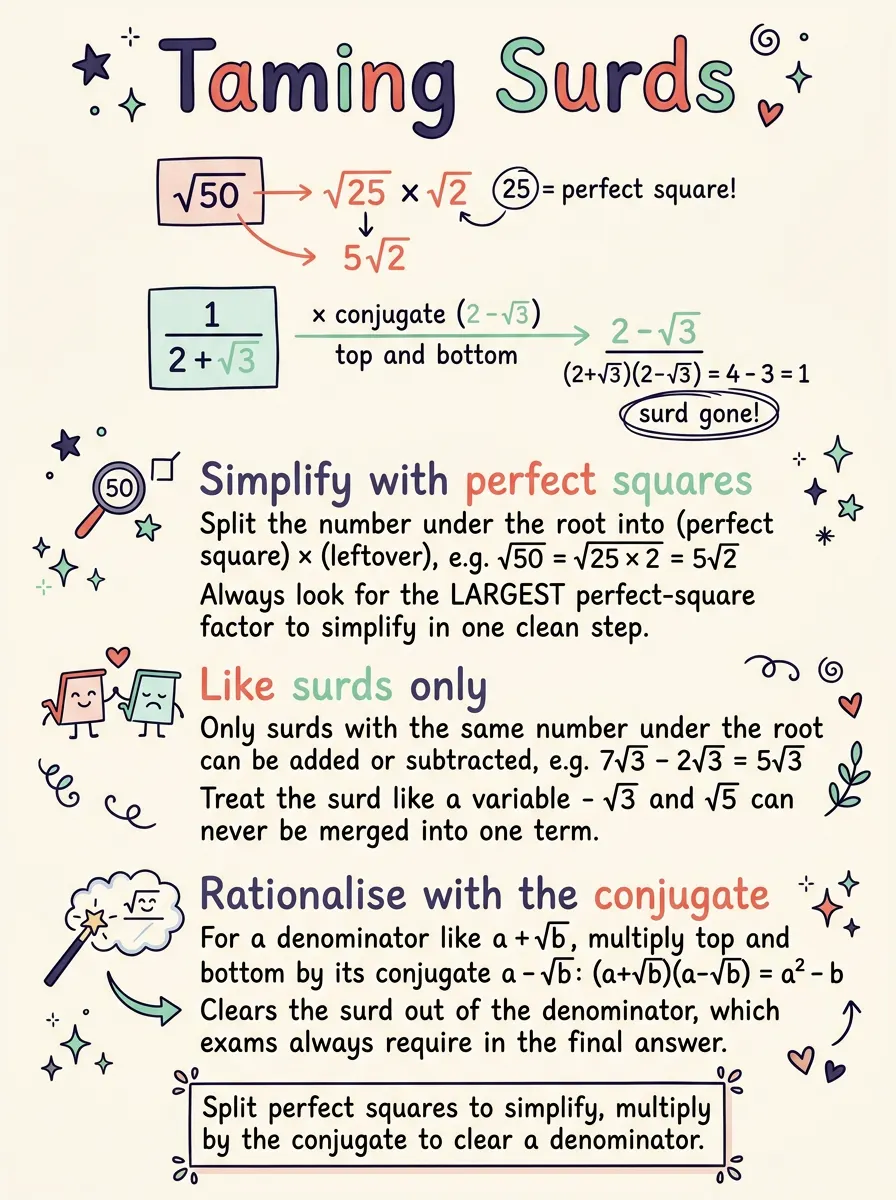
Try typing √2 into a calculator. You get 1.41421356… — a decimal that never ends and never repeats. Numbers like this, built from a root that refuses to simplify to a whole number, are called surds — and O-Level exams want them left exact, not rounded off.
What Actually Makes a Root a Surd
A surd is a root — usually a square root — whose value is irrational: it can't be written as a whole number or a simple fraction, however you rearrange it. √2, √3 and √5 are all surds.
Not every square root is a surd, though. √4 isn't — it simplifies exactly to 2, a whole number, so nothing irrational survives. A number like 4, 9 or 25 — some whole number multiplied by itself — is a perfect square (1, 4, 9, 16, 25, 36, 49, 64, 81, 100, and so on). The test is simple: if the number under the root is a perfect square, the root collapses to a whole number and isn't a surd; otherwise, it is one.
A surd never changes value when it's rewritten more simply — the same way 6/8 and 3/4 are the same amount, just written differently — so simplifying is worth doing whenever the number under the root hides a perfect-square factor. The tool that unlocks this is: √(a × b) = √a × √b, for a, b ≥ 0.
Worked Example — Simplify √50
- Look for a perfect-square factor of 50. Scanning the perfect-square list: 50 = 25 × 2, and 25 is a perfect square (5²).
- Apply the rule with a = 25, b = 2: √50 = √25 × √2.
- √25 is a whole number, 5, so it steps outside the root: √50 = 5√2.
Always look for the largest square factor you can find — it saves having to simplify a second time.
The rest of the method — every worked example, a listen-along audio walkthrough and a practice worksheet — is in the full lesson below.
Keep going — unlock the whole topic
Notes, audio and the worksheet for this topic, plus every other topic in the subject.
Claim a free seat →