Trigonometric Functions, Identities and Equations — Study Notes
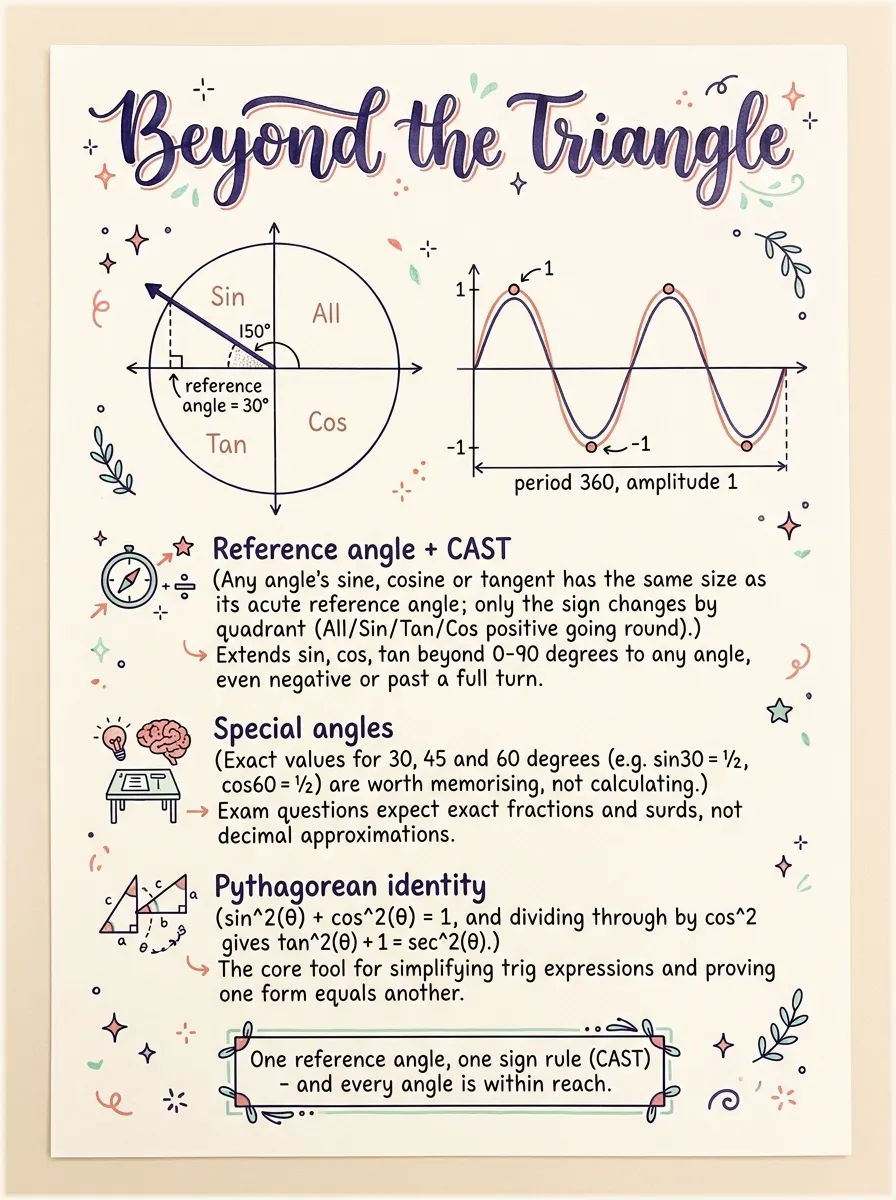
Picture a Ferris wheel: as a seat goes round, its height above the ground rises, falls, and rises again — a smooth, repeating pattern. Sine and cosine are exactly this kind of shape in maths. At O-Level you only met trigonometric functions inside a right-angled triangle, where an angle runs from 0° to 90° and no further — this topic knocks that ceiling down.
Beyond the Right-Angled Triangle
You already know sin θ = opposite ÷ hypotenuse, cos θ = adjacent ÷ hypotenuse, and tan θ = opposite ÷ adjacent (SOH-CAH-TOA). But a right-angled triangle can only ever contain angles between 0° and 90°, while exam questions — and the Ferris wheel — don't stop there: a seat can be past the top of the wheel, or on its way back down, corresponding to obtuse, reflex, even negative angles.
The fix is a reference angle: the acute angle between the rotating arm and the nearest arm of the axis. The size of the ratio only ever depends on this reference angle — it's the sign that changes, depending on which quadrant the angle lands in. All three ratios are positive in the 1st quadrant (0°–90°); only sine is positive in the 2nd (90°–180°); only tangent in the 3rd (180°–270°); only cosine in the 4th (270°–360°).
Worked Example — Evaluate sin 150°
- 150° sits between 90° and 180°, so it's in the second quadrant.
- Find the reference angle — the gap back to the nearest axis arm, 180°: 180° − 150° = 30°.
- Sine is positive in the second quadrant, so the sign stays positive: sin 150° = sin 30° = 1/2.
Quadrant tells you the sign; reference angle tells you the size — keep those two jobs separate and the method never changes, whichever ratio you're asked for.
The rest of the method — every worked example, a listen-along audio walkthrough and a practice worksheet — is in the full lesson below.
Keep going — unlock the whole topic
Notes, audio and the worksheet for this topic, plus every other topic in the subject.
Claim a free seat →