Acids, Bases & pH — study notes
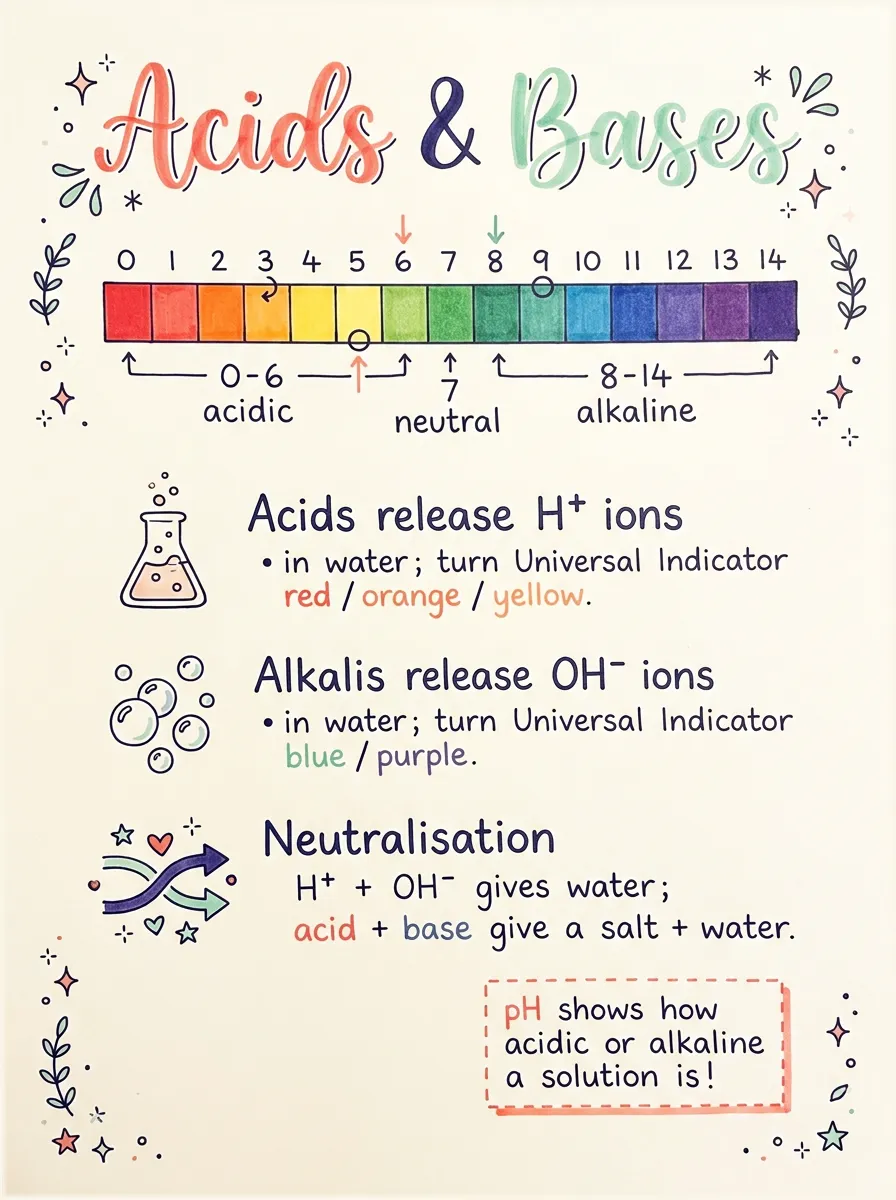
Squeeze lemon juice onto a cut and it stings; sprinkle baking soda on the same spot and the sting eases. Two kitchen substances, opposite chemistry — and once you know what's actually dissolved in each one, that whole family of reactions stops being a memory exercise and starts being predictable.
The Ion Behind Every Acid Reaction
Every acid, once it's in water, lets go of a positively charged particle called the hydrogen ion (H⁺). That single released particle is responsible for the sourness, the fizzing with certain metals, and the low reading on a pH meter — all three trace back to the same ion. An alkali — the name given to a base once it has dissolved in water — works the opposite way, releasing hydroxide ions (OH⁻) instead. When the two solutions meet, the H⁺ and OH⁻ particles pair off one-to-one and lock together as plain water — a swap that erases both the sourness and the soapiness in one go. Exam questions almost never reward "it's an acid because it's sour" — they want the ion named, so build the habit early of reaching for H⁺ or OH⁻ whenever you're asked to explain, not just identify.
Worked Example — Potassium Hydroxide Meets Sulfuric Acid
- Identify the two reactants: potassium hydroxide, KOH (an alkali), and sulfuric acid, H₂SO₄.
- Write the unbalanced skeleton: KOH + H₂SO₄ → potassium sulfate + water.
- Check the charges in the salt: sulfate is 2−, but each potassium ion is only 1+, so it takes two potassium ions to balance — meaning two lots of KOH are needed, not one.
- Balance and finish: 2KOH + H₂SO₄ → K₂SO₄ + 2H₂O. Two hydroxide ions from the alkali pair with the two hydrogen ions the sulfuric acid supplies, giving two water molecules.
Notice the coefficient isn't arbitrary — it falls out of matching how many H⁺ the acid can give against how many OH⁻ the base can give, every single time.
That charge-matching trick is exactly what you'll practise across a full spread of acid–base pairs in the complete lesson below — plus a listen-along audio walkthrough and a worksheet that drills the rest of the reaction types (metals, carbonates, ammonium salts) you'll need for the exam.
Keep going — unlock the whole topic
Notes, audio and the worksheet for this topic, plus every other topic in the subject.
Claim a free seat →