Atomic Structure: What's Inside Every Atom? — Study Notes
Atomic Structure: What's Inside Every Atom?
Combined Science (5086) · Atomic Structure — revision notes
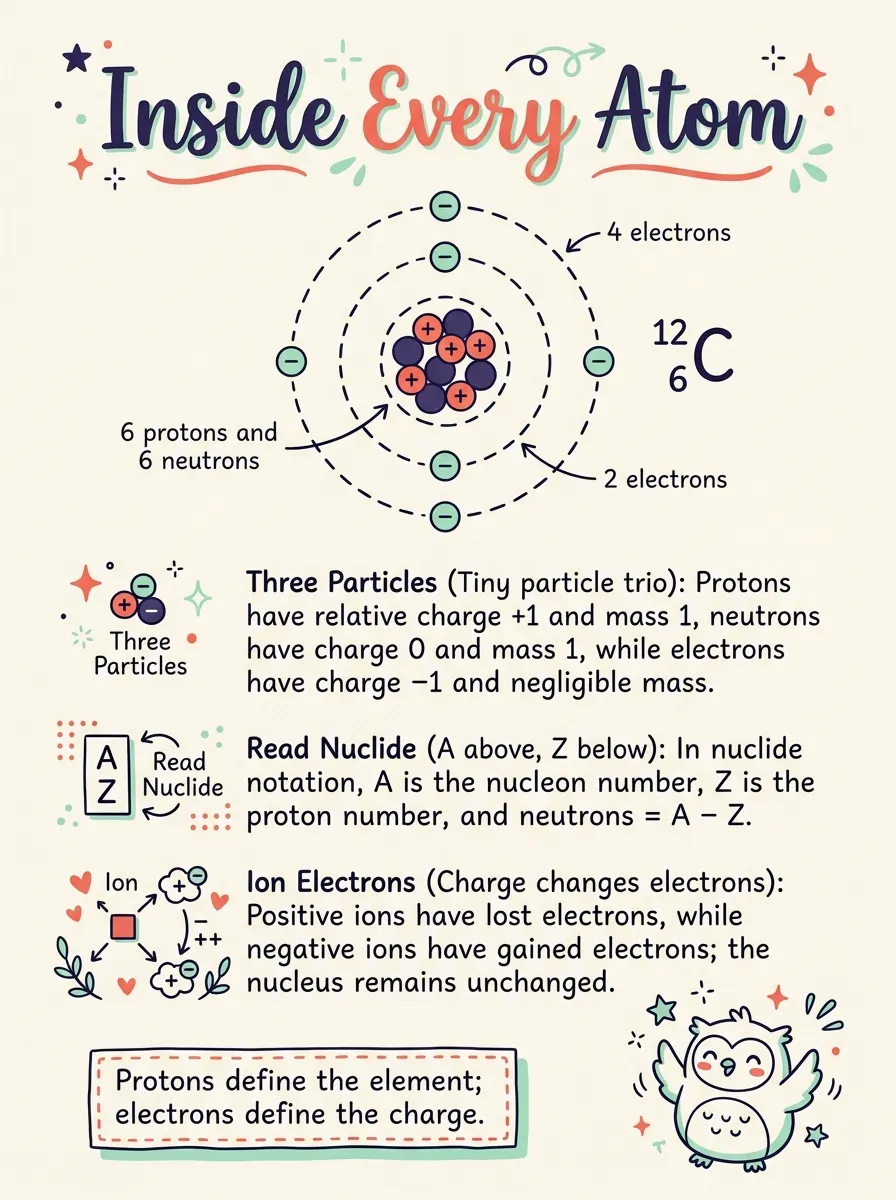
Everything around you is built from atoms. Atoms are made from up to three types of subatomic particle: protons, neutrons and electrons. Once you know those three particles and one piece of shorthand notation, you can read off the full "recipe" of any atom or ion just by looking at its symbol. That's the whole game of this topic. By the end of this guide, you'll be able to do it on sight.
Meet the Three Subatomic Particles
Before looking at the details, ask: why do chemists split the atom into three particles instead of treating it as one blob? Because those three particles behave completely differently — where they sit, what charge they carry, how heavy they are — and that explains almost everything else in chemistry (bonding, ions, isotopes). Getting these three particles solid now pays off for the rest of the course.
Picture an atom like a tiny solar system: a packed, heavy centre with something much lighter moving around it. The centre is called the nucleus (the dense core of the atom), and it's home to two of the three particles.
Protons live inside the nucleus. Each one carries a relative charge of +1 and a relative mass of 1.
Neutrons also live inside the nucleus, packed in right next to the protons. Each one carries no charge at all (relative charge 0) but still has a relative mass of 1, the same as a proton.
Electrons are the odd ones out: they don't live in the nucleus at all. They move around outside it, in regions called shells (energy levels — zones where electrons are likely to be found). Each electron carries a relative charge of −1. An electron's mass is negligible (about 1/1840 of a proton's mass). For Combined Science calculations, we treat it as 0.
Quick memory trick: ProTon = Positive. NeuTron = Neutral. Electron = nEgativE.
| Particle | Where? | Relative Charge | Relative Mass |
|---|---|---|---|
| Proton | Nucleus | +1 | 1 |
| Neutron | Nucleus | 0 | 1 |
| Electron | Shells (outside nucleus) | −1 | negligible (≈ 0) |
Your turn. A particle has a relative charge of 0 and a relative mass of 1. Which subatomic particle is it? Hint: which word means "no charge"?
Answer - have a real go first. It's a neutron. Charge 0 rules out protons (+1) and electrons (−1); mass 1 rules out electrons (negligible). Students sometimes assume "neutral" must mean "light," but charge and mass are separate properties.
The Structure of an Atom
Now put the three particles together into one atom. Since protons and neutrons both live in the nucleus, the nucleus ends up dense and heavy (that's where basically all the mass is). The electrons arrange themselves around that nucleus in layers — like the layers of an onion — and each layer is called a shell.
A carbon atom: the nucleus (6 protons + 6 neutrons) sits in the centre; the electrons sit in shells around it (2 in the inner shell, 4 in the outer). Remember the shells are regions where electrons are found — energy levels — not solid rings.
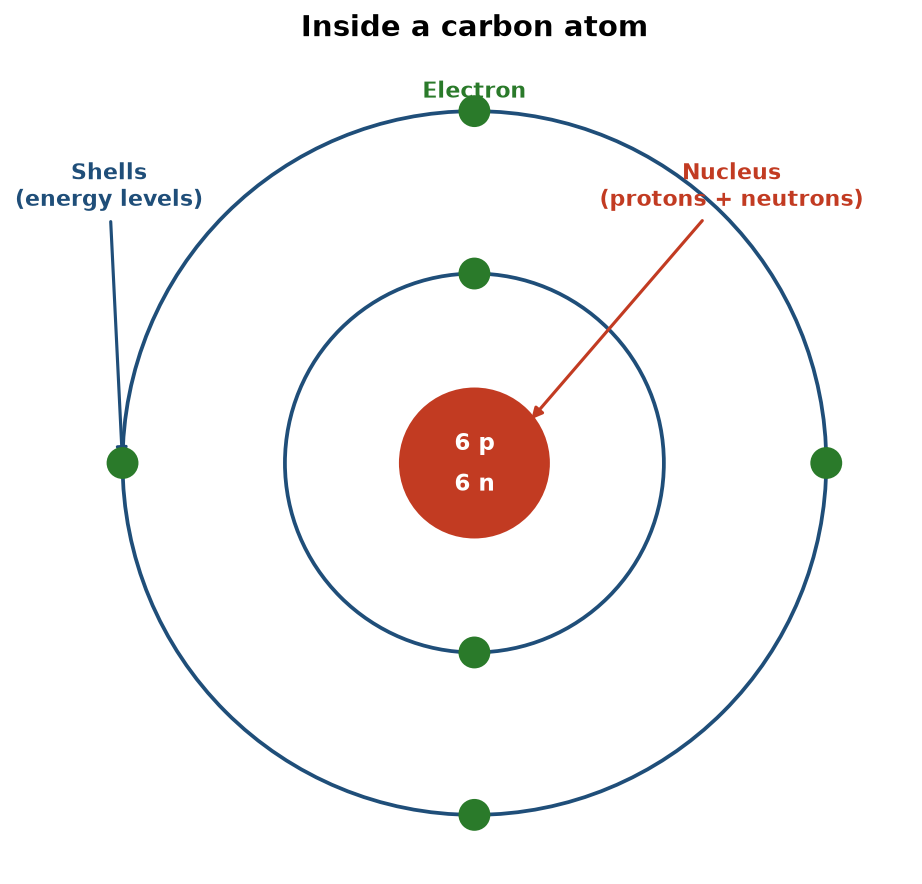
Here's a fact worth pausing on: a neutral atom (one with no overall charge) always has exactly as many electrons as protons. Why must that be true? Because charge has to balance to zero. Each proton's +1 needs an electron's −1 to cancel it, so the two counts must match exactly.
Why don't the electrons just fly off? The nucleus is positively charged and the electrons are negatively charged. Opposite charges attract. That electrostatic pull holds the atom together — similar to gravity holding planets in orbit, but here it's electric attraction.
Your turn. An atom of fluorine has 9 protons. If it is neutral, how many electrons does it have? Hint: what has to happen to the total charge for it to be neutral?
Answer - have a real go first. 9 electrons. Neutral means total charge = 0. The only way 9 protons (each +1) are cancelled out is by exactly 9 electrons (each −1). A common slip is to assume "neutral" means zero electrons, but it means the charges cancel out.
Proton Number and Nucleon Number
Chemists need a fast way to say exactly which atom they mean without listing every particle each time. Two numbers do that job.
Proton Number (Atomic Number) — symbol Z. This is simply the number of protons in the nucleus. It identifies the element: every carbon atom has exactly 6 protons, every oxygen atom exactly 8. Change the proton number and you've changed the element entirely.
Nucleon Number (Mass Number) — symbol A. This is the total count of protons plus neutrons in the nucleus. Protons and neutrons are collectively called nucleons. Electrons are never counted in A because they don't live in the nucleus and their mass is negligible.
Exam answer — how to earn the 'define' mark: write a full sentence. - Proton number = the number of protons in the nucleus of an atom. - Nucleon number = the total number of protons and neutrons (nucleons) in the nucleus of an atom.
Your turn. An atom has 17 protons and 18 neutrons. What are its proton number and its nucleon number? Hint: nucleon number adds two things together — which two?
Answer - have a real go first. Proton number Z = 17 (just the proton count). Nucleon number A = 35 (protons + neutrons = 17 + 18). The common mistake is writing A as "18" (copying only the neutron count); A is always the combined total.
Nuclide Notation — Reading the Shorthand
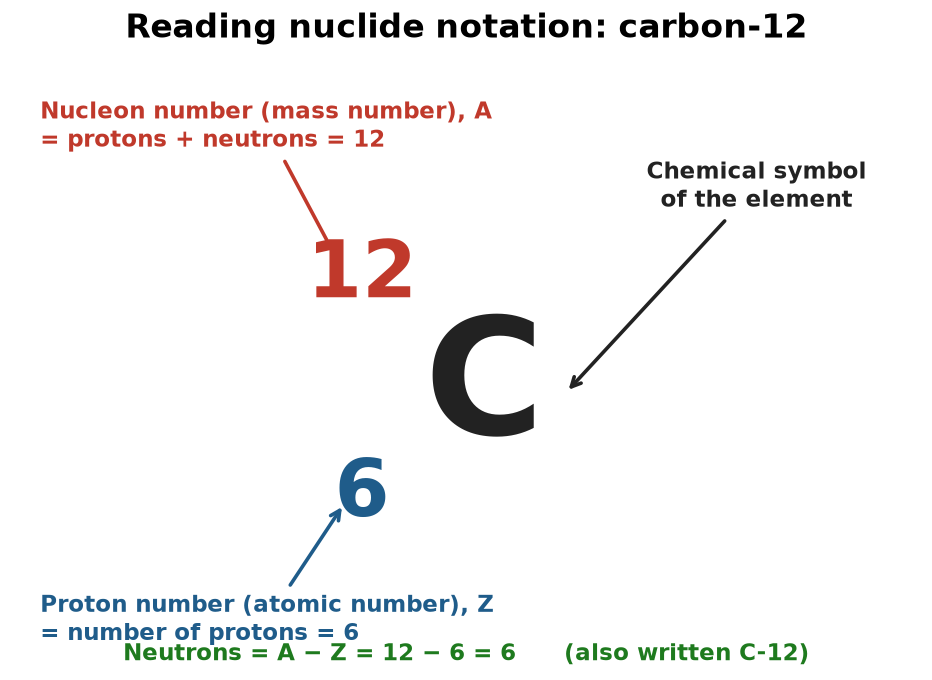
Writing "17 protons, 18 neutrons" every time is slow, so chemists compress Z and A into one compact symbol called nuclide notation. A nuclide is a specific type of atom defined by its proton and nucleon numbers. It's written like this:
 A
 Z X
Where:
- X is the chemical symbol of the element.
- A (top number) is the nucleon number (mass number).
- Z (bottom number) is the proton number (atomic number).
You'll also see this written as X-A, for example C-12. Both notations carry the same information; nuclide notation just shows Z explicitly.
The top-left number (A) is the nucleon number; the bottom-left number (Z) is the proton number. Subtract them (A − Z) to get the neutrons.
Worked Example
Let's decode carbon-12, written as ¹²₆C.
- Read off Z first: Z = 6, so there are 6 protons.
- Read off A next: A = 12, meaning protons + neutrons together = 12.
- Find neutrons by subtraction: neutrons = A − Z = 12 − 6 = 6 neutrons.
- Finally, electrons: the question doesn't say "ion," so this is a neutral atom. Electrons = protons = 6.
That gives the general formula you'll use constantly:
Number of neutrons = A − Z
Your turn. Sodium is written as ²³₁₁Na. How many protons, neutrons, and electrons does a neutral sodium atom have? Hint: find protons and neutrons first, then use "neutral = electrons equal protons."
Answer - have a real go first. 11 protons, 12 neutrons, 11 electrons. Protons come straight from Z (11); neutrons = A − Z = 23 − 11 = 12; electrons = protons because it's neutral (11). Subtracting the wrong way round (Z − A) gives a negative number, which is impossible for a neutron count.
Isotopes
Can two atoms both genuinely be "carbon," yet not be identical? Yes — and working out how is exactly what isotopes are about.
Isotopes are atoms of the same element (same proton number, Z) that have different numbers of neutrons — and therefore different nucleon numbers, A.
Analogy: picture identical twins — same face, same identity (same proton number) — but one is carrying a heavy backpack the other isn't (different number of neutrons, so different mass). They're still unmistakably the same person; carbon-12 and carbon-14 are still unmistakably carbon.
Example: Isotopes of Carbon
| Isotope | Protons | Neutrons | Electrons |
|---|---|---|---|
| ¹²₆C (carbon-12) | 6 | 6 | 6 |
| ¹³₆C (carbon-13) | 6 | 7 | 6 |
| ¹⁴₆C (carbon-14) | 6 | 8 | 6 |
All three are carbon (6 protons each), but the number of neutrons rises from 6 to 7 to 8. Same element, different mass.
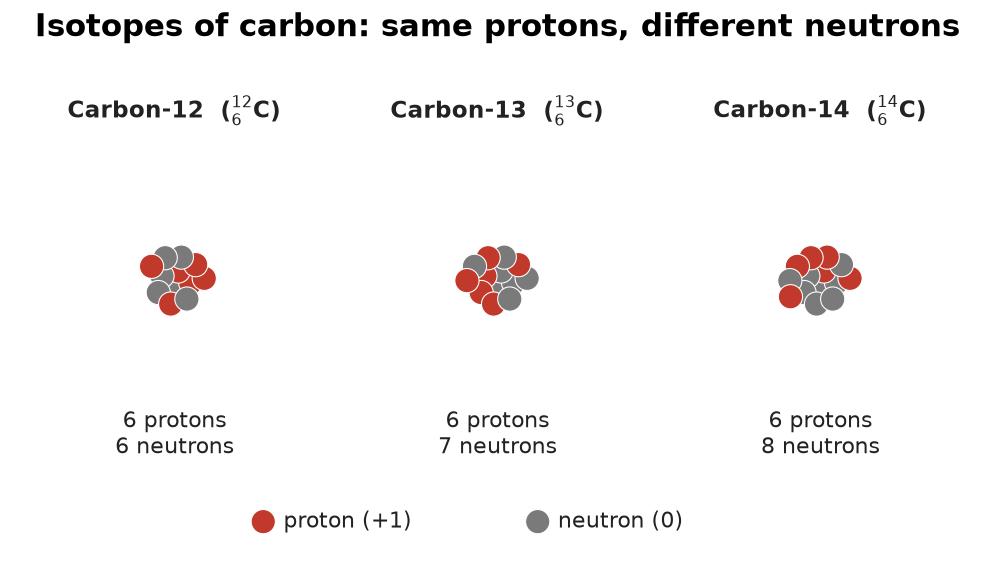
Notice what stays fixed and what changes: the proton number never moves — that's why all three are still carbon — while only the neutron count climbs.
This matters because: all three isotopes have the same number of electrons, and chemical behaviour is driven entirely by electrons (not by the nucleus). Therefore, at this level, isotopes are treated as having the same chemical properties; their reaction rates may differ slightly.
Your turn. Chlorine has two common isotopes: ³⁵₁₇Cl and ³⁷₁₇Cl. Do they react the same way chemically? Why or why not? Hint: what actually controls chemical reactions — protons, neutrons, or electrons?
Answer - have a real go first. They have essentially the same chemical properties and are treated as reacting the same way at this level, although small isotope effects can cause slight differences in reaction rates. Both have 17 protons, so both have 17 electrons. Since electrons control chemical behaviour, matching electron counts means matching chemistry, regardless of the extra neutrons.
Working Out Particles in Ions
So far every atom has been neutral. But atoms can lose or gain electrons to become ions — atoms with an overall electric charge. This only complicates one count: the electron count.
The key rule: protons and neutrons are unaffected when ions form — the nucleus doesn't change at all. Only the electron count changes. Gaining or losing a proton would mean physically altering the nucleus (a nuclear reaction), which is not ordinary chemistry.
From there, the direction of the change follows logically:
- A positive ion has fewer electrons than protons (lost negative charge).
- A negative ion has more electrons than protons (gained negative charge).
How to find the number of electrons in an ion
Start from the number of protons (= Z). Then adjust for the charge:
- For a charge of +n (lost n electrons): electrons = Z − n
- For a charge of −n (gained n electrons): electrons = Z + n
Rather than memorising a signed formula, reason it through: positive means lost electrons (subtract); negative means gained electrons (add).
Worked Example
Magnesium ion: ²⁴₁₂Mg²⁺
- Z = 12, so there are 12 protons.
- A = 24, neutrons = 24 − 12 = 12 neutrons.
- The charge is 2+, meaning it lost 2 electrons. Electrons = 12 − 2 = 10 electrons.
Oxide ion: ¹⁶₈O²⁻
- Z = 8 → 8 protons.
- A = 16, neutrons = 16 − 8 = 8 neutrons.
- The charge is 2−, meaning it gained 2 electrons. Electrons = 8 + 2 = 10 electrons.
Your turn. A chloride ion is written as ³⁵₁₇Cl⁻. How many protons, neutrons, and electrons does it have? Hint: protons and neutrons come from A and Z exactly as normal — only the electron step changes for a charged particle.
Answer - have a real go first. 17 protons, 18 neutrons, 18 electrons. Protons = Z = 17; neutrons = A − Z = 35 − 17 = 18; electrons = 17 + 1 = 18 (gained one electron). The common mistake is subtracting for a negative charge, but a negative ion has more electrons than protons.
Putting It All Together
You now know:
- The three particles, where they live, their charges and masses.
- How the atom is structured — nucleus in the middle, electrons in shells, held together by electrostatic attraction.
- What proton number (Z) and nucleon number (A) mean.
- How to read nuclide notation like ²³₁₁Na or Na-23.
- What isotopes are, why same-element atoms can still differ, and why their chemistry stays identical.
- How to find particle numbers for ions by reasoning through what gaining or losing electrons actually means.
That's the whole topic — and you've got this.
Key formulas
- Nucleon number (A) = number of protons + number of neutrons
- Number of neutrons = A − Z, where A is the nucleon number and Z is the proton number
- Electrons in a neutral atom = Z (because equal protons and electrons means charges cancel)
- Electrons in a positive ion with charge n+ = Z − n (lost n electrons)
- Electrons in a negative ion with charge n− = Z + n (gained n electrons)
Common mistakes
- Mixing up mass number (A) and atomic number (Z) — remember Z is at the bottom and stands for the proton count; A is at the top.
- Forgetting that neutrons are found by subtracting Z from A, not the other way round.
- Thinking isotopes have different chemical properties — they don't, because chemistry depends on electron number, which stays the same.
- Forgetting to adjust electron count for ions — a neutral atom and its ion have the same protons and neutrons, but different numbers of electrons.
- Giving electrons a relative mass of 1 — their mass is negligible (about 1/1840), so it's effectively 0 for these calculations.
Exam tips
- Always write out Z and A clearly when answering structure questions — examiners want to see you know which is which.
- For a 'define' question on proton number or nucleon number, write the full sentence — a bare number or one word will not earn the mark.
- For isotope questions, state explicitly that the proton number is the same AND the nucleon number (or neutron number) is different — both parts are needed for full marks.
- When finding particles in an ion, work in order: protons first (= Z), then neutrons (= A − Z), then electrons last (adjust for charge). This order stops you making errors.
- If a question says 'nuclide notation', it wants the full symbol with A on top and Z on the bottom — not just the name or the mass number alone.
- Double-check your neutron calculation by adding your protons and neutrons back together — they must equal A.
📝 Listening worksheet
Print this (or keep it open) and fill in the blanks as the podcast reaches each idea. Answers are at the bottom for self-check.
Download worksheet (PDF)