Biological Molecules — Study Notes
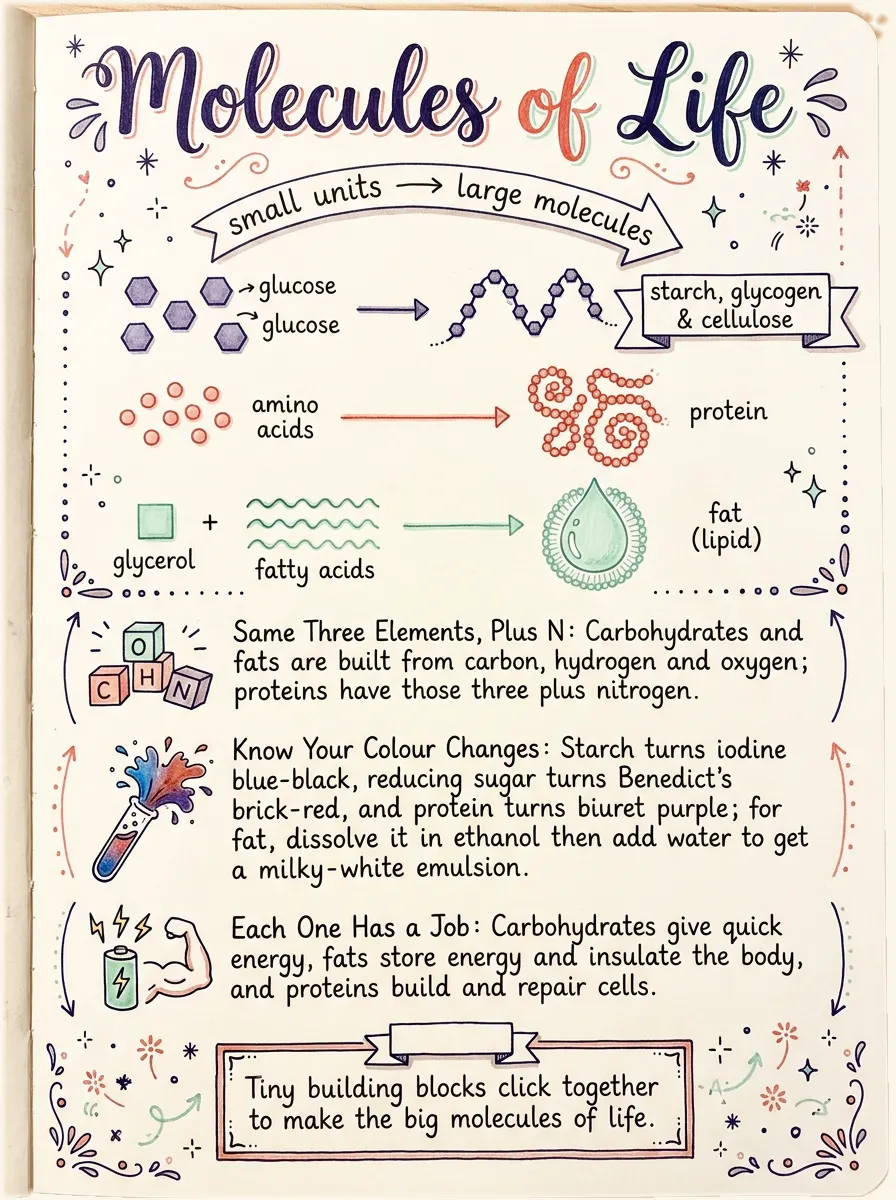
Everything you eat sorts into just three families of large molecule, and every single one of them is built the same way — a small chemical piece gets repeated or combined until it forms something huge. Spot that pattern once and this whole topic gets far less to memorise.
Big Molecules Are Really Small Units, Joined Up
Carbohydrates, fats and proteins look nothing alike on a nutrition label, yet each one comes from a tiny starting piece. Starch, a carbohydrate, is thousands of glucose molecules bonded end to end into one long strand. A protein works the same way but with a different piece: a chain built from amino acids. Fat is the odd one out in scale — instead of a long chain, it's just one glycerol molecule attached to three fatty acid molecules, rather like a small three-pronged fork. Knowing which tiny unit belongs to which family lets you reason backwards: hand a scientist the pieces, and they can name the molecule those pieces came from, without ever tasting the sample.
Worked Example — Naming a Molecule From Its Building Blocks
- A lab breaks an unlabelled sample apart chemically and finds it separates into exactly one glycerol molecule plus three fatty acid molecules, every single time.
- Compare that ratio against the three known assembly patterns: a long strand of glucose units signals a carbohydrate; a long strand of amino acids signals a protein; one glycerol paired with three fatty acids signals a fat.
- Only the third pattern matches what came out of the sample, so the molecule must be a fat — the one-to-three glycerol-to-fatty-acid ratio is the giveaway, since neither carbohydrates nor proteins ever break apart into that pairing.
That same building-block logic is exactly how you'll be asked to identify molecules from lab results in an exam question — and it's only one of the tools covered here. The audio walkthrough, the element-counting shortcut, the four food-colour tests and the rest of the worked examples are in the full lesson below.
Keep going — unlock the whole topic
Notes, audio and the worksheet for this topic, plus every other topic in the subject.
Claim a free seat →