Blood — Study Notes
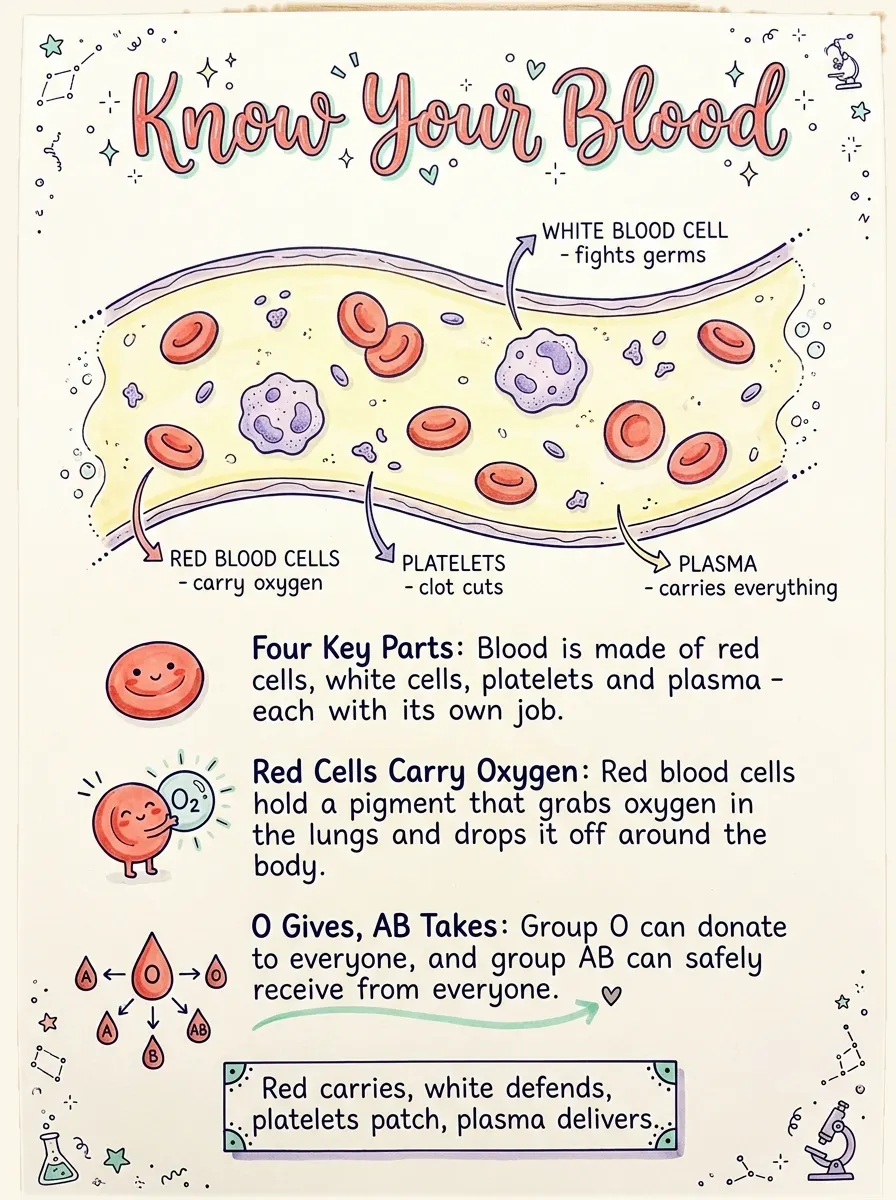
Give a patient the wrong type of blood and it isn't a paperwork slip — it's an emergency. The reason sits on the surface of every red blood cell: tiny marker molecules that your own immune system is primed to attack the moment it spots a type it doesn't recognise as yours.
Why Mismatched Blood Reacts
Every red blood cell carries marker molecules, called antigens, stuck to its outer surface — think of them as an ID tag the immune system reads. Depending on which tags are present, a person's blood falls into one of four possible groups: A, B, AB, or O. Floating in the plasma alongside those cells are antibodies, and the rule is strict: your plasma only carries antibodies against tags your own cells don't have — because attacking your own tags would be self-destructive.
That rule is the entire mechanism behind a transfusion reaction. Introduce donor cells whose tag happens to match an antibody already patrolling the recipient's plasma, and that antibody locks straight onto it, sticking donated cells together into clumps — a response called agglutination. Clumped cells can jam narrow blood vessels, so before any transfusion a doctor must check the recipient's antibodies against the donor's tags, not just match a label on a bag.
Worked Example — Is Group AB Blood Safe for a Group O Patient?
- Work out the recipient's antibodies first. A group O patient's cells carry neither tag, so their plasma carries antibodies against both the A tag and the B tag.
- Work out the donor's tags. Group AB red cells display both the A tag and the B tag on their surface.
- Compare the two: the patient's anti-A antibodies meet the donor's A tag, and the anti-B antibodies meet the donor's B tag — both react at once.
- Conclude: this transfusion is unsafe. The antibodies bind to the tags immediately, clumping the donated cells and risking a blocked vessel.
That same tag-versus-antibody logic explains why one group can give to almost anyone while another can only ever receive from itself — the full compatibility picture for all four groups, walked through with audio and a practice worksheet, is waiting in the full lesson below.
Keep going — unlock the whole topic
Notes, audio and the worksheet for this topic, plus every other topic in the subject.
Claim a free seat →