Carbon Cycle and Global Warming — Study Notes
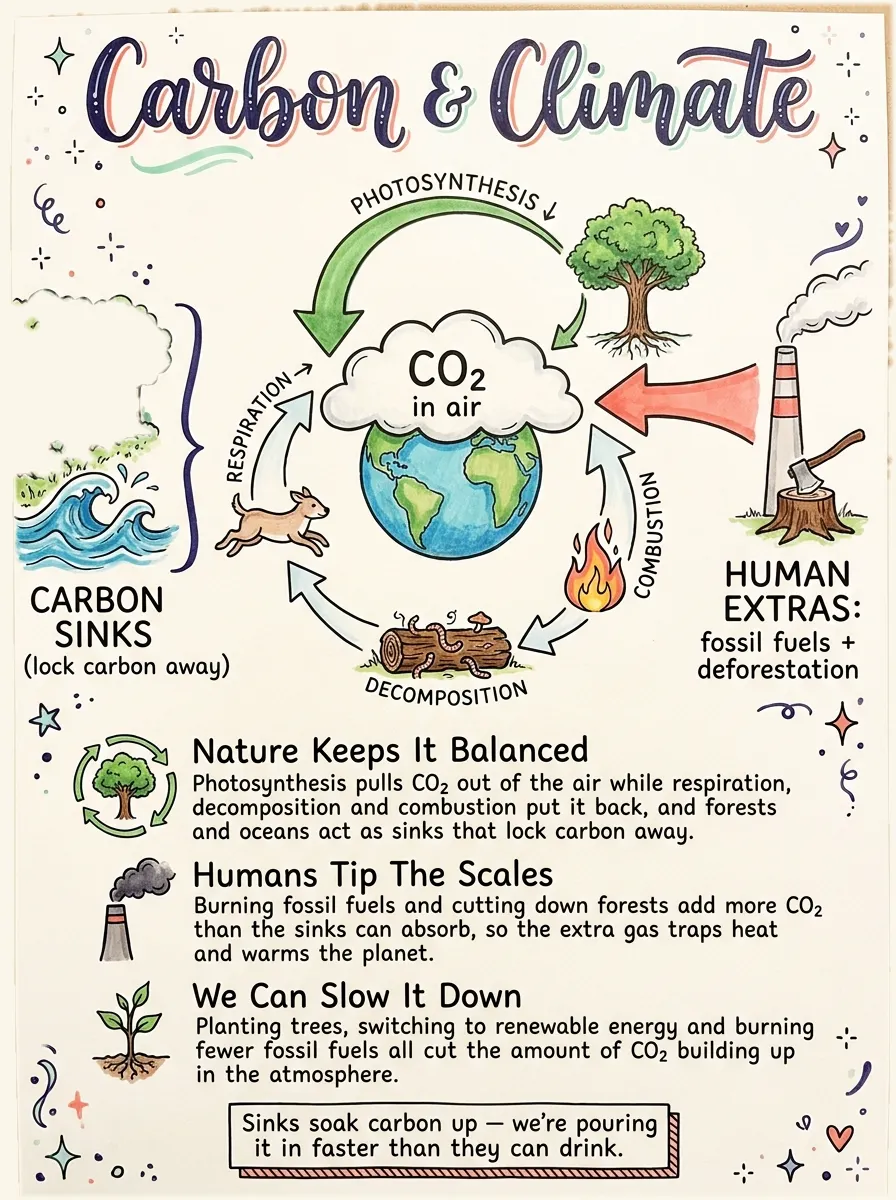
Ask most students why the planet is warming and you get one word: "pollution." That answer scores zero marks. O-Level examiners want the actual mechanism — which gas is building up, where it's coming from, and why trapping heat follows from that build-up. Get the chain of reasoning right and the topic stops being a list to memorise.
Reading Carbon Dioxide Like a Bank Balance
Treat atmospheric carbon dioxide as an account with money moving in and out. Deposits come from respiration, decomposition and combustion — every living cell burning glucose for energy, every burnt fuel releasing what it stored. Withdrawals come from one process only: photosynthesis, where a plant pulls the gas out of the air and locks it into sugar. For most of history those two sides roughly matched, so the balance held steady.
Two human habits have unbalanced the account. Burning coal, oil and gas adds carbon that was withdrawn from the air a very long time back and stayed sealed away untouched until now — a huge, sudden deposit. Clearing forests shrinks the only withdrawal route, so less gets taken back out. More deposits plus fewer withdrawals means the balance keeps climbing, and a thickening layer of carbon dioxide traps extra heat that would otherwise have escaped — the mechanism examiners are actually testing.
Worked Example — Is a Woodland a Sink or a Source?
- A council records that its woodland absorbs 480 tonnes of carbon dioxide a year through photosynthesis, while respiration and natural decay across the site release 210 tonnes a year.
- Compare the two flows: absorbed (480) versus released (210). The woodland takes in more than it gives back, so classify it first — this makes it a carbon sink, not a source.
- Find the net effect by subtracting: 480 − 210 = 270 tonnes removed from the atmosphere each year. That figure, not the raw 480, is what the woodland actually contributes to slowing the build-up.
Notice the trap: quoting only the 480-tonne absorption figure overstates the woodland's benefit — examiners award marks for weighing both flows, not just the impressive one.
That net-flow logic is exactly how the full lesson tackles fossil fuels, deforestation and the rest of the carbon-cycle processes — with a listen-along audio walkthrough, worked answers to every "your turn" question, and the printable worksheet, all waiting below.
Keep going — unlock the whole topic
Notes, audio and the worksheet for this topic, plus every other topic in the subject.
Claim a free seat →