Cellular Respiration — Study Notes
Sit dead still for a minute and your heart still beats, your gut still churns, your brain still fires. None of that is free — every one of your cells is quietly cashing in fuel to pay for it, and that cashing-in process has a name examiners expect you to use precisely.
Respiration Is a Cell-Level Reaction, Not Breathing
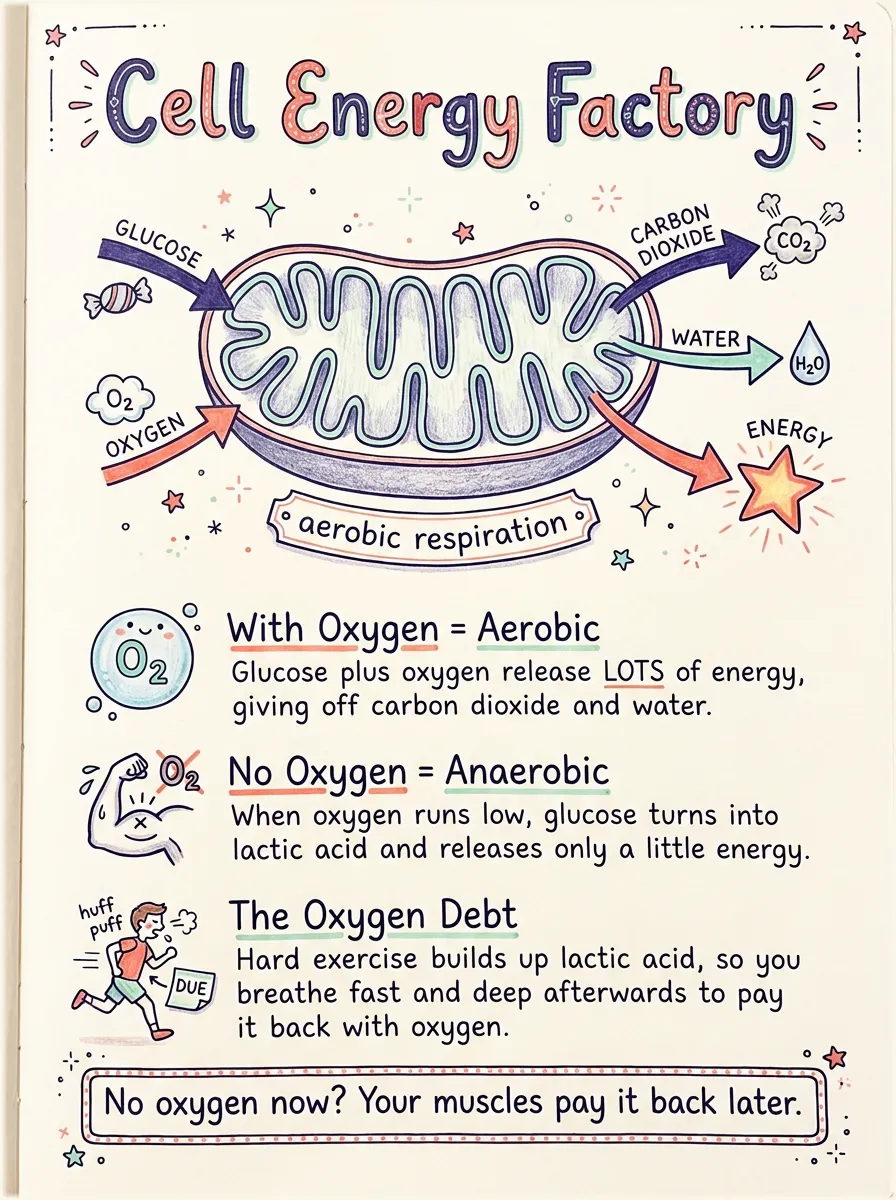
Respiration is the chemical process, happening inside living cells, that releases usable energy from food. It gets muddled with breathing constantly because the words sound related, but they describe two completely different things: breathing is air physically moving through your airways; respiration is a reaction going on inside the cell itself, using oxygen that breathing supplies. One transports a gas, the other unlocks energy from it.
Cells run this reaction in one of two modes. Aerobic respiration uses oxygen and fully breaks glucose apart, so it yields a large amount of energy per glucose molecule — this is the default mode almost all the time. Anaerobic respiration skips oxygen entirely, only partly breaks glucose down, and therefore hands back far less energy; cells fall back on it only when oxygen can't arrive fast enough to keep up with demand.
Worked Example — Reading a Scenario to Identify the Respiration Type
A coach notices a sprinter's calves feel tight right after a 100m race, and she keeps panting hard for several minutes after crossing the line, even standing still.
- Spot the clue: discomfort in the working muscle appearing straight after an all-out effort points to a substance that has built up inside the muscle cells, not simple fatigue.
- Check the oxygen supply against the demand: a 100m sprint asks muscles to work far faster than blood can realistically deliver oxygen to them.
- When supply can't keep pace, muscle cells switch to the oxygen-free pathway, breaking glucose down only part-way and producing a mildly acidic waste product as a result.
- That leftover product still holds unreleased energy, so it must be broken down afterwards — which is exactly why the sprinter keeps breathing hard once she has already stopped moving.
Answer: her leg muscles were respiring anaerobically during the race, and the heavy after-race breathing is her body clearing the waste product that built up — a debt being repaid, not random tiredness.
The full lesson below works through both exact word-and-symbol equations, the separate breathing-rate-and-depth mechanism, a labelled diagram, and a listen-along audio walkthrough plus worksheet.
Keep going — unlock the whole topic
Notes, audio and the worksheet for this topic, plus every other topic in the subject.
Claim a free seat →