Energy Profiles & Bonds — study notes
Strike a match and it throws out heat and light for as long as the flame lasts. Tip a sachet of citric acid crystals into water, though, and the beaker turns noticeably cooler within seconds. Both are ordinary chemical reactions — the only difference is which way the energy is flowing.
Reading a Reaction's Energy Change
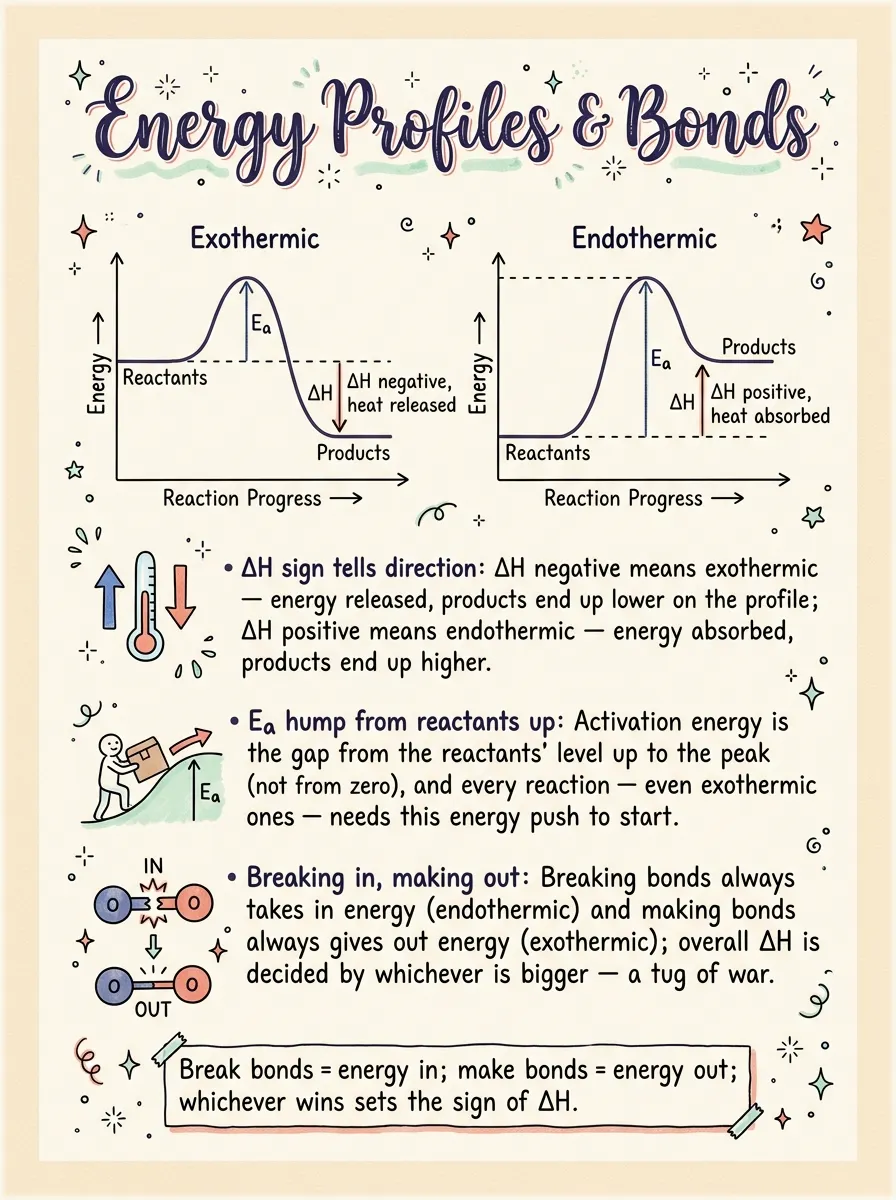
Every reaction has an enthalpy change, written ΔH, that tells you how much energy moved between the reacting chemicals and their surroundings. If the reaction hands energy out to its surroundings, ΔH is negative and we call it exothermic — the flask, the air, your fingers all warm up. If the reaction instead pulls energy in, ΔH is positive and we call it endothermic — everything nearby cools down.
Underneath every ΔH sits a tug-of-war between two opposite steps. Splitting the reactants' bonds apart is always an energy-in process, because bonds hold atoms together and you have to supply effort to prise them loose. Forming brand-new bonds in the products is always an energy-out process, because atoms settling into a stable arrangement release energy as they lock together. Add up how much a reaction demands to break its old bonds, subtract how much it gives back forming its new ones, and whichever side wins decides the overall sign of ΔH.
Worked Example — Bond Energies for N₂ + 3H₂ → 2NH₃
Given N≡N = 945 kJ/mol, H–H = 436 kJ/mol and N–H = 391 kJ/mol, find ΔH for this reaction.
- List every bond broken on the reactant side: one N≡N bond plus three H–H bonds, since the equation shows 3H₂. Energy needed = 945 + (3 × 436) = 945 + 1308 = 2253 kJ.
- List every bond made on the product side: each NH₃ molecule has three N–H bonds, and the equation shows 2NH₃, so six N–H bonds form in total. Energy released = 6 × 391 = 2346 kJ.
- Subtract in the fixed order, broken minus made: ΔH = 2253 − 2346 = −93 kJ per mole of reaction.
Since more energy came out forming the ammonia bonds than went in splitting the nitrogen and hydrogen apart, the negative answer confirms this reaction gives out energy overall — it's exothermic, matching what happens industrially in the Haber process.
Sketching the matching energy profile, naming the activation-energy hump, and working through the reverse calculation are covered with a full audio walkthrough and practice worksheet in the gated lesson below.
Keep going — unlock the whole topic
Notes, audio and the worksheet for this topic, plus every other topic in the subject.
Claim a free seat →