Continuous Writing — Study Notes
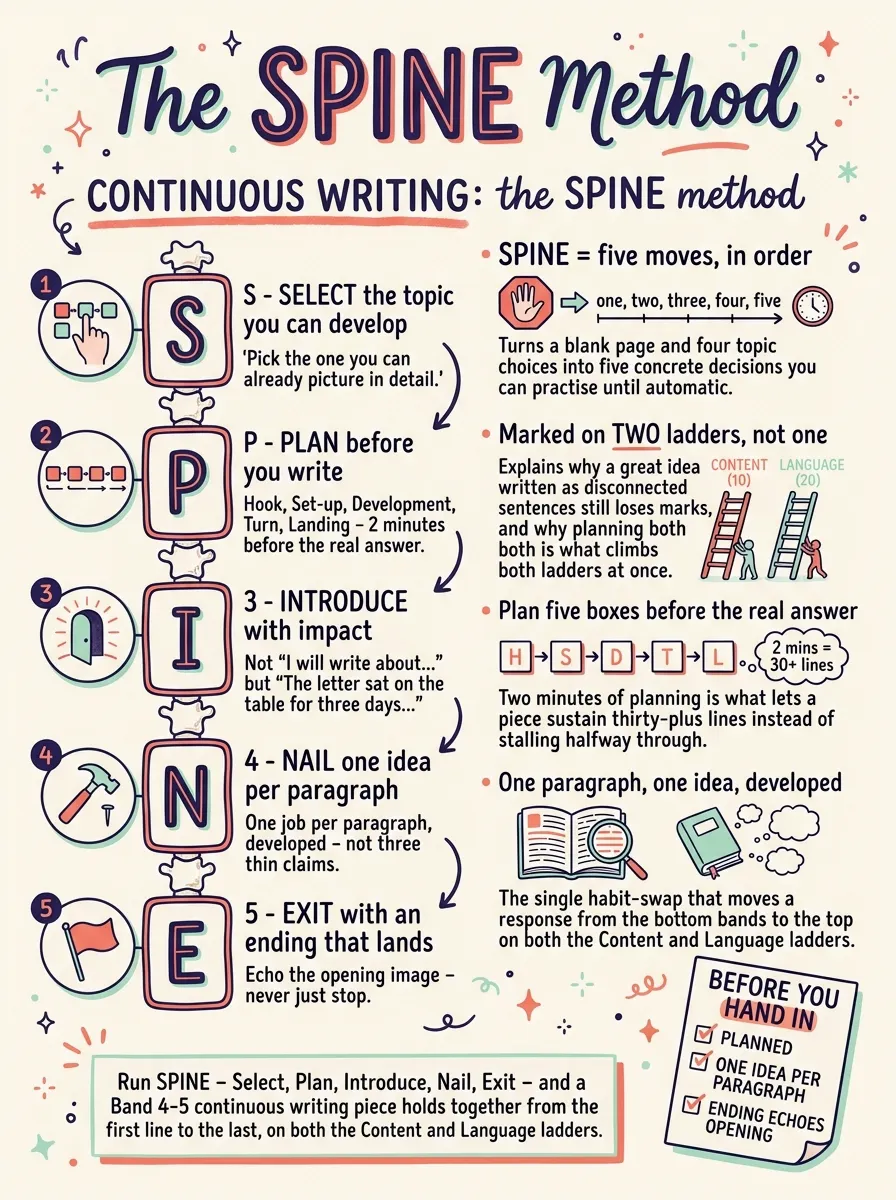
Four topics land in front of you, one choice gets circled, and suddenly you must fill 350 to 500 words with nothing to lean on but your own head — no source passage, no sentence starters. Most students don't freeze because they lack ideas; they freeze because they start writing before they've decided where the piece is going.
Why a plan beats a blank page
Every script earns two separate scores, worth 30 marks together: one for how fully and specifically you deal with the topic you chose, and one for the quality of the language — how well paragraphs connect to each other, plus the range and accuracy of your vocabulary and grammar. A piece can be rich in ideas yet read like sentences dumped side by side, or flow elegantly while wandering away from the question — and either weakness drags a score down. So the safest habit is deciding the whole shape of the piece, beginning to end, on scrap paper first. Once that shape exists, each paragraph only has one job: carry a single moment, reason, or stage forward, using a concrete detail instead of a vague statement. An opening line matters most of all, because it's the marker's very first evidence of both qualities — so it should place the reader inside a scene, never restate the topic back at them.
Worked Example — Fixing a flat opening line
- Take the topic "Write about an unexpected friendship." A rushed first attempt often opens: "I want to write about a friendship that surprised me." This only repeats the title — the marker learns nothing beyond what the topic already said.
- Ask what single object, sound, or moment belongs inside that friendship. Suppose it began the afternoon a stranger returned a dropped umbrella in the rain.
- Rebuild the opening around that image instead of the title: "Rain was still dripping off the umbrella she handed back when she asked, oddly, if I wanted to share her seat on the bus."
- Compare the two versions: the rewrite drops the reader straight into a specific scene, which reads as controlled, purposeful writing — the restated title reads as a stalling tactic, and a marker notices the difference within one sentence.
The full five-step planning routine, the complete box-by-box planning grid for every topic type, and worked openings for narrative, descriptive and argumentative pieces — plus a listen-along audio walkthrough and practice worksheet — are in the full lesson below.
Keep going — unlock the whole topic
Notes, audio and the worksheet for this topic, plus every other topic in the subject.
Claim a free seat →