Sharing Electrons, Full Shells — study notes
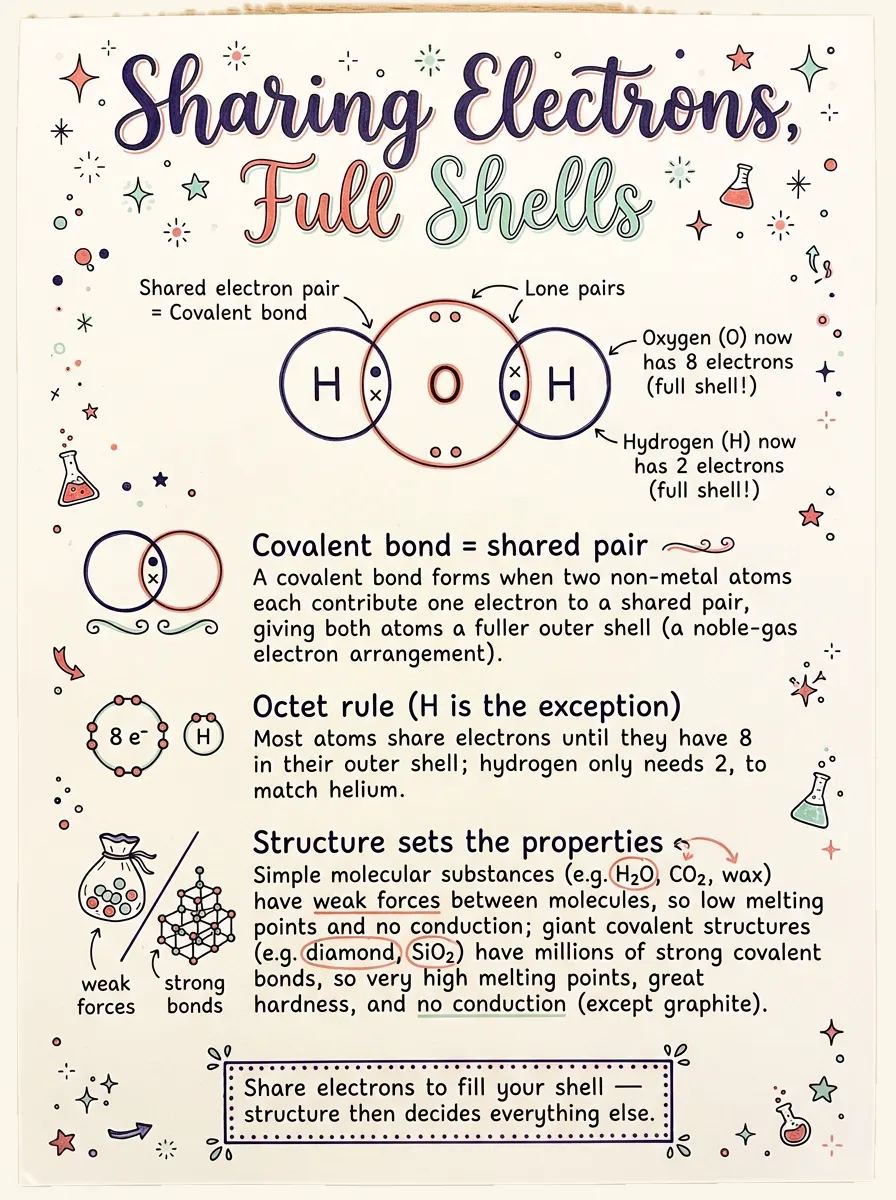
Oxygen keeps you alive and water can drown you — yet both are built the same way, from non-metal atoms locked together by covalent bonds. Understanding what that lock actually is turns a long list of "learn these molecules" into one reusable method.
What a Covalent Bond Really Is
Non-metal atoms want a full outer shell — the same electron count as a noble gas (the unreactive Group 0 elements), usually 8 (hydrogen is the odd one out: it only needs 2, because its single shell can't hold more). A metal atom can just give electrons away to get there, but a non-metal atom is too reluctant to lose electrons outright. So instead, the two atoms pool: each puts one of its own electrons into a shared pair that sits between them. Each atom treats that shared pair as part of its own shell, so both reach a full shell while neither gives anything up. One shared pair is one covalent bond; if an atom is short by two electrons rather than one, it can share two pairs with the same partner — a double bond.
Worked Example — Bonding in Water (H₂O)
- Find each atom's outer-shell electrons. Oxygen is in Group 6, so it has 6 outer electrons and needs 2 more to reach 8. Hydrogen has 1 electron and needs 1 more to reach 2.
- Match the shortfall to partners. Oxygen needs 2 electrons, and each hydrogen atom can only supply 1 — so oxygen must bond to two hydrogen atoms, not just one.
- Form the shared pairs. Oxygen shares one electron with the first hydrogen and one electron with the second, creating two single covalent bonds (two O–H bonds).
- Check the totals. Oxygen now "sees" 8 electrons (its own 6, plus 1 shared from each hydrogen) — a full outer shell. Each hydrogen now sees 2 — matching helium. The 4 electrons oxygen didn't use in bonding stay behind as two lone pairs.
That four-step method — tally each atom's outer electrons, find the gap to a full shell, then pair up the gaps — is all you need to work out the bonding in any covalent molecule the exam gives you, not just the ones you've memorised. The full lesson below draws every molecule's dot-and-cross diagram — H₂, O₂, CH₄, CO₂ — and adds an audio walkthrough you can listen to on the go, plus a worksheet to practise the method yourself.
Keep going — unlock the whole topic
Notes, audio and the worksheet for this topic, plus every other topic in the subject.
Claim a free seat →