D C Circuits — study notes
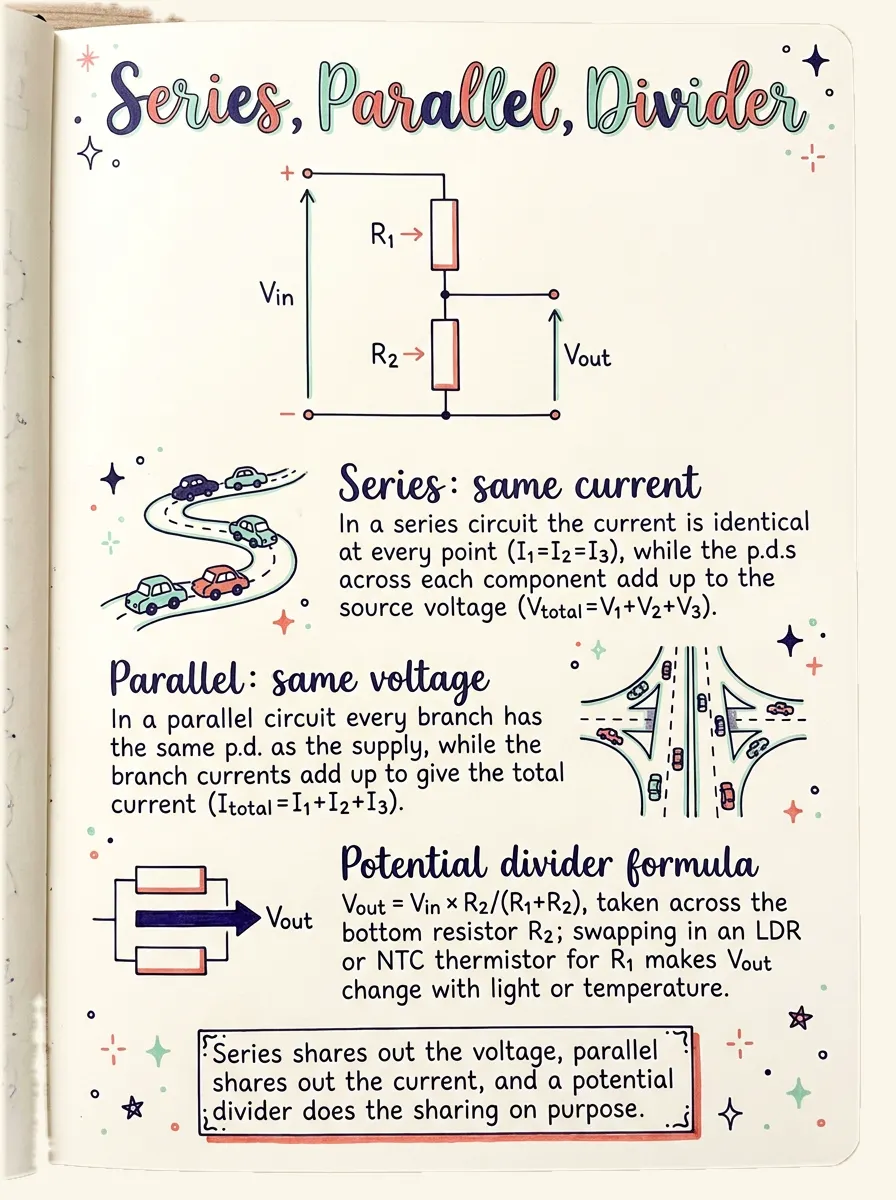
Wire three lamps in series and loosen just one — the whole string goes dark, not only that lamp. That everyday oddity is actually two of the most heavily tested circuit rules hiding in plain sight.
Why Current Stays Constant But Voltage Gets Shared Out
A series arrangement forms one unbroken loop, so there is nowhere along the way for charge to peel off or build up. Because charge can neither appear from nothing nor vanish, whatever amount passes one point in that loop must also pass every other point — an ammeter gives the identical reading no matter where you clip it in.
Voltage works differently. Treat the battery as handing out a fixed budget of electrical "push," and picture every component along the loop spending part of that budget to force the same current through itself. A component offering more opposition spends a bigger slice. Add up every slice and you land exactly back on what the battery supplied — nothing left unspent, nothing invented along the way. So the supply voltage always equals the total of the individual readings taken across each component.
A frequent slip is picturing a lamp as "eating" some current on its way past, as though current were fuel running low. That's the wrong quantity: current doesn't shrink as it travels a series loop — it is the voltage, the energy handed over per unit charge, that gets spent as the current forces its way through each obstacle.
Worked Example — Finding a Missing Voltage in a Series Loop
- A 20 V supply drives three resistors wired one after another. A meter across the first resistor shows 9 V, and a meter across the second shows 6 V.
- Every reading taken around this loop must sum back to the supply, so combine the two known figures first: 9 + 6 = 15 V already accounted for.
- Take that away from the total the battery provides to find what remains for the third resistor: 20 − 15 = 5 V.
Notice the three shares — 9 V, 6 V and 5 V — aren't equal thirds; each resistor claims a portion sized to its own opposition, not to how many resistors happen to share the loop.
The full lesson below covers the matching rule for branches wired in parallel, a complete R = V/I circuit calculation worked start to finish, an audio walkthrough, and a worksheet with every remaining worked example.
Keep going — unlock the whole topic
Notes, audio and the worksheet for this topic, plus every other topic in the subject.
Claim a free seat →