Dynamics — study notes
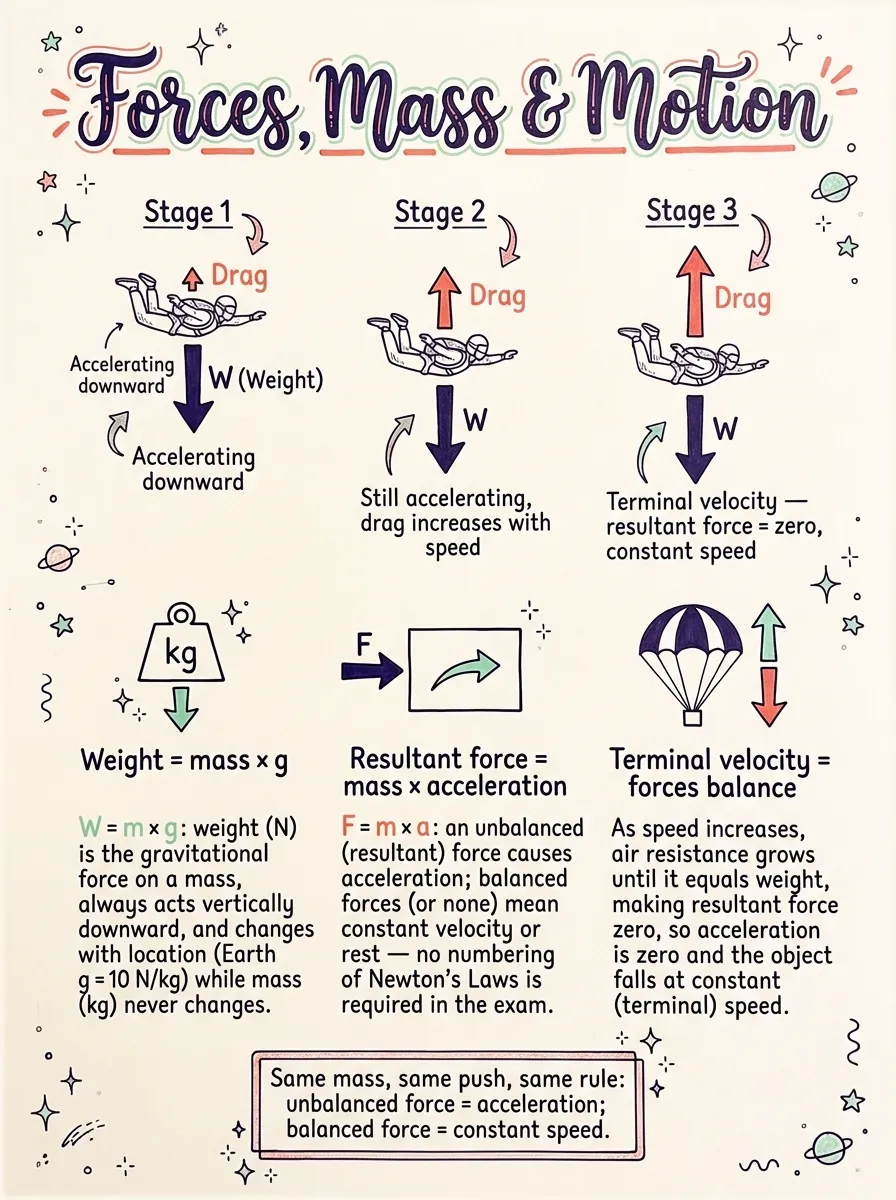
Push a shopping trolley and it pushes back on your hands. Watch a skydiver fall, and after a while they stop speeding up even though gravity never switches off. Both are dynamics — the study of forces and how they change, or fail to change, motion.
Mass Isn't the Same Thing as Weight
Everyday language mixes these two up, and that mix-up costs real exam marks. Mass is how much matter an object is built from, measured in kilograms — it never changes no matter where the object goes, Earth, the Moon, or deep space. Weight is the force gravity pulls on that mass with, and it does change from place to place, because it depends on how strong the local gravitational field is.
Gravitational field strength (g) tells you how many newtons of pull each kilogram of mass feels at a given location — on Earth's surface, g ≈ 10 N/kg. Weight is simply mass multiplied by that field strength:
W = m × g, where W = weight (newtons, N), m = mass (kilograms, kg), and g = gravitational field strength (N/kg).
Worked Example
A student has a mass of 50 kg. Find her weight on Earth (g = 10 N/kg).
- Read off what's given: m = 50 kg, g = 10 N/kg.
- Apply the formula: W = m × g = 50 × 10 = 500 N.
Her mass would stay exactly 50 kg anywhere in the universe — only the weight changes, because only g changes from place to place.
The rest of the method — every worked example, a listen-along audio walkthrough and a practice worksheet — is in the full lesson below.
Keep going — unlock the whole topic
Notes, audio and the worksheet for this topic, plus every other topic in the subject.
Claim a free seat →