Algebraic Expressions and Formulae — Study Notes
Think about a gym that charges a joining fee plus a set amount for every visit. Whatever your name, whatever month it is, the cost always follows the same rule: fee plus (rate × visits). Algebra is just a compact way of writing that kind of rule once, using a letter for whatever number happens to change.
Expressions Are Rules, Not Just Answers
An algebraic expression bundles letters and numbers together with operations, and it stays unfinished until you decide what the letters are standing for. Two things trip students up constantly: what a bracket means, and how to tidy an expression once brackets are gone.
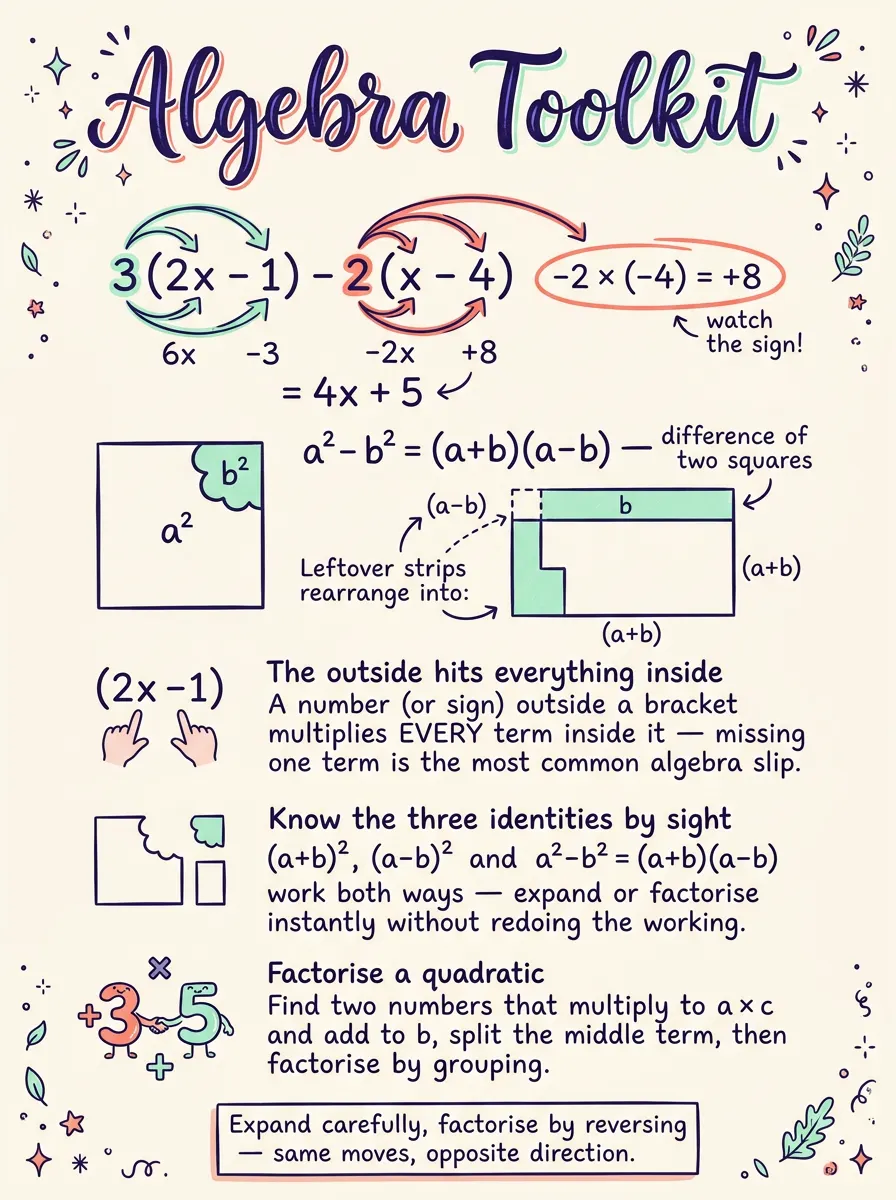
A number sitting right outside a bracket has to multiply each term inside it, not merely the one closest by — treat the bracket's contents as a single glued-together package. Once brackets are opened, you're left with separate pieces called terms, and only like terms — ones built from the exact same letter and power — can be merged. Three lots of x and eight more lots of x merge into eleven x's, the same logic as three chairs plus eight chairs making eleven chairs; a number term can never merge with an x term, because they're counting different things.
Worked Example — Simplify 5(x − 2) + 3(x + 4)
- Open the first bracket: the 5 must reach both terms inside, giving 5 × x = 5x and 5 × (−2) = −10, so 5(x − 2) becomes 5x − 10.
- Open the second bracket the same way: 3 × x = 3x and 3 × 4 = 12, so 3(x + 4) becomes 3x + 12.
- Write both expansions side by side: 5x − 10 + 3x + 12.
- Group the x-terms together and the number terms together: (5x + 3x) and (−10 + 12).
- Merge each group: 5x + 3x = 8x, and −10 + 12 = 2, giving a final answer of 8x + 2.
That's the pattern behind almost every "simplify" question on this topic — open every bracket carefully, then sort the pieces before merging. Once brackets get negative multipliers, or the expression involves fractions, formulae rearrangement, or quadratics, the method needs a few extra safeguards — those, plus a full audio walkthrough and a printable practice worksheet, are waiting in the full lesson below.
Keep going — unlock the whole topic
Notes, audio and the worksheet for this topic, plus every other topic in the subject.
Claim a free seat →