Angles, Triangles and Polygons — Study Notes
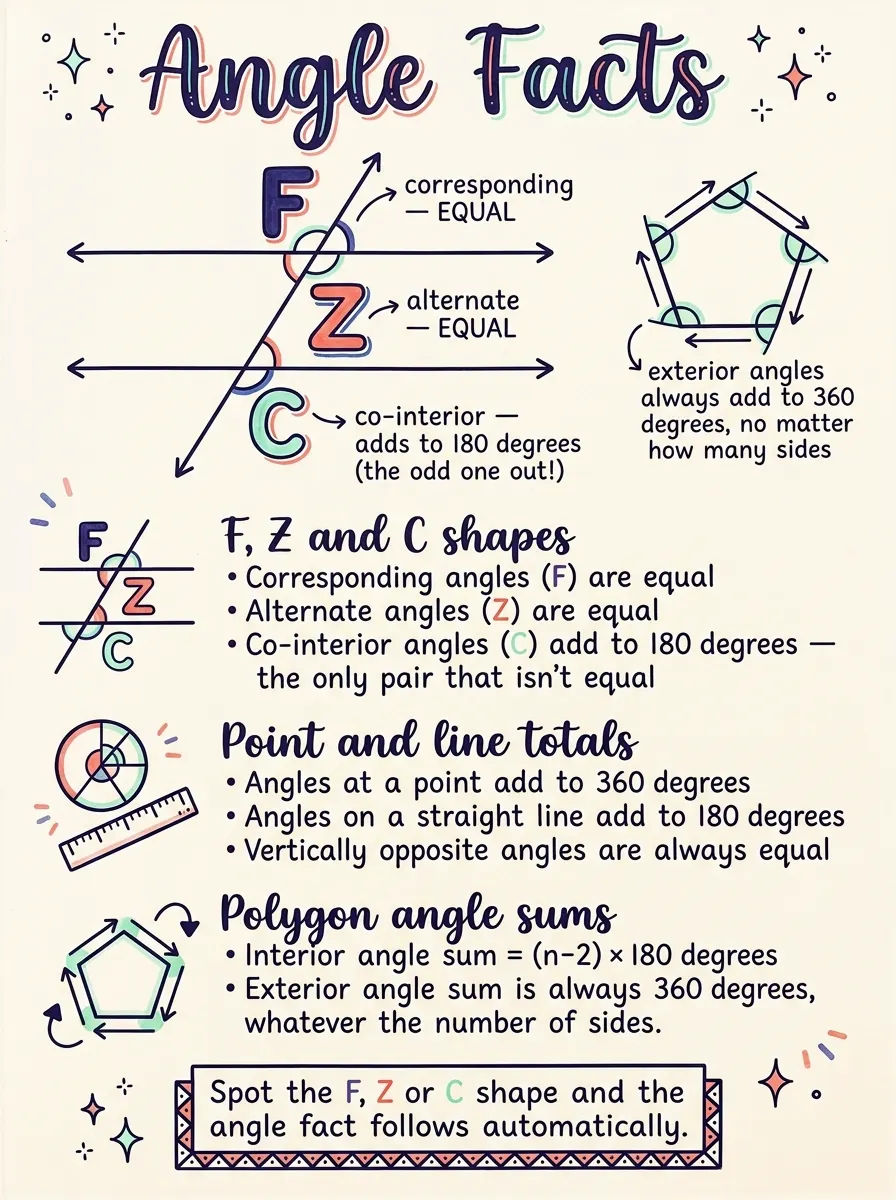
Picture two straight roads crossing at a junction. However you tilt either road before they cross, the angle facing you on one side always matches the angle facing you from directly across the junction. That's not a coincidence — it falls straight out of two much simpler ideas, and once you see why, half of angle geometry stops needing memorising.
Why Angles Around a Point Behave Predictably
A full turn back to your starting direction measures 360°, and a flat line laid out straight measures 180° — those two totals are fixed by definition, not by measurement. So whenever several angles sit packed together with no gaps and no overlap, either right around a single vertex or strung along one straight edge, they can only ever add back up to whichever of those two totals they came from. Nothing needs remembering beyond "the pieces must rebuild the whole."
That accounting trick also explains the crossing-roads pattern above. Where two lines cross, each line separately forces its own pair of neighbouring angles to total a flat 180°. Work that requirement for both lines together and the two angles facing each other across the crossing — called vertically opposite — are forced to end up equal, every single time.
Worked Example — Three Angles Meeting at a Point
Rays OA, OB and OC all meet at point O, arranged so together they surround O completely with no gap left over. ∠AOB is a marked right angle, ∠BOC = 2x, and ∠COA = x + 45°. Find x, then state ∠BOC and ∠COA.
- The three angles pack the whole space around O with nothing left over, so — because a complete turn is fixed at 360° — their sizes must total exactly that.
- Write the equation: 90° + 2x + (x + 45°) = 360°.
- Collect the x-terms and constants: 3x + 135° = 360°, so 3x = 225°, giving x = 75°.
- Substitute back: ∠BOC = 2(75°) = 150°, and ∠COA = 75° + 45° = 120°.
- Check by adding all three: 90° + 150° + 120° = 360° — it balances, confirming the answer.
Whenever three or more angles claim to fill the space around one vertex, that full-turn total is the equation you reach for first — the same accounting habit carries straight through triangle angle sums and polygon angle sums later in this topic.
Everything past this — reading angles off a transversal crossing parallel lines, proving why a triangle's angles must total 180°, working out interior and exterior angles for any polygon, and constructing figures accurately with compasses and a protractor — is walked through step by step in the full lesson below, complete with an audio narration and a practice worksheet.
Keep going — unlock the whole topic
Notes, audio and the worksheet for this topic, plus every other topic in the subject.
Claim a free seat →