Congruence and Similarity — Study Notes
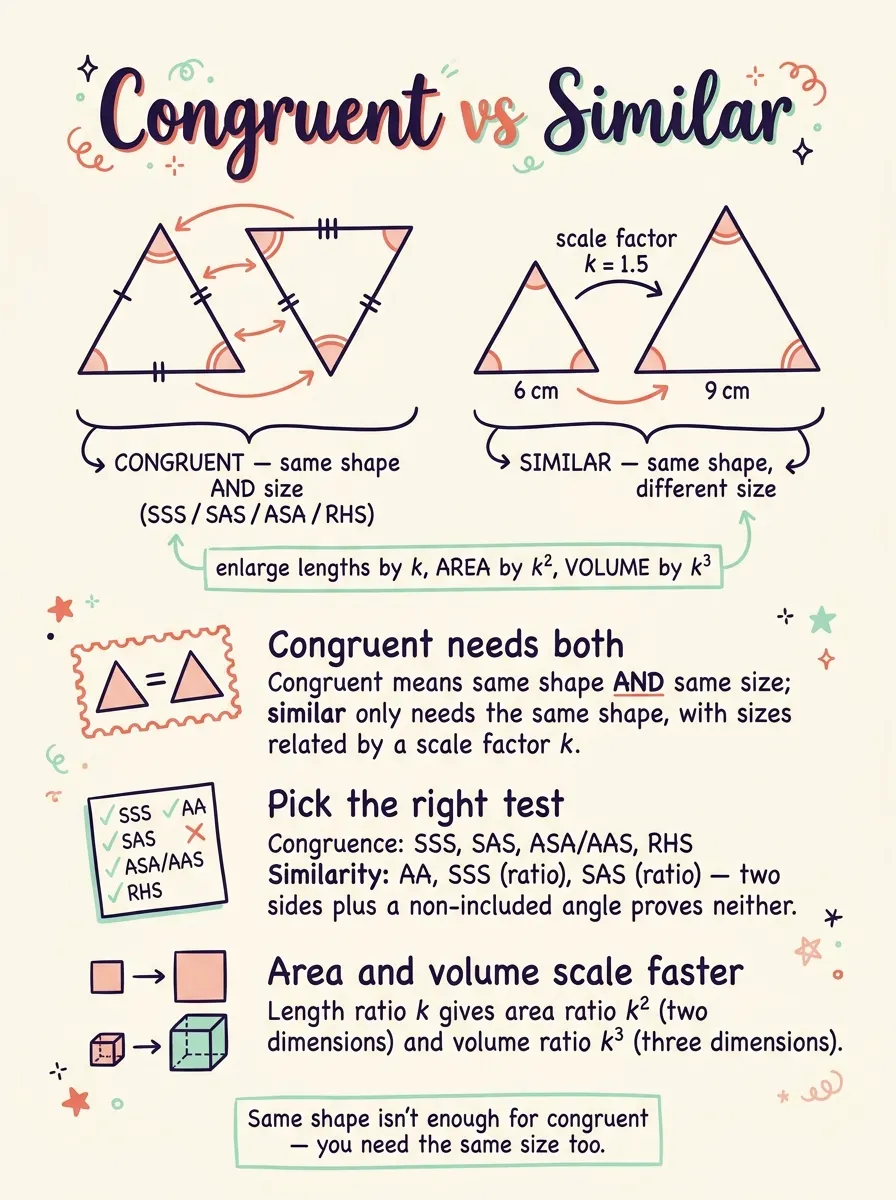
Blow up a photo on your phone from a small thumbnail to a full-screen image and every edge inside it — a doorframe, someone's arm — stretches by the exact same amount. That "same shape, bigger size" idea has a precise mathematical name, and O-Level markers reward you for proving it properly instead of just eyeballing which shapes look alike.
Same Shape, or Same Shape and Size?
Two figures are congruent when one is an exact copy of the other: every side and every angle matches, so you could lift one up and lay it directly over the other, nothing sticking out anywhere. Figures count as similar instead when they share a shape but not necessarily a size — one is a scaled copy of the other. A "same size" copy is just a scaled copy where the multiplier happens to be 1, which is why congruent figures always count as similar too, just a tighter, stronger version of it.
Proving similarity needs two things to hold together, not one on its own: corresponding angles must be equal, and corresponding sides must all share the same multiplier, called the scale factor (usually written k). A shape with the right angles but sides that don't grow by a matching amount isn't similar — a square and a tall thin rectangle both have four right angles, yet they clearly aren't the same shape. Once k is confirmed, it converts any known length on one figure into its matching length on the other by straight multiplication or division.
Worked Example — Finding a Missing Side Using Similar Triangles
Triangle DEF is similar to triangle UVW, with DE corresponding to UV and EF corresponding to VW. Given DE = 7 cm, UV = 21 cm and EF = 9 cm, find VW.
- Pick the matching pair you know in full — DE and UV — and use it to work out k: k = UV ÷ DE = 21 ÷ 7 = 3.
- Dividing the new figure's side by the original figure's side, in that order, keeps k pointed the correct direction — from the triangle already fully known toward the one being solved.
- Because a single multiplier links every pair of sides on similar triangles, use it on the remaining pair too: VW = EF × k = 9 × 3 = 27 cm.
Get the division backwards — original ÷ new instead of new ÷ original — and every length that follows comes out wrong, so it's worth double-checking which figure k is scaling into before multiplying.
The full lesson below covers the exact test names (SSS, SAS, ASA, RHS for congruence; AA, SSS and SAS by ratio for similarity), enlargement, scale drawings, and how areas and volumes scale — plus more worked examples, an audio walkthrough and a practice worksheet.
Keep going — unlock the whole topic
Notes, audio and the worksheet for this topic, plus every other topic in the subject.
Claim a free seat →