Coordinate Geometry — Study Notes
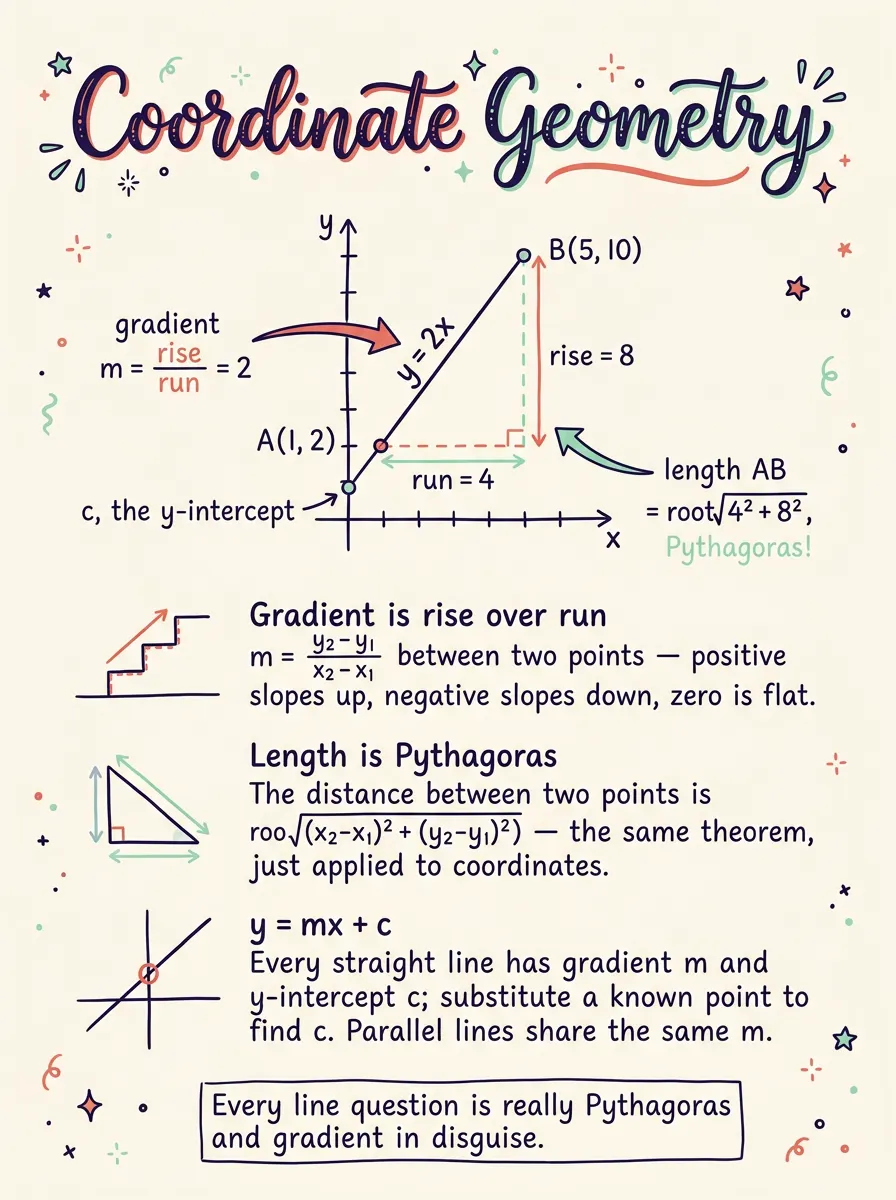
Every point on a map can be pinned down by two numbers — how far across, and how far up. This topic asks: once you can plot a point, what can you calculate from its coordinates alone, with no ruler needed? The first tool in coordinate geometry is the gradient — a single number for how steep a line is.
Gradient: Putting a Number on "Steep"
Take two points on a line, (x₁, y₁) and (x₂, y₂) — the subscripts just label which point is which, so you don't mix them up. Steepness measures "how much up, for how much across," so you divide the vertical change by the horizontal change:
m = (y₂ − y₁) ÷ (x₂ − x₁)
It doesn't matter which point you call "first" — swap the labels and both the top and bottom of the fraction flip sign, and the two flips cancel out, leaving the same value of m. A positive gradient climbs as you move right; a negative gradient falls; zero is flat; and if both points share the same x-coordinate, the line is vertical and has no gradient at all (the formula would divide by zero).
Worked Example
Find the gradient of the line joining A(1, 2) and B(5, 10).
- Label A as (x₁, y₁) = (1, 2) and B as (x₂, y₂) = (5, 10).
- Substitute into the formula: m = (10 − 2) ÷ (5 − 1) = 8 ÷ 4 = 2.
The gradient is positive, which matches the picture: B is further right and further up than A, so the line climbs.
The rest of the method — every worked example, a listen-along audio walkthrough and a practice worksheet — is in the full lesson below.
Keep going — unlock the whole topic
Notes, audio and the worksheet for this topic, plus every other topic in the subject.
Claim a free seat →