Equations and Inequalities — Study Notes
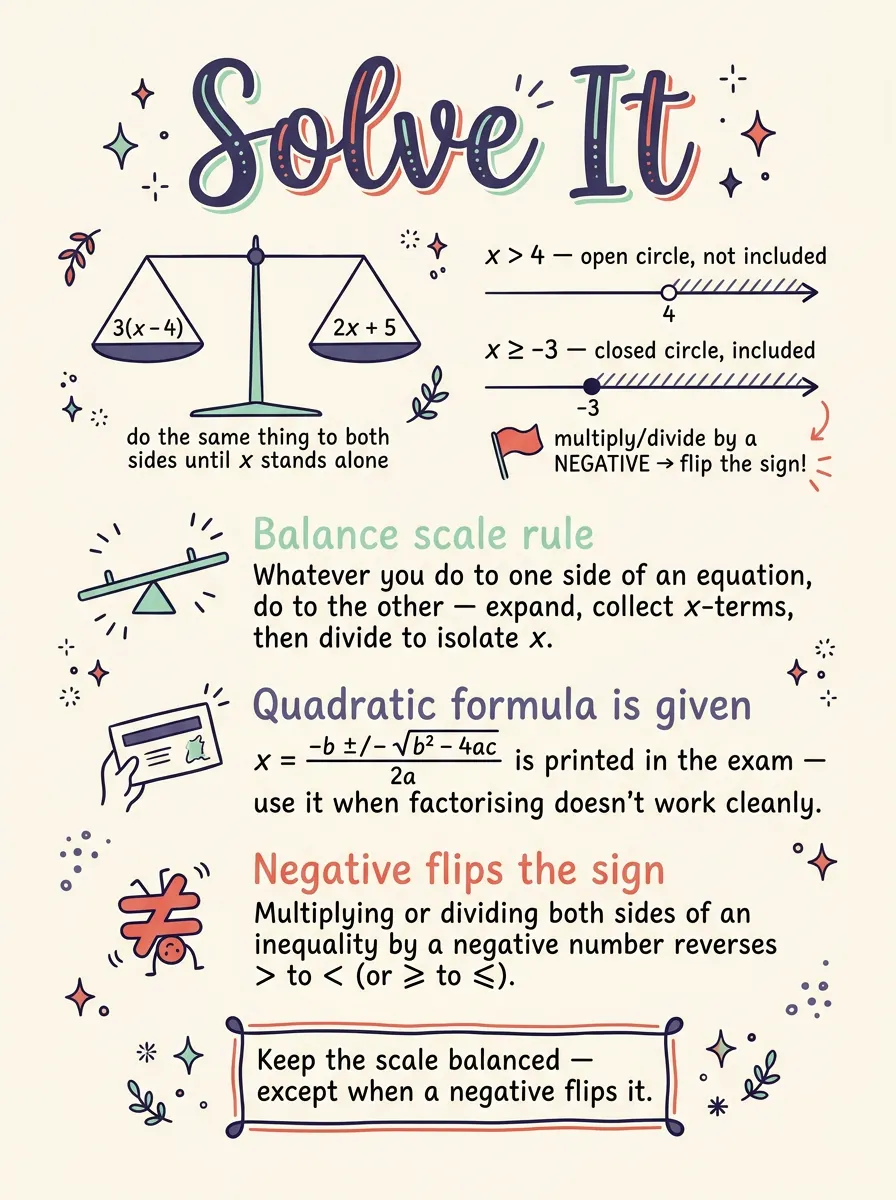
Ask most students what "solving an equation" means and they'll say "find x" — but that's the goal, not the method. The method is one habit, repeated: keep both sides equal by doing the exact same thing to each of them, every single step.
The One Habit Behind Every Equation
Picture two trays on a set of scales, perfectly level. Add a weight to the left tray and the scales tip — unless you add the same weight to the right tray too. An equation behaves exactly like that: the equals sign says the two sides currently weigh the same, and any move you make — adding, subtracting, multiplying, dividing — is only allowed if it happens to both sides at once. Lose that discipline for a single step and the whole solution collapses, even if every other line looks tidy.
Before you can apply that habit, though, a side dressed up with brackets needs tidying first: multiply out so every term is a plain number or a plain multiple of x, then gather the x-pieces on one side and the number-pieces on the other. Only once the equation looks that plain should you divide to leave x by itself.
Worked Example — Solve 5(x − 2) = 3x + 8
- Clear the bracket on the left first, multiplying the 5 across both terms inside it: 5(x − 2) = 5x − 10, so the equation is now 5x − 10 = 3x + 8.
- Gather the x-pieces on one side. Subtracting 3x from both sides removes it from the right without disturbing the balance: 5x − 3x − 10 = 8, which is 2x − 10 = 8.
- Gather the plain numbers on the other side. Adding 10 to both sides: 2x = 18.
- Divide both sides by 2, the coefficient sitting in front of x: x = 9.
Checking matters as much as solving — swap x = 9 back into the original equation, brackets and all: left side gives 5(9 − 2) = 5 × 7 = 35; right side gives 3(9) + 8 = 27 + 8 = 35. Both sides land on 35, so the balance genuinely holds and x = 9 is confirmed correct.
That same balance habit — with one extra twist when a negative number gets involved — is what carries you through simultaneous pairs, quadratics and inequalities too. The full lesson below walks through each case with a guided audio walkthrough, a printable worksheet, and every remaining worked example.
Keep going — unlock the whole topic
Notes, audio and the worksheet for this topic, plus every other topic in the subject.
Claim a free seat →