Matrices — Study Notes
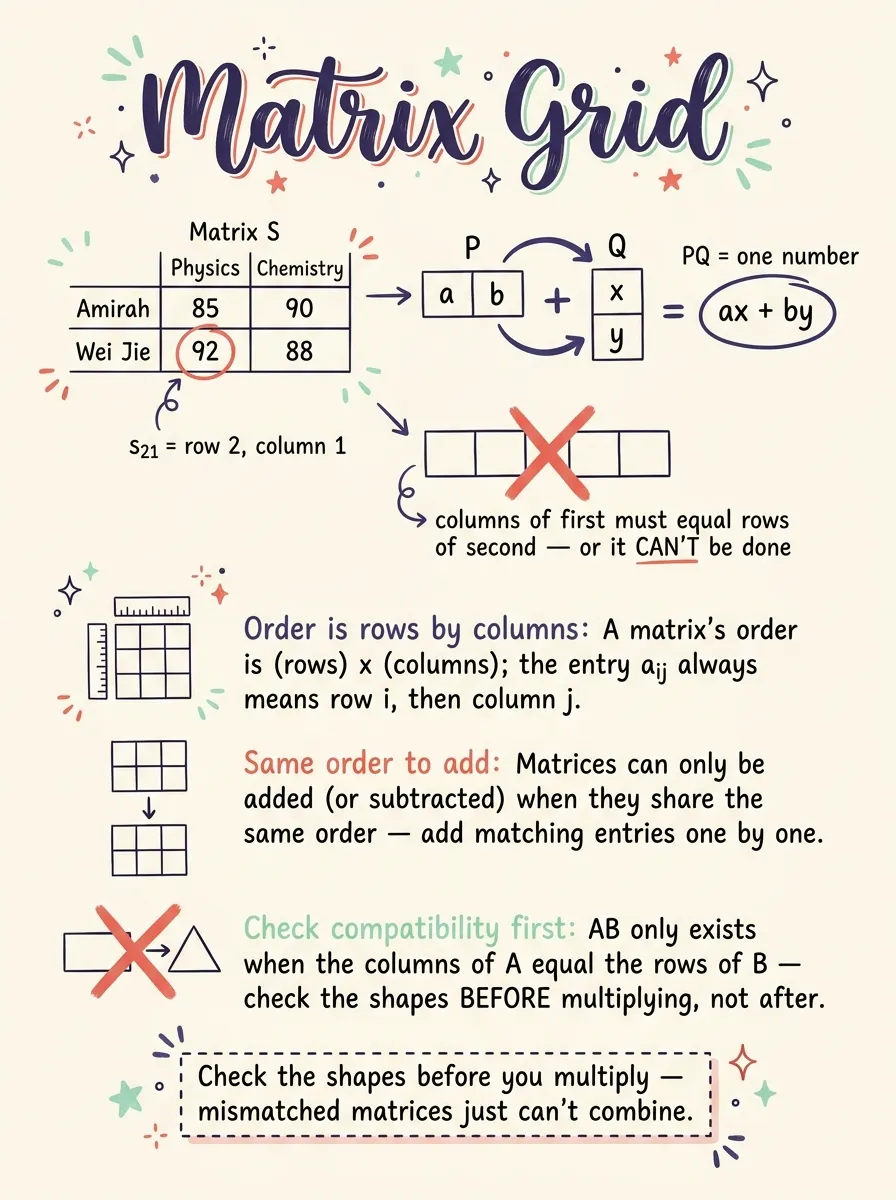
A badminton club keeps a record sheet: how many wins and losses each of its two teams picked up this month. Rows for teams, columns for wins and losses — that grid of numbers is already a matrix, and O-Level Maths gives you a toolkit for working with grids like this instead of tracking every number by hand.
Reading and Combining Matrices
A matrix's shape is called its order: rows first, then columns, so a grid with 2 rows and 2 columns has order 2 × 2. Each number inside is an entry, and a single entry sitting at row i, column j gets the label a₍ᵢⱼ₎ — the row number comes before the column number, which flips the usual habit from coordinate geometry.
Two matrices can only be added or subtracted when they share the same order. That's because the operation works by pairing up entries that sit in the same spot in each grid — the top-left of one with the top-left of the other, and so on for every position — and then adding or subtracting each pair. If one grid has an extra row or column the other doesn't, some entry is left with no partner, so the sum simply cannot be formed. Once the orders match, though, the method itself is easy: line the two grids up and combine spot by spot.
Worked Example — Adding two matrices
- Matrix P shows wins and losses this month for two teams: Team 1 has 5 wins, 2 losses; Team 2 has 3 wins, 4 losses. Matrix Q shows next month's results: Team 1 gets 4 wins, 1 loss; Team 2 gets 6 wins, 2 losses.
- Check the orders first: P and Q are both 2 × 2, so P + Q exists.
- Pair matching positions and add: Team 1 wins 5 + 4 = 9, Team 1 losses 2 + 1 = 3, Team 2 wins 3 + 6 = 9, Team 2 losses 4 + 2 = 6.
- So P + Q gives Team 1 a combined 9 wins, 3 losses, and Team 2 a combined 9 wins, 6 losses over the two months.
Scalar multiplication, matrix multiplication and the compatibility checks examiners actually test — plus every remaining worked example, the audio walkthrough and the printable worksheet — are waiting in the full lesson below.
Keep going — unlock the whole topic
Notes, audio and the worksheet for this topic, plus every other topic in the subject.
Claim a free seat →