Mensuration — Study Notes
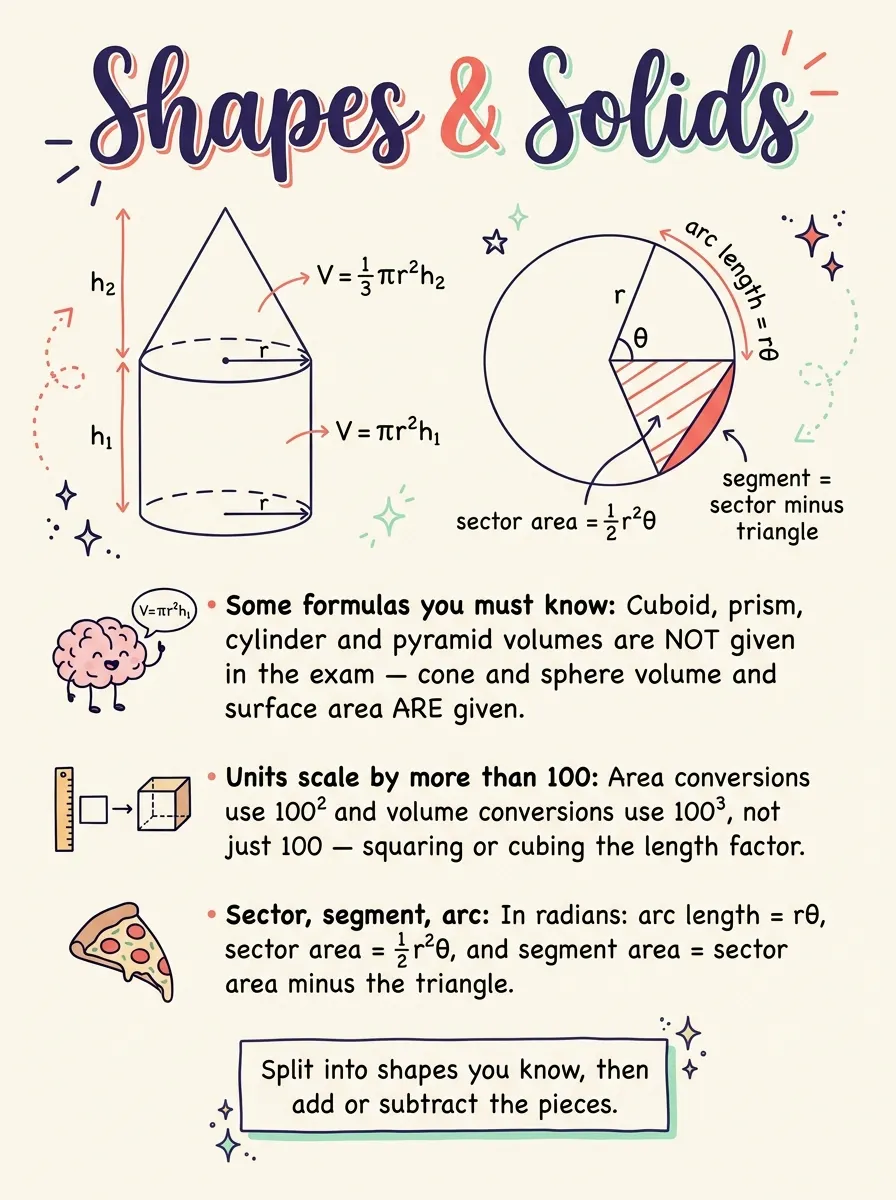
A water tank, a tin of paint, a rolled-up gym mat — each one is a cylinder, and each one raises the same practical question: how much can it actually hold? Mensuration is the set of formulas that turns a shape's dimensions into a real number for space occupied or surface covered, and the cylinder is one of the most useful shapes to master first, because so many other solids build on the same idea.
Why a Cylinder's Capacity Comes From Its Circular Face
Think of a cylinder as a tall stack of identical coin-shaped discs, each one a circle with area πr². Stacking h of those discs (where h is the height) doesn't change the size of any single disc — it just repeats it, so the total space filled is simply that circle's area multiplied by how far it's been stretched:
volume of cylinder = πr² × h
Nothing about that formula depends on which way up the cylinder stands or how wide it looks in a diagram — only the radius of the circular face and the straight-line distance between the two ends matter. Mix those two numbers up (say, using a diameter where a radius belongs) and every later step inherits the error — remember the diameter runs the whole way across the circle, while the radius is only half of that — so check which one a question has actually given you before reaching for the formula.
Worked Example — Capacity of a Cylindrical Tank
- A cylindrical tank has radius 1.5 m and height 2 m. Write down the formula: volume = πr² × h.
- Substitute the values: volume = π × (1.5)² × 2 = π × 2.25 × 2.
- Simplify inside first: 2.25 × 2 = 4.5, so volume = 4.5π m³.
- Keep the exact form, then evaluate: volume = 4.5π ≈ 14.1 m³ (3 significant figures).
- Since 1 m³ holds 1000 litres, convert from the exact form: 4.5π × 1000 = 4500π ≈ 14 100 litres (3 significant figures).
Notice how the π stayed in the working until the final line, with rounding done exactly once — trim a value too soon and every later part that depends on it drifts with it.
Cones, spheres, prisms and every composite solid built from them follow this same habit of reasoning from a cross-section outward — you'll walk through each one, plus a full audio walkthrough and practice worksheet, in the full lesson below.
Keep going — unlock the whole topic
Notes, audio and the worksheet for this topic, plus every other topic in the subject.
Claim a free seat →