Numbers and Their Operations — Study Notes
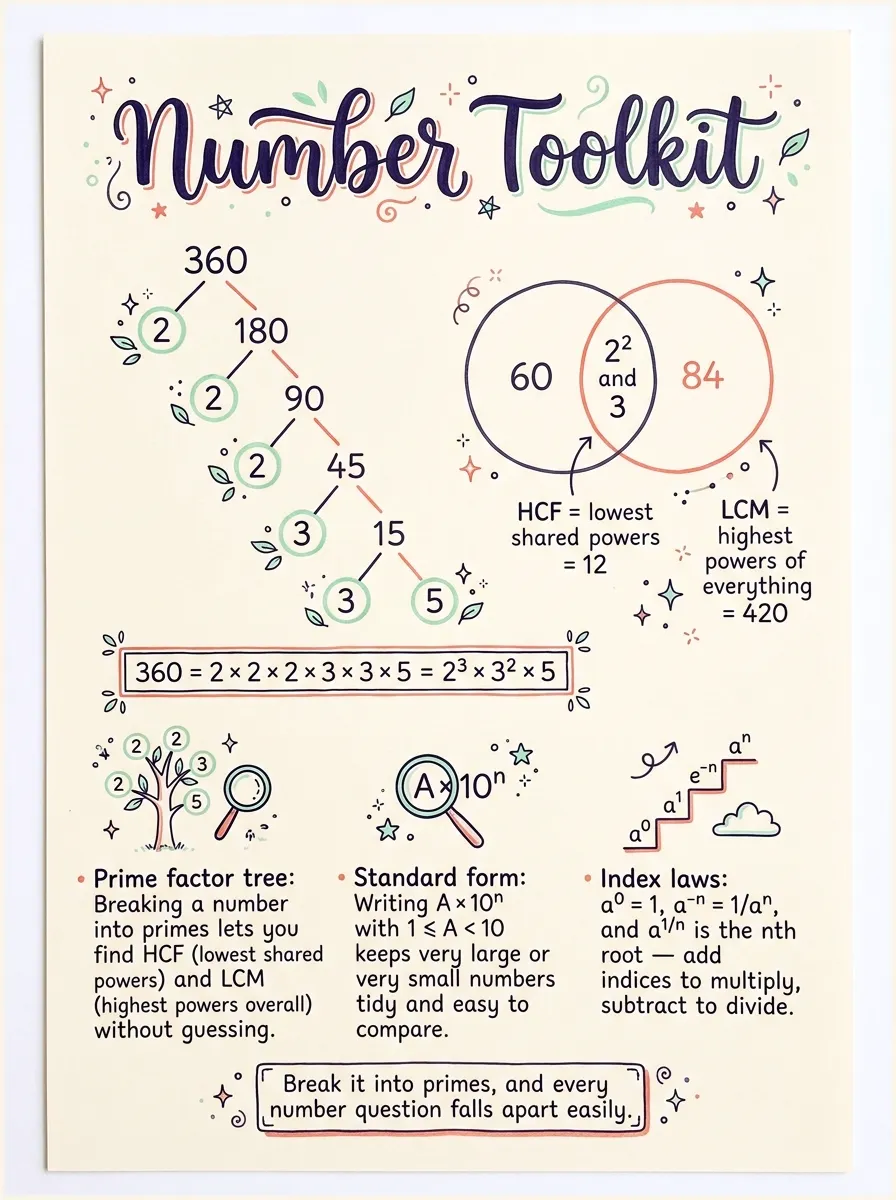
Imagine trying to key Singapore's population, roughly 5,900,000, into a display that only shows six digits at once — you'd lose count of a zero before you finished typing. Standard form exists precisely so numbers like this stay compact, exact and impossible to miscount.
How Standard Form Packs a Number Down
Standard form rewrites any number as a single leading digit multiplied by a power of ten: A × 10ⁿ, where A sits between 1 and 10 (never reaching 10 itself) and n is a whole number, positive or negative. Instead of counting a long run of zeros by eye, you're tracking how far a decimal point travels — a mechanical swap that's much harder to miscount. A genuinely large number needs a positive index, because multiplying by ten repeatedly is what rebuilds a shrunk leading digit back up to full size; a number under one needs a negative index for the mirror reason — dividing by ten repeatedly shrinks it back down. Getting that sign backwards is the single most common slip on this topic, so it pays to ask "am I making this bigger or smaller?" before settling on + or −.
Worked Example — Convert 52,000,000 to Standard Form
- Spot the leading digit cluster: reading from the left, the first two non-zero figures are 5 and 2, so A will be 5.2.
- Track how far the decimal point has to travel to land right after that 5: starting from the end of 52,000,000, it shifts seven places to the left.
- Because shrinking the value down to 5.2 meant travelling left through a large number, the missing size gets restored with a positive index: 52,000,000 = 5.2 × 10⁷.
Sanity-check it in reverse — expanding 5.2 × 10⁷ by shifting the point seven places right should land you straight back on 52,000,000, and it does.
Small numbers with leading zeros follow the mirror-image version of this rule, and that's exactly where most marks slip on this topic — the audio walkthrough, the full worksheet and every remaining worked example (including negative indices and converting back the other way) are waiting for you in the full lesson below.
Keep going — unlock the whole topic
Notes, audio and the worksheet for this topic, plus every other topic in the subject.
Claim a free seat →