Rate and Speed — Study Notes
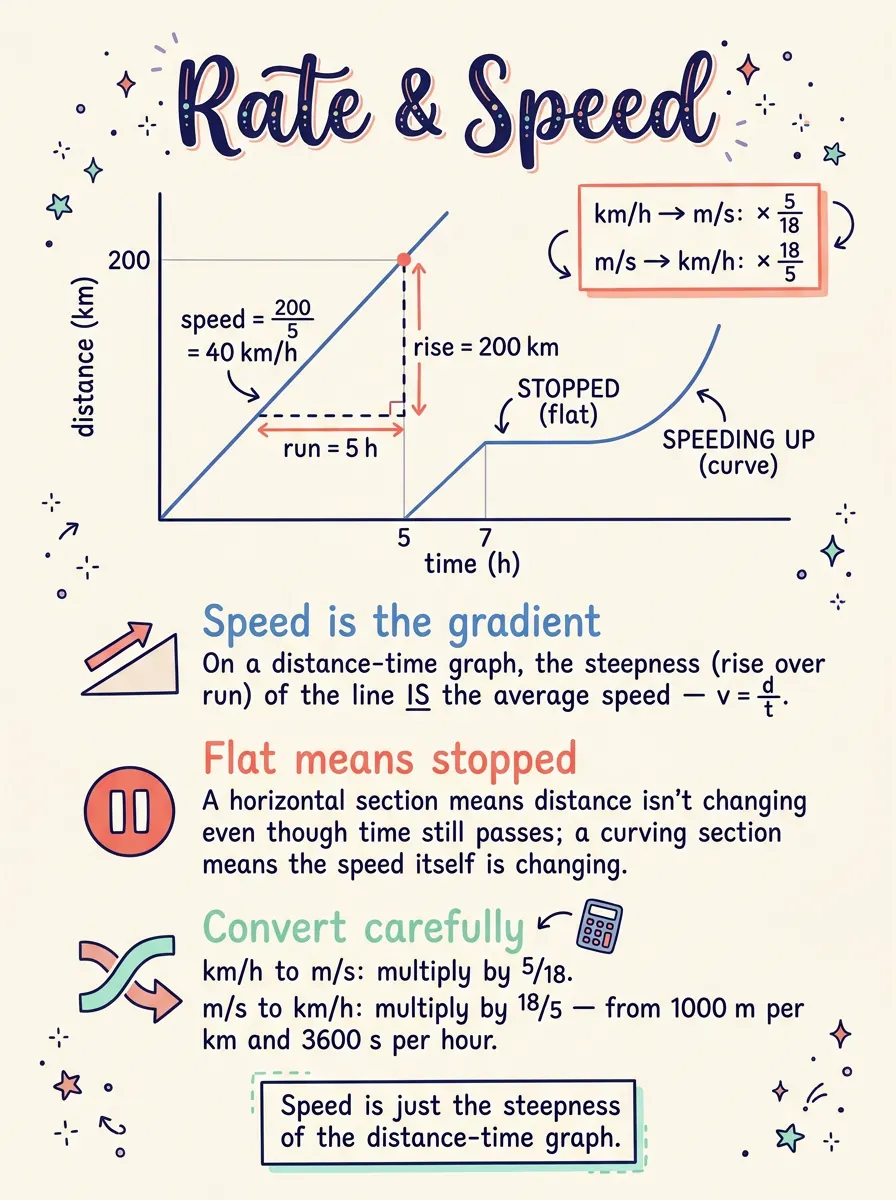
Picture a delivery rider weaving through traffic: some minutes she's crawling, others she's flying past parked cars. Ask "how fast is she going overall?" and you need one single number that sums up the whole trip — that number is a rate, and when the amount being compared is distance, that rate gets a special name: speed.
The Idea Behind Every Rate
A rate simply tells you how much of one quantity you get for every unit of another — pay per hour, heartbeats per minute, distance covered per hour. Strip away the context and the pattern stays the same: divide the total amount by the total time it took. For motion specifically, the "amount" is distance, so a journey covering a distance d in a time t has an average speed v found from v = d ÷ t. Because it's an average, this single figure smooths over any speeding up or slowing down along the way — it only cares where the journey started, where it finished, and how long that took overall.
Worked Example — Finding an Average Speed
- A delivery van drives 84 km, and the trip takes 3 hours. Distance and time are both given, and speed is wanted, so v = d ÷ t is the formula that fits.
- Substitute the numbers straight in: v = 84 ÷ 3.
- Working through that division gives v = 28 km/h — the van's average speed across the entire trip.
A quick sanity check confirms it: multiplying back, 28 km each hour for 3 hours gives 28 × 3 = 84 km — recovering exactly the distance we started with. Building this reverse-check habit into every exam calculation catches upside-down divisions before they cost marks.
Beyond this single calculation, the same idea gets rearranged whenever distance or time is the unknown instead, stretched across journeys made of several different legs, picked straight off the slope of a plotted line, and switched between km/h and m/s — all of that, plus a talk-through audio track and a practice sheet to test yourself, is waiting inside the complete lesson underneath this preview.
Keep going — unlock the whole topic
Notes, audio and the worksheet for this topic, plus every other topic in the subject.
Claim a free seat →