Set Language and Notation — Study Notes
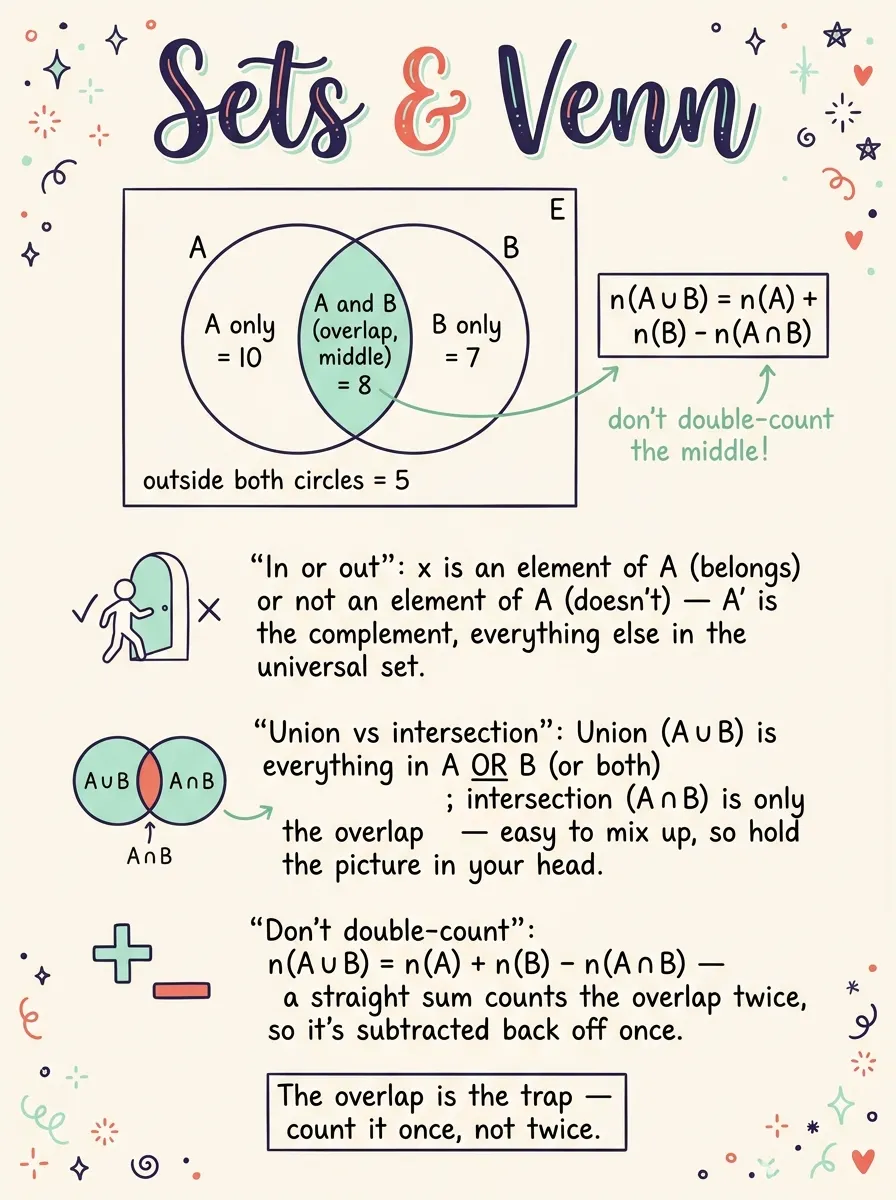
Picture two after-school clubs — one for badminton, one for swimming — with a handful of students who show up to both. Set language gives you exact wording for slicing that crowd apart: who's in just one club, who's in both, and how many people that actually adds up to. None of the symbols are difficult once you see what everyday question each one is answering.
Grouping Without Double-Counting
A set is simply a named collection — the badminton players, the swimmers, whichever group a question is describing. Two sets can share members, and that shared patch is the intersection. Everyone who belongs to at least one of the two groups, shared members included, is the union. Counting a union honestly is the part students trip on: adding the two group sizes straight up counts anyone in the overlap twice, once inside each group's total, so that double-count has to come back off before the number is trustworthy. That gives the counting rule its shape — start with both totals, then remove whatever got counted twice — and it's this reasoning, not a memorised line, that tells you which number to subtract.
Worked Example — Counting a Combined Group
- Of 45 students on a school trip, 27 signed up for the museum tour and 20 signed up for the science centre, with 9 students down for both activities. Identify the three known counts: the museum total is 27, the science-centre total is 20, and the overlap — students doing both — is 9.
- Add the two totals first: 27 + 20 = 47. This figure over-counts, because each of the 9 double-activity students has been tallied once under the museum and again under the science centre.
- Remove the overlap once to cancel that extra tally: 47 − 9 = 38 students signed up for at least one activity.
Thirty-eight is comfortably below the 45 travelling — a quick sanity check that catches the common slip of forgetting the subtraction and reporting 47 instead.
Element notation, subsets, complements, and how to build a full Venn diagram region by region from totals like these — worked step by step with an audio walkthrough and a practice worksheet — are waiting in the full lesson below.
Keep going — unlock the whole topic
Notes, audio and the worksheet for this topic, plus every other topic in the subject.
Claim a free seat →