Vectors in Two Dimensions — Study Notes
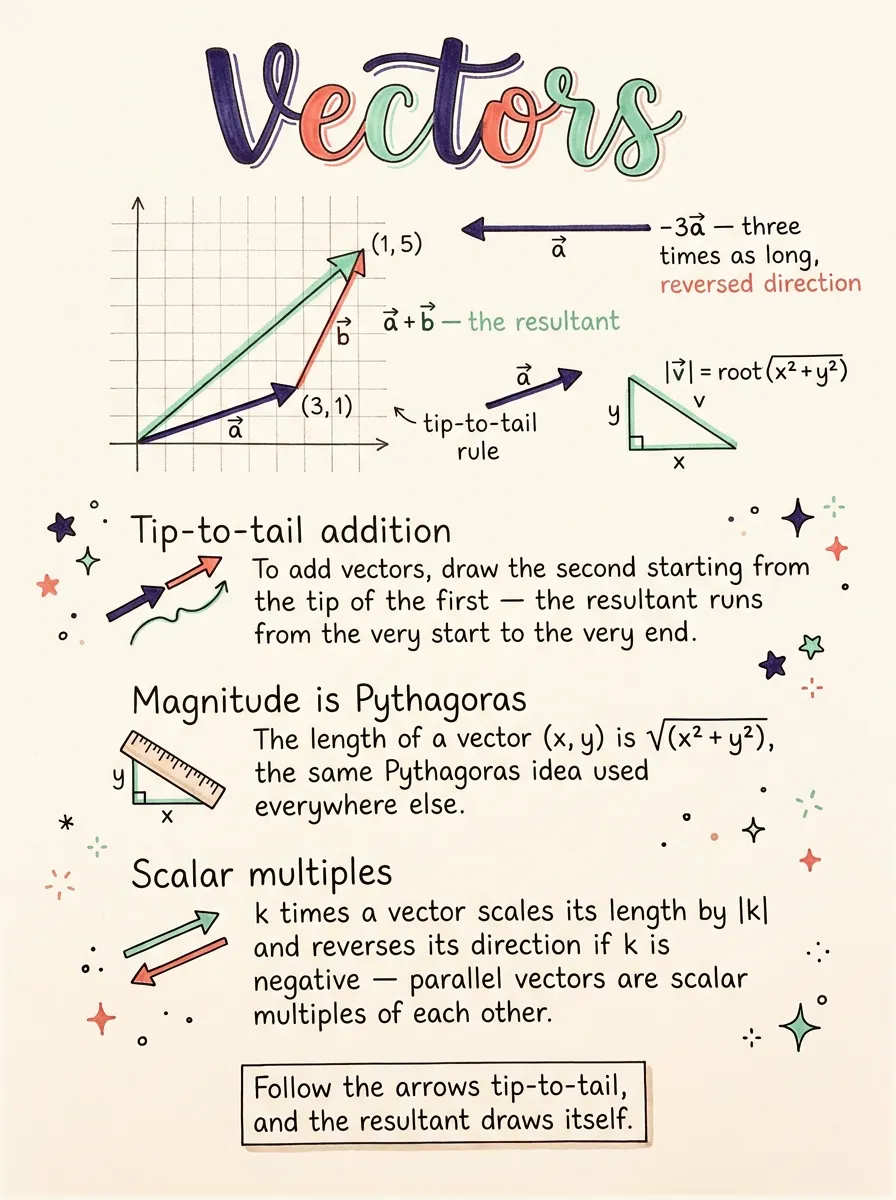
Ask a friend to meet you "200 metres from the gate" and they'll immediately ask which direction — a distance on its own leaves half the story untold. A quantity that's fully pinned down by size alone, like plain distance, is called a scalar; one that needs a size AND a direction, like a displacement, is a vector. This topic is about writing vectors down cleanly, then using that notation to locate and connect points on a grid.
Position Vectors and the Subtraction Order
Every point on a grid can be tied back to one fixed starting point, usually labelled O. The position vector of a point is the vector running from O out to that point, and handily its column form is just the point's ordinary coordinates — nothing new to calculate, only a fresh label for something already familiar.
The genuinely useful trick shows up when you need the vector joining two named points rather than either point's position vector on its own. Suppose points X and Y have position vectors x and y. Picture a short journey: travel first from X back to the origin, then continue out to Y — those two legs combine into one direct hop from X to Y. Reversing a leg flips its sign, so the vector from X to Y works out to y minus x: take the second letter's position vector and subtract the first's, in the same order the two letters are written. Swap that order and you land on the reverse trip instead — a slip worth guarding against every time.
Worked Example — Connecting Two Points
Points C(3, 7) and D(9, 2) have position vectors (3, 7) and (9, 2). Find the vector CD.
- The name "CD" runs C-then-D, so the rule fixes the order: subtract C's position vector from D's, giving CD = d − c.
- Fill in each point's coordinates as a column: d − c = (9, 2) − (3, 7).
- Subtract the matching entries separately — horizontal with horizontal, vertical with vertical: (9 − 3, 2 − 7).
- Work out each subtraction on its own: 9 − 3 = 6 and 2 − 7 = −5, so CD = (6, −5).
Check the direction makes sense: D sits to the right of and below C, and a positive horizontal entry paired with a negative vertical entry describes exactly that — right and down.
That subtraction rule underpins nearly everything else in this topic — translating shapes, measuring lengths, and proving points lie on a line all build on it. The full lesson below walks through each of those with a listen-along audio track, a self-check worksheet, and the remaining worked examples.
Keep going — unlock the whole topic
Notes, audio and the worksheet for this topic, plus every other topic in the subject.
Claim a free seat →