Editing — Study Notes
Read this line once, quickly: "The instructions on the packet was hard to follow." Did anything snag, or did it slide past unnoticed? That question is exactly what the Editing task is built to test — whether you can stop reading for meaning and start checking grammar on purpose, line by line. (The slip: instructions is plural, so the verb must be were — the nearby word packet is a decoy.)
What this task is really asking you to fix
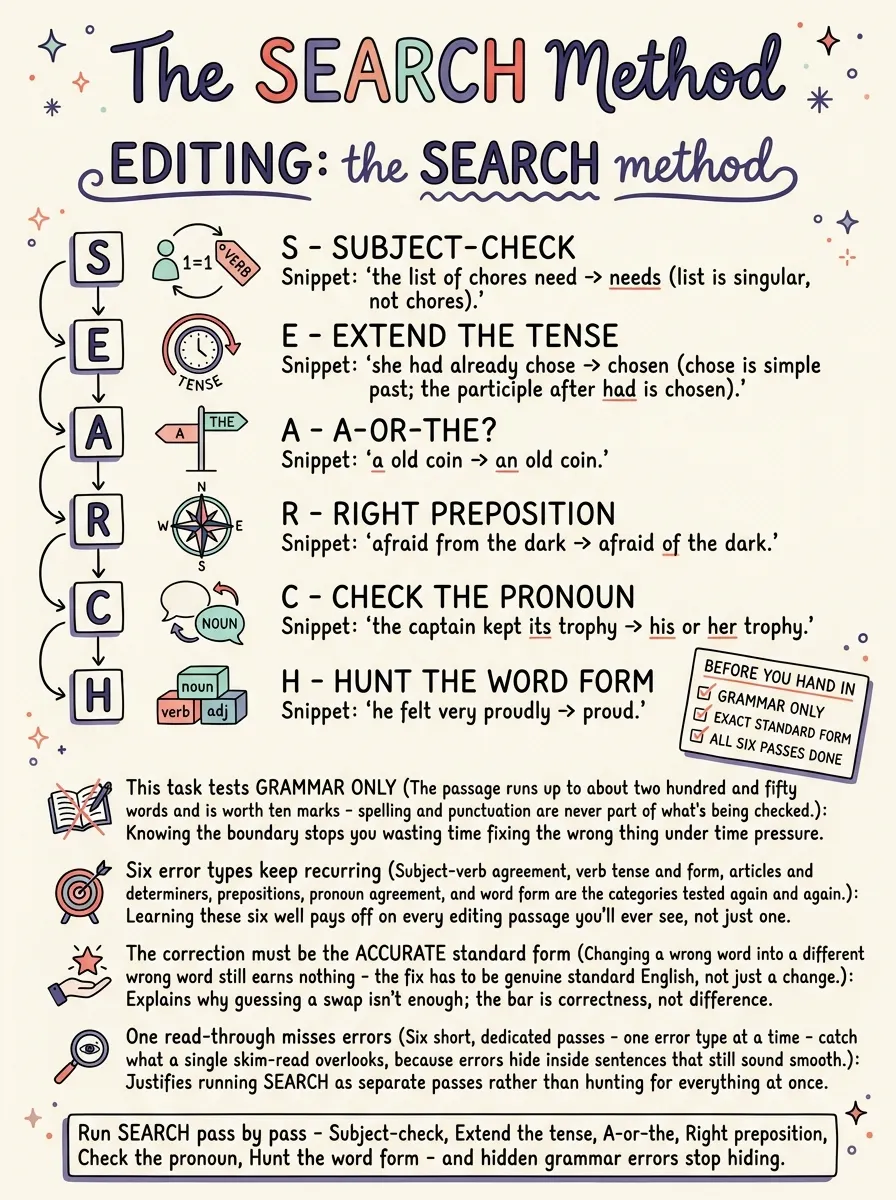
You'll get a short passage where each numbered line hides no more than one grammar slip — and some lines hide none at all. None of it is about spelling or how it's punctuated. Beside every line sits a blank space: locate the broken word or phrase and swap in the accurate version. A line that's already correct still earns credit, but only if you mark it as clean rather than leaving that space empty.
The trap most candidates fall into is treating this like ordinary proofreading — scanning for anything that looks untidy. Credit only comes from real grammar slips: a verb not matching its subject, a verb sitting in the wrong tense, a missing or wrong little word such as "a" or "an", a phrase that English locks to one particular preposition using another (think good at, never good in), a stand-in word that no longer matches what it refers to, or a word doing the job of the wrong part of speech. Naming which of these lanes a slip belongs to is what turns a vague "something's off" into a precise, markable fix.
Worked Example — Fixing "The soup tasted deliciously"
- Locate the verb connecting the subject to its description: tasted here is describing a quality, not an action being carried out. Grammar calls this a linking verb.
- Work out what belongs after a linking verb: an adjective (a word describing the noun) — never an adverb (a word describing an action), because no action is happening.
- Look closely at the word already sitting there: deliciously carries the -ly ending that usually signals an adverb, so it's answering a question this sentence never asks.
- Replace it with the adjective form: The soup tasted delicious.
The fix isn't about sounding nicer — it's about matching the correct grammatical role for the job. The other five slip-types, an audio walkthrough of the full routine, and a worksheet passage to drill it on are waiting in the full lesson below.
Keep going — unlock the whole topic
Notes, audio and the worksheet for this topic, plus every other topic in the subject.
Claim a free seat →