Electrolysis (Part 1): Molten Compounds & the Fundamentals — Study Notes
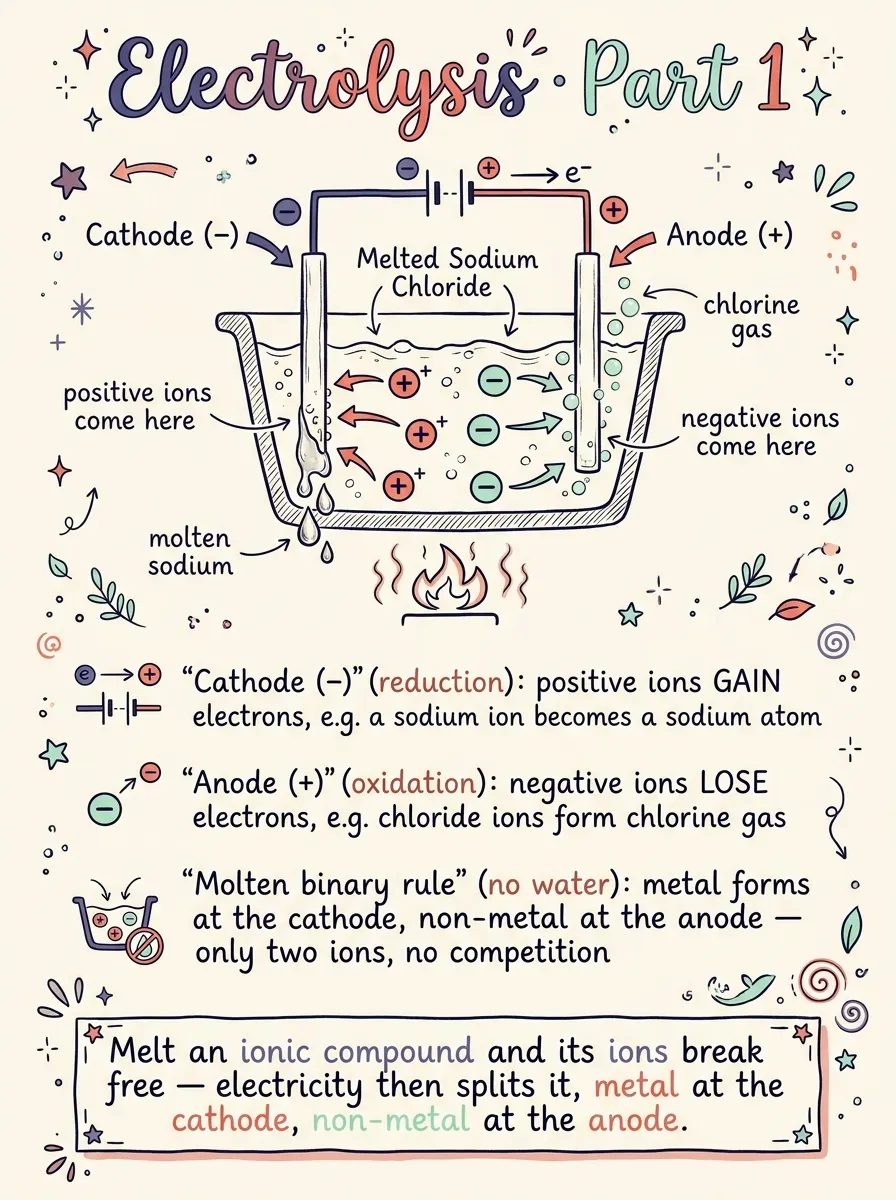
Melt an ordinary salt and run a current through it, and something strange happens: it splits into two completely different substances — a shiny metal on one rod and a gas bubbling off the other. That splitting trick has a name, and once you see the logic behind it, the rest of the topic falls into place fast.
The Core Idea Behind Electrolysis
An ionic substance is made of charged particles — chemists call them ions. Locked up as a solid, those particles sit frozen in a rigid arrangement and can't travel anywhere, so no current flows. Melt the substance (or dissolve it in water) and that rigid arrangement collapses — the charged particles are suddenly free to drift toward a pair of rods dipped into the liquid, called electrodes. Electrolysis is simply this: forcing a current through a molten or dissolved ionic substance so it splits apart at those two rods.
The rod hooked up to the battery's negative side is the cathode; the rod on the positive side is the anode. Charged particles are drawn to whichever electrode carries the opposite sign — positives head for the cathode, negatives head for the anode — and once an ion arrives, it gains or loses just enough electrons to become a neutral atom or molecule. Gaining electrons at the cathode is reduction; losing them at the anode is oxidation. For a molten compound built from just one metal and one non-metal, predicting the outcome takes three moves: spot the two ions, send the metal one to the cathode, send the other to the anode.
Worked Example — Molten Zinc Chloride
- Zinc chloride, once melted, contains two ions only: zinc, carrying a 2+ charge, and chloride, carrying a 1− charge each.
- The positive zinc ion travels to the cathode. It needs two electrons to cancel its charge: Zn²⁺ + 2e⁻ → Zn, so zinc metal is deposited there.
- The negative chloride ion travels to the anode, where two of them give up one electron each and pair off into a molecule: 2Cl⁻ → Cl₂ + 2e⁻, releasing pale green chlorine gas.
Zinc forms at one rod, chlorine escapes at the other — a clean electron swap driven entirely by which rod each particle is drawn to.
The mnemonic for keeping cathode and anode straight, a step-by-step method for building any half-equation from scratch, and several more fully worked examples are waiting in the audio walkthrough and worksheet inside the full lesson below.
Keep going — unlock the whole topic
Notes, audio and the worksheet for this topic, plus every other topic in the subject.
Claim a free seat →