Electrolysis (Part 2): Aqueous Solutions & Applications — Study Notes
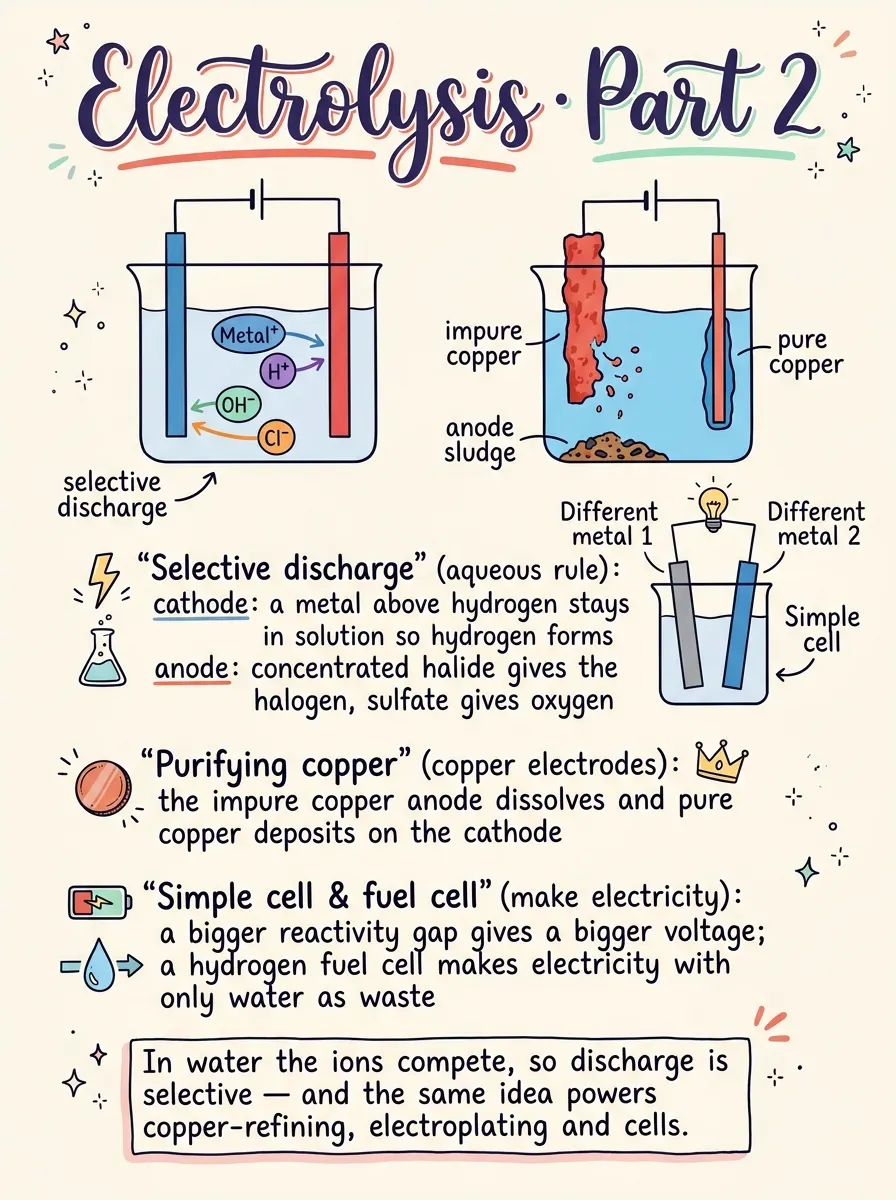
Dissolve an ionic compound in water and electrolysis stops being a simple two-ion race. Water quietly contributes a pair of ions of its own, so every electrode now has two rivals fighting to be discharged — and only one of them can win.
Selective Discharge: Picking the Winner at Each Electrode
In a molten compound there are only two ions, so each electrode has no real choice. Once that same compound is aqueous, water adds H⁺ and OH⁻ into the mix, giving four ions total — a metal cation and its partner anion, plus hydrogen and hydroxide from the solvent. Deciding which ion actually gets discharged at each electrode is called selective discharge, and it runs on two separate tests.
At the cathode, the contest is between the metal ion and H⁺, settled by the reactivity series: any metal above hydrogen loses the fight, so hydrogen gas bubbles off instead, while a metal below hydrogen (copper, silver) is the one that plates out. At the anode, with unreactive electrodes, the contest depends on the anion type: a halide ion — chloride, bromide or iodide — usually wins and releases its halogen, but sulfate and nitrate never get discharged, so oxygen comes from hydroxide instead. A dilute halide solution is the one exception where concentration flips the outcome toward oxygen.
Worked Example — Concentrated Aqueous Copper(II) Chloride, Unreactive Electrodes
- Identify every ion present: Cu²⁺ and Cl⁻ from the dissolved salt, plus H⁺ and OH⁻ supplied by the water.
- Settle the cathode contest: copper sits below hydrogen on the reactivity series, so it is the more willing ion — copper metal plates onto the cathode: Cu²⁺ + 2e⁻ → Cu.
- Settle the anode contest: chloride belongs to the halide family, and with the solution concentrated there are plenty of chloride ions crowding the electrode, so it outcompetes hydroxide — chlorine gas is released: 2Cl⁻ → Cl₂ + 2e⁻.
- Combine both halves: copper deposits at the cathode while chlorine gas escapes at the anode, leaving the solution steadily less concentrated as both ions are used up.
That's the core selective-discharge logic — the audio walkthrough, the printable worksheet and the remaining worked examples covering copper purification, electroplating and the simple cell are waiting in the full lesson below.
Keep going — unlock the whole topic
Notes, audio and the worksheet for this topic, plus every other topic in the subject.
Claim a free seat →