Electromagnetic Induction — study notes
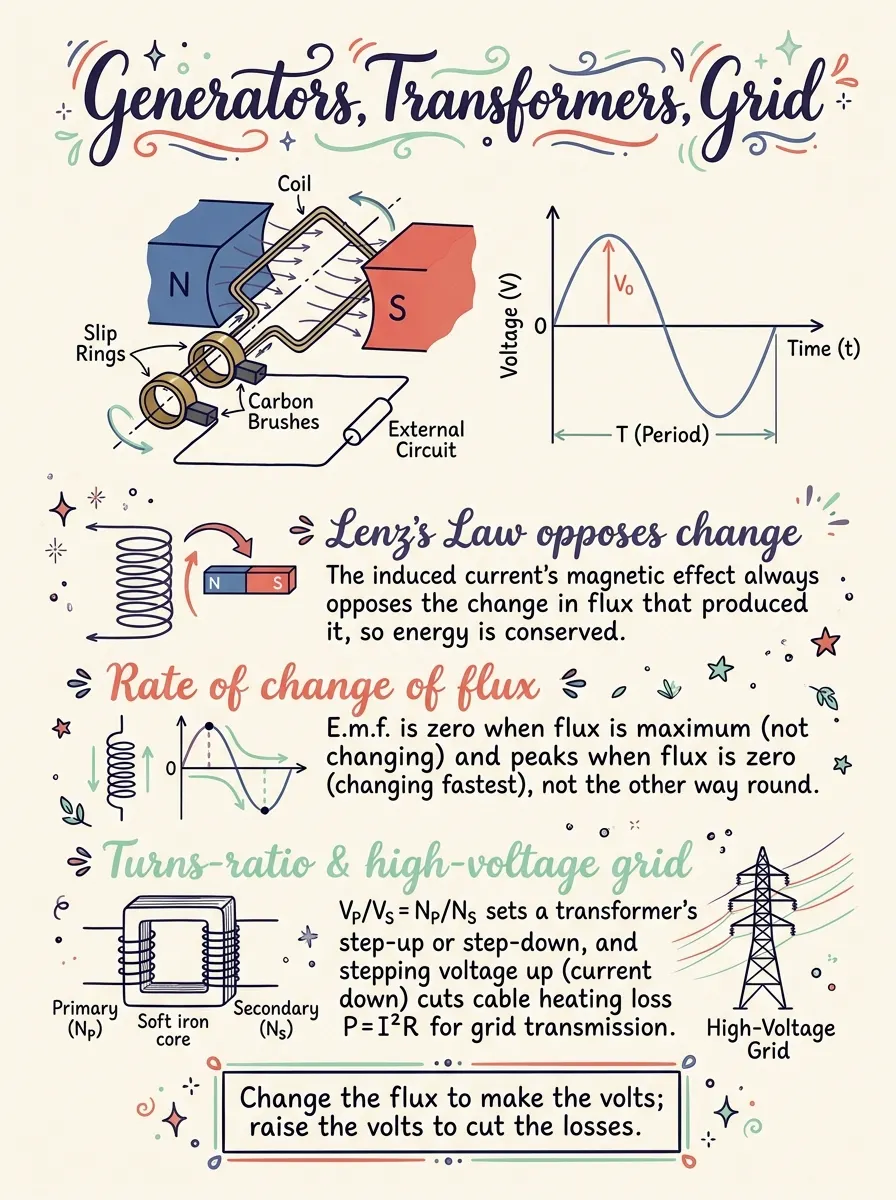
Every socket in your home is fed by electricity that started life as a spinning magnet, not a chemical reaction — no wires ever touch that magnet at all. That single trick, using a shifting magnetic field to push current through a coil, is the idea behind both generators and transformers, and O-Level questions lean on it constantly.
The Core Idea: Only a Changing Field Pushes Current
Hold a magnet still beside a loop of wire and nothing happens, no matter how powerful that magnet is. Move it — push it in, pull it out, or spin it — and a voltage appears across the loop, driving current around the circuit. That voltage is called an e.m.f. (electromotive force), and what causes it is not the magnet's presence but its motion relative to the coil. Scientists give a name to "how much field is threading through the loop right now": flux. So the rule tightens to this: an e.m.f. only appears while flux is changing — a parked magnet next to a parked coil produces nothing at all.
Three levers make that induced e.m.f. bigger: shove the magnet in faster, swap in a stronger magnet, or wrap extra loops of wire onto the coil. Each lever raises how fast the flux is altering through the coil, and it's that rate of alteration — never the flux itself — that sets the size of the push. A coil facing a magnet dead-on actually has plenty of flux passing through it, yet right at that instant the flux has stopped growing, so the e.m.f. there is briefly nothing.
Worked Example — Finding a Transformer's Output Voltage
- A transformer has 600 turns wound on its primary coil and 150 turns on its secondary, fed by 120 V at the primary. Set up the turns ratio linking voltage and turns: primary voltage ÷ secondary voltage = primary turns ÷ secondary turns, giving 120 ÷ V_S = 600 ÷ 150.
- Work out the right-hand side first: 600 ÷ 150 = 4, leaving 120 ÷ V_S = 4.
- Rearrange for V_S by cross-multiplying: V_S = 120 ÷ 4 = 30 V.
- Sanity check the direction: the secondary has fewer turns than the primary (150 is less than 600), which marks this as a step-down design — so the output should sit below the input, and 30 V being less than 120 V confirms the arithmetic is pointing the right way.
That ratio move is the engine behind step-up transmission problems, the matching power equation, and reading off a generator's spinning-coil graph — all worked through carefully, with a listen-along audio version and a practice worksheet, in the complete lesson below.
Keep going — unlock the whole topic
Notes, audio and the worksheet for this topic, plus every other topic in the subject.
Claim a free seat →