Electromagnetic Spectrum — study notes
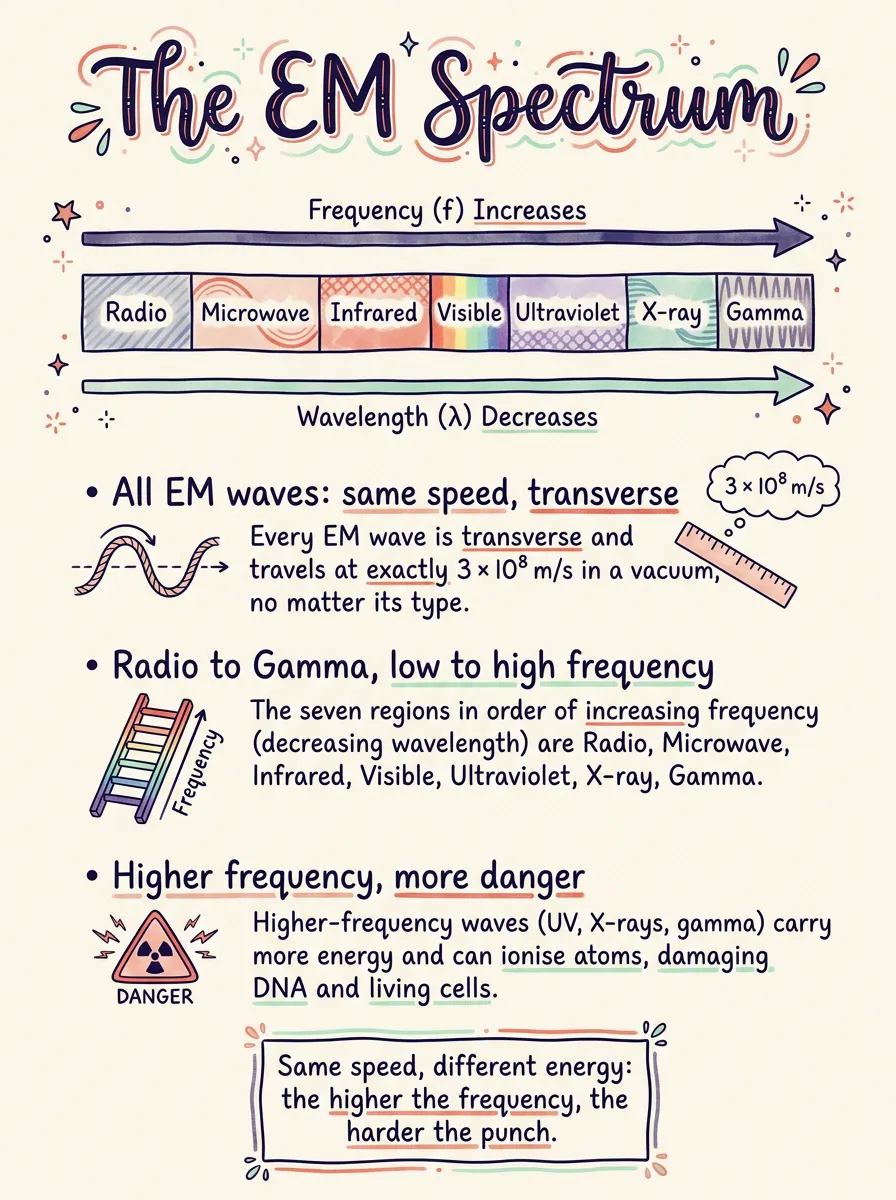
A remote control clicking your TV on, a hospital scanner picturing your bones, and the sunlight warming your skin all rely on the exact same kind of wave — just tuned differently. Once you see what links them, the whole spectrum stops being seven things to memorise and becomes one idea applied seven times.
One Rulebook, Seven Members
Every wave in this family shares two properties no matter where it sits on the spectrum. First, each one vibrates sideways to the direction it's moving — a transverse pattern, not a push-pull one. Second, in empty space every member travels at the identical top speed: three hundred million metres per second (3 × 10⁸ m/s). Nothing in the family is ever faster or slower than another member when both are in a vacuum.
So what tells one member apart from the next? Not speed — that's fixed. It's how tightly packed the wiggles are. A tightly packed wave has a short distance between peaks (a short wavelength) and squeezes more peaks past a fixed point each second (a high frequency). A loosely packed wave does the opposite: long wavelength, low frequency. Because the travelling speed never budges, frequency and wavelength are locked in a trade-off — push one up and the other must fall, captured by speed = frequency × wavelength.
Worked Example — Finding the Frequency of Green Light
- A beam of green light has a wavelength of 500 nanometres. Convert to metres first: 500 nm = 500 × 10⁻⁹ m = 5 × 10⁻⁷ m.
- Every member of this wave family shares the same vacuum speed, so here v = 3 × 10⁸ m/s.
- Rearrange speed = frequency × wavelength to isolate frequency: frequency = speed ÷ wavelength.
- Substitute: frequency = (3 × 10⁸) ÷ (5 × 10⁻⁷) = 6 × 10¹⁴ Hz.
- Check it's sensible: visible colours sit far above radio-style frequencies, and 6 × 10¹⁴ Hz is exactly that kind of huge number, so the size checks out.
That single relationship — a fixed speed shared out between frequency and wavelength — is the key that unlocks the entire family, from the low end that carries broadcast signals to the high end that can damage living tissue. The full lesson below walks through where each region sits, what it's used for, why some parts are hazardous, and includes more worked examples alongside an audio walkthrough and practice worksheet.
Keep going — unlock the whole topic
Notes, audio and the worksheet for this topic, plus every other topic in the subject.
Claim a free seat →