Electromagnetism — study notes
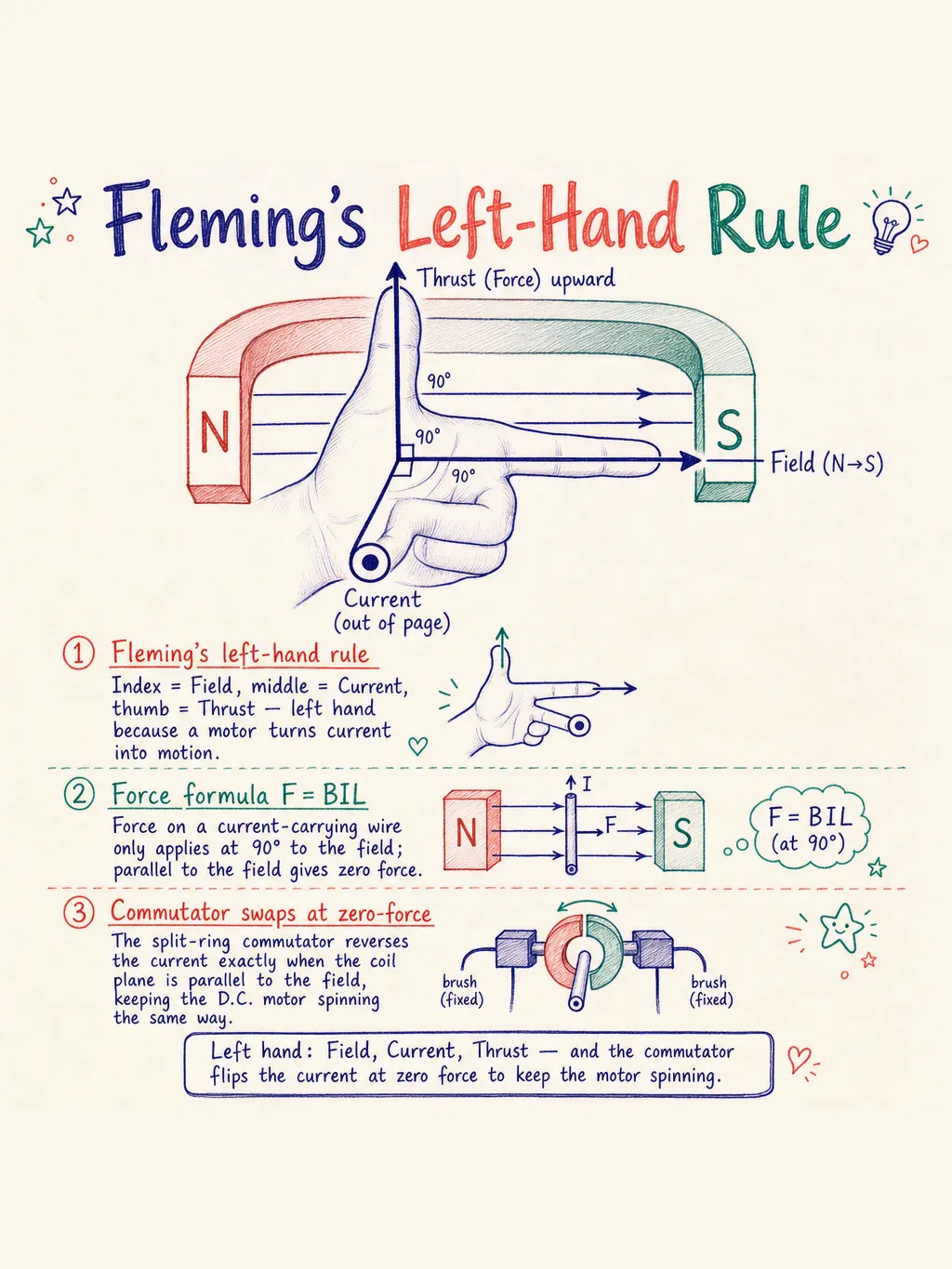
Hold a wire near a strong magnet, switch on the current, and the wire jumps sideways — no one touched it. That jump is the same push that spins an electric motor, and once you can predict its direction, half of the electromagnetism topic falls into place.
Why a Current-Carrying Wire Feels a Push
A wire carrying current sits inside a magnetic field made by a separate magnet. The field and the current interact, and the wire gets shoved at right angles to both — think of a raft caught side-on by a river current, deflected sideways rather than swept downstream. Swap the current's direction, or swap the magnet's poles, and the shove flips to the opposite side. Swap both at once and the two flips cancel, so the push ends up back where it started.
How big is the shove? Three things decide it: how strong the magnet is, how much current flows, and how much of the wire actually sits inside the field. Multiply those three together and you get the size of the force, measured in newtons — but only when the wire crosses the field straight-on. Line the wire up running along the field instead of across it, and there is nothing to push against, so the force drops to nothing.
Worked Example — Finding the Push on a Wire
- A 0.3 m length of wire sits at right angles inside a field of strength 0.25 tesla, carrying a current of 4 amperes.
- Check the angle first: the wire crosses the field straight-on, so the full multiplication applies rather than giving zero.
- Multiply the three quantities together: 0.25 × 4 × 0.3 = 0.3 newtons of sideways push on the wire.
Notice the units line up: tesla × amperes × metres gives newtons, so there's no conversion to worry about once every value is in its standard SI unit.
Which side the wire actually jumps to needs a hand-rule trick, and that's where the full lesson picks up — along with the listen-along audio walkthrough, a printable worksheet, and the remaining worked examples below the fold.
Keep going — unlock the whole topic
Notes, audio and the worksheet for this topic, plus every other topic in the subject.
Claim a free seat →