Energy Flow — Study Notes
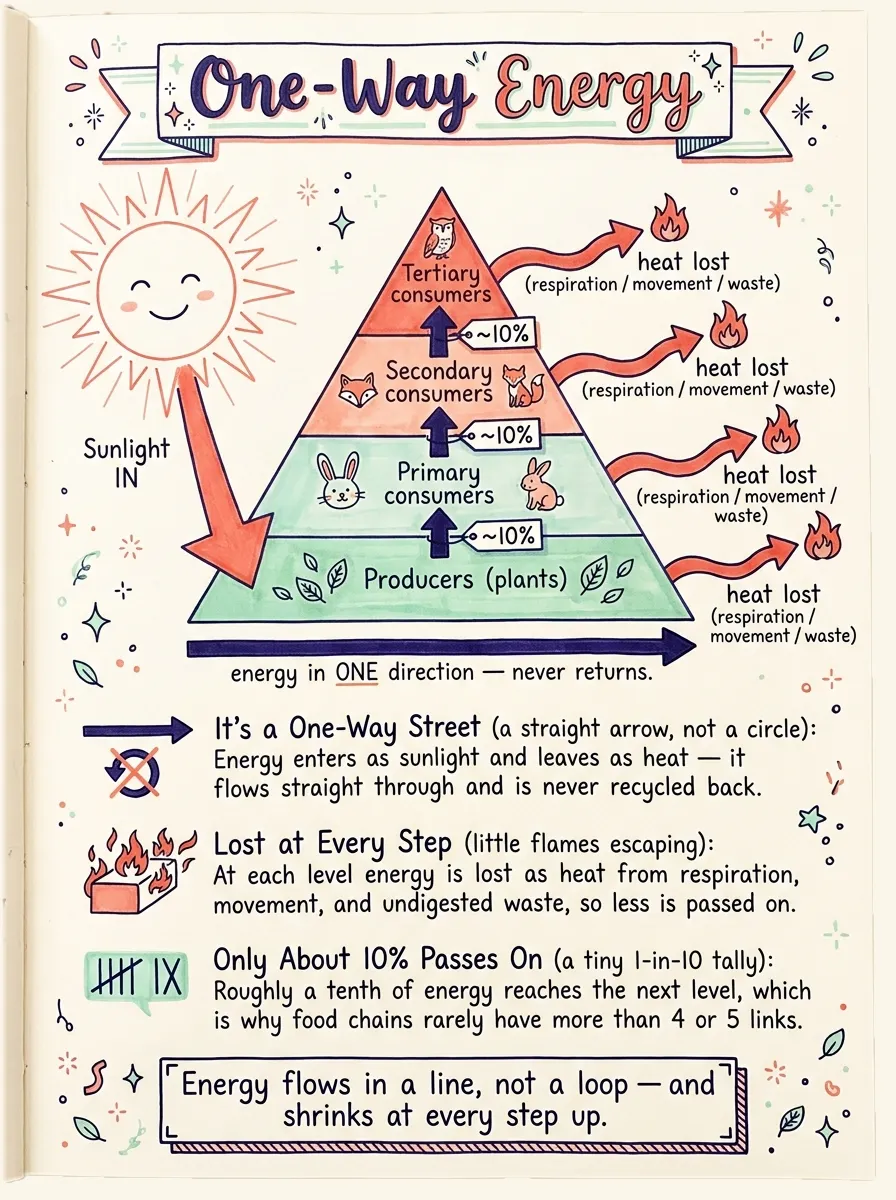
A farmer could feed far more people by growing rice on a plot of land than by raising chickens on that same plot. That isn't about taste or convenience — it comes down to a strict rule about how energy moves through living things, and once you see it, a whole cluster of exam questions about food chains and farming efficiency start answering themselves.
Why Energy Only Ever Flows One Way
Every scrap of energy available to living things starts as sunlight, captured by producers during photosynthesis and stored as chemical energy in their tissues. From there it passes forward — plant to plant-eater, plant-eater to hunter — but it never travels backward. At each handover, the feeding organism keeps only a slice of what its meal contained; the remainder escapes as heat given off during respiration, leaves the body as undigested waste, or sits in tough parts — bone, fur, stems — that simply go uneaten. Because that lost heat scatters into the surroundings and can never be gathered back up by a producer, this movement of energy is described as a one-way flow, unlike carbon or nitrogen, which genuinely do return through decomposers and soil. Roughly a tenth of the energy held at one feeding position survives to reach the next; call that fraction the transfer efficiency. Multiply that shrinkage across several feeding positions and it becomes obvious why a chain of feeding relationships rarely stretches past four or five links — too little energy is still on offer by that point to keep yet another hungry mouth fed.
Worked Example — Tracking energy through a grassland chain
- Grass growing in a field traps 8,000 kJ of chemical energy this season through photosynthesis.
- A population of grasshoppers feeding on that grass keeps only about a tenth of it: 8,000 × 10% = 800 kJ.
- A population of shrews feeding on the grasshoppers keeps a tenth of that figure in turn: 800 × 10% = 80 kJ.
- A population of hawks feeding on the shrews keeps a tenth again: 80 × 10% = 8 kJ — a tiny sliver of what the grass originally trapped, which is exactly why a hunting bird needs such a large territory to find enough to eat.
The full lesson below builds out the complete picture — producers, consumers and decomposers as named roles, the pyramid shape this shrinkage produces, a listen-along audio walkthrough, and further worked examples with a downloadable worksheet.
Keep going — unlock the whole topic
Notes, audio and the worksheet for this topic, plus every other topic in the subject.
Claim a free seat →