Energy — study notes
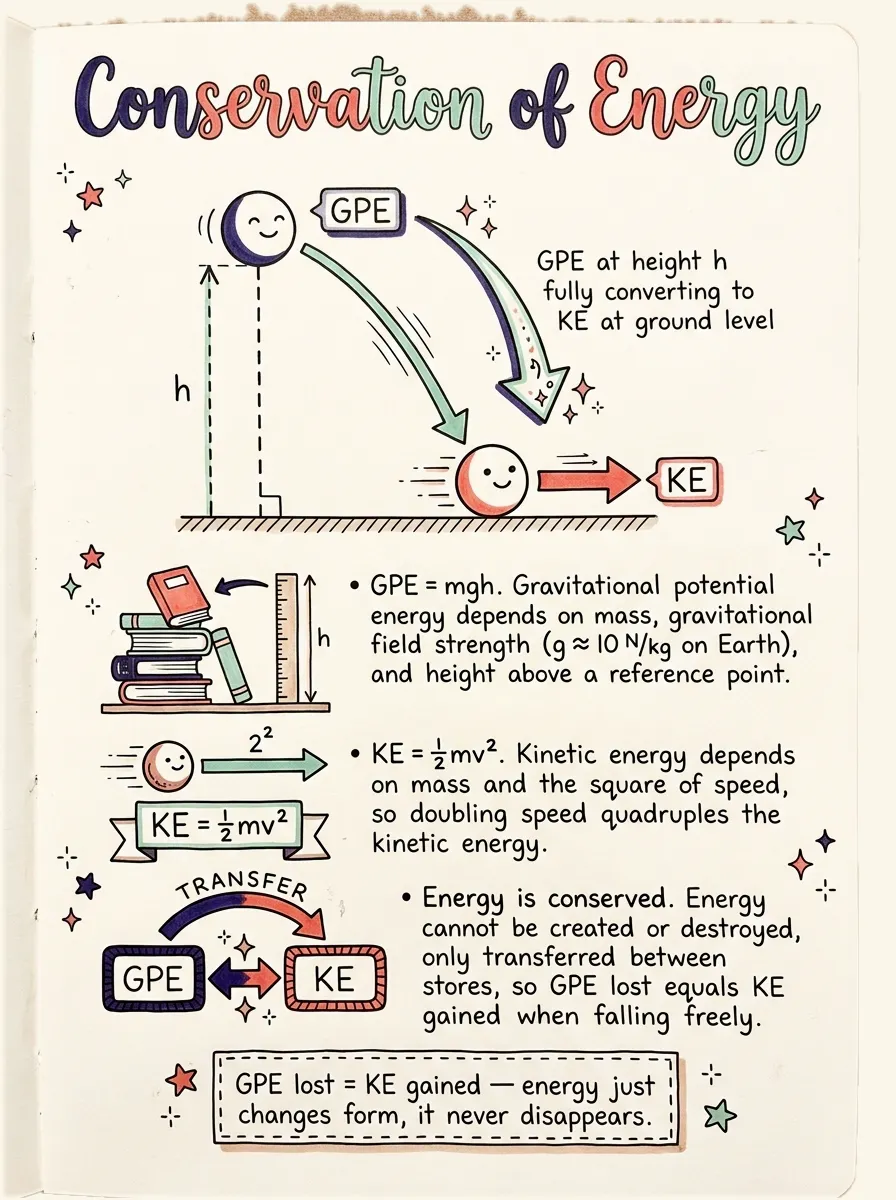
Picture a marble balanced at the top of a ramp. Right now it isn't moving, yet it clearly has the potential to shoot off the moment you let go — because height above the ground is itself a form of stored energy. Learning to see energy this way, hiding inside objects until something releases it, is the single idea this whole O-Level topic rests on.
Energy Doesn't Vanish — It Just Changes Address
Physicists describe energy as sitting in different "stores" depending on what's true about an object: whether it's moving, how high up it sits, how hot it is, or what's locked inside its atoms. A store label is only useful if you can also say how it changes — and that's where transfers come in. Every time something speeds up, cools down, lifts or falls, energy shifts from one store into another, carried along by a push, a current, a temperature difference, or a wave.
The rule tying every calculation together is conservation of energy: the grand total never grows or shrinks, it only relocates. So whenever an object falls and speeds up, whatever height-based energy it loses must reappear as motion energy gained — no more, no less. That trade is what lets falling-and-rolling problems be solved with two formulas instead of one tangled unknown.
Worked Example — A Trolley Rolling Down a Slope
- A 4 kg trolley starts at rest at the top of a smooth 1.25 m ramp. At this point, all its energy is stored by height: E_p = m × g × h = 4 × 10 × 1.25 = 50 J.
- As it rolls down, the height shrinks to zero, so that height-based energy must have moved entirely into motion energy — by conservation, the motion store now holds that same 50 J.
- Set the motion-energy formula equal to 50: ½ × m × v² = 50, so ½ × 4 × v² = 50, which gives 2 × v² = 50 and therefore v² = 25.
- Undo the square by taking a square root: v = √25 = 5 m/s.
That single swap — height-energy lost equals motion-energy gained — is the exam's favourite trick, and it's exactly the kind of link the full lesson below drills further, with an audio walkthrough, additional worked problems and a printable worksheet.
Keep going — unlock the whole topic
Notes, audio and the worksheet for this topic, plus every other topic in the subject.
Claim a free seat →