Genetic Engineering — Study Notes
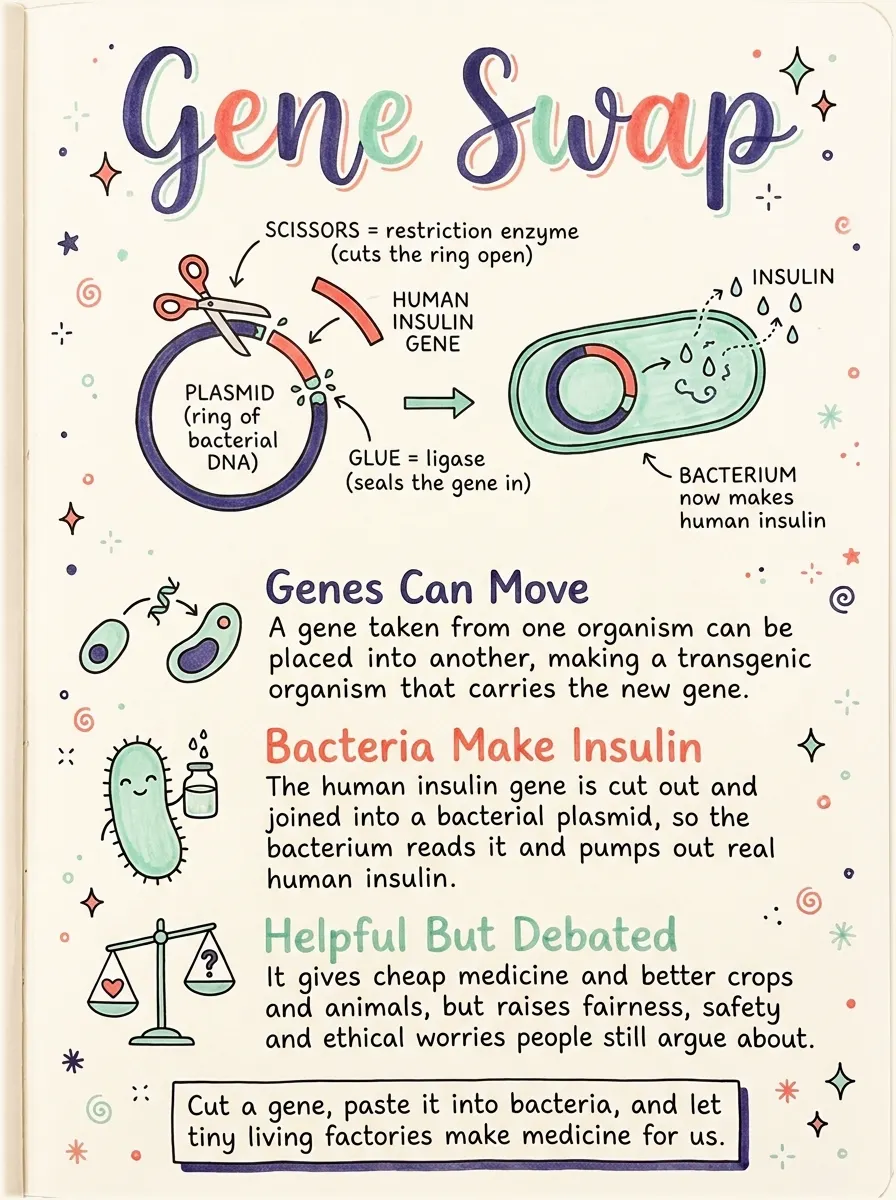
Every living cell — a rose bush, a jellyfish, a person — reads DNA using the exact same four-letter code. That single fact is what lets scientists lift a working gene out of one species and drop it into a totally different one, and have it actually get read correctly. That controlled swap is genetic engineering, and O-Level examiners are strict about the one word that separates it from an ordinary DNA mistake.
The Word That Decides the Marks: Deliberate
Genetic engineering means scientists pick out a useful gene on purpose and move it into a different organism so that organism gains a new trait it didn't have before. Compare that with a mutation: a spontaneous, unplanned change in DNA caused by copying slip-ups or exposure to something like radiation, with nobody choosing the outcome. Same result — DNA has been altered — but only one of them involved a scientist selecting the exact gene and its destination.
Moving the gene needs two named tools working in sequence. A restriction enzyme snips DNA open at one precise spot, freeing the chosen gene and also opening up a plasmid — a small ring of DNA that bacteria carry separately from their main chromosome and that acts as the delivery vehicle. Then ligase seals the gene into that opened ring, sewing it back into one unbroken loop the bacterium can copy every time it divides. Remember it as cut, then stitch — never the other order.
Worked Example — Engineering Bacteria to Produce Human Growth Hormone
- Scientists locate the human gene responsible for making growth hormone within human DNA, using its known position as a marker.
- A restriction enzyme cuts that gene free, and the same enzyme opens a bacterial plasmid so both cut ends match shape.
- Ligase joins the growth-hormone gene into the opened plasmid, re-forming a complete circular loop of DNA.
- This engineered plasmid is placed inside a bacterial cell, which now carries foreign instructions alongside its own.
- Grown in huge fermentation tanks, the bacteria multiply rapidly, copying the plasmid — and the hormone gene — into every new cell, so the colony mass-produces human growth hormone for patients whose own bodies can't make enough.
That five-step sequence is exactly how real biotech companies supply growth-hormone treatment today — and it's only one worked case. The rest of this topic — including insulin production worked in full, transgenic crops and animals, the ethics questions examiners love to ask, plus an audio walkthrough and a printable worksheet — is in the full lesson below.
Keep going — unlock the whole topic
Notes, audio and the worksheet for this topic, plus every other topic in the subject.
Claim a free seat →