Grammar for Writing — Study Notes
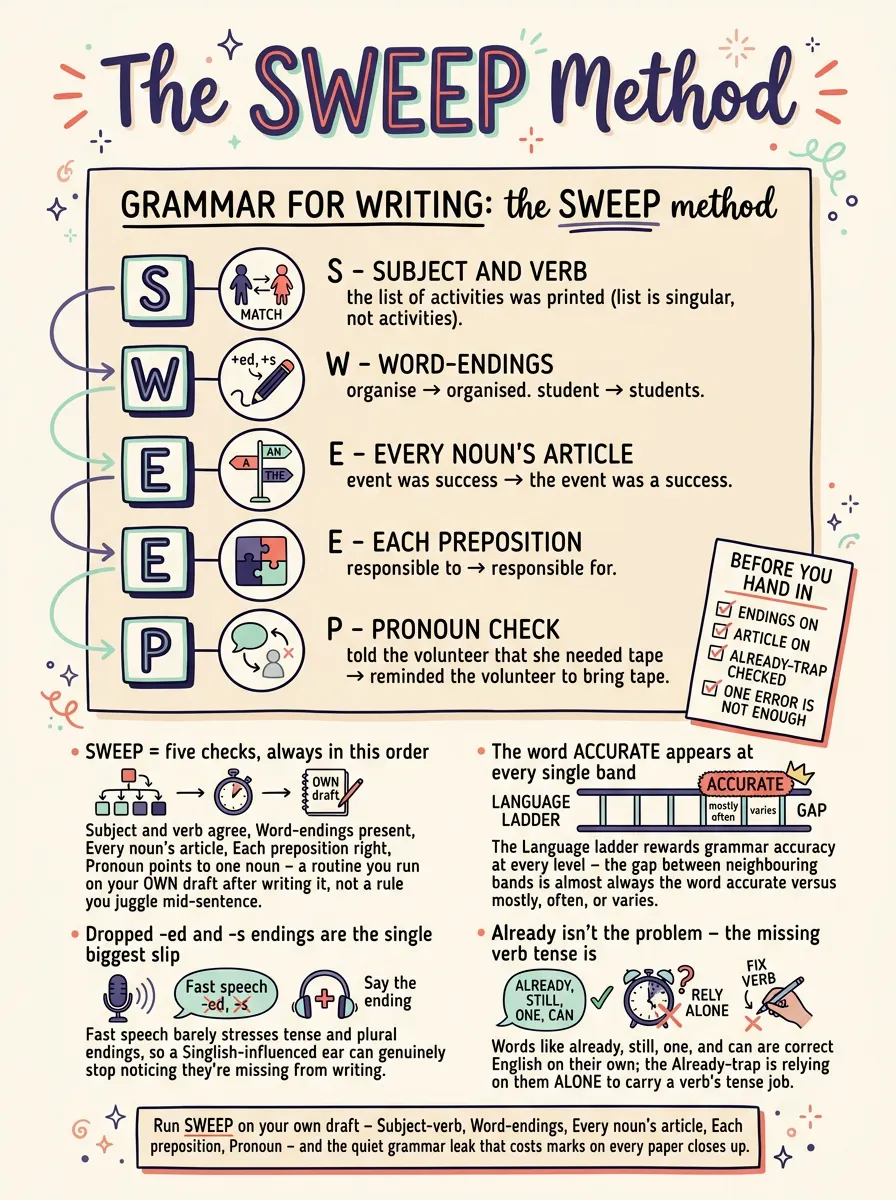
Picture two scripts with the exact same good idea in them. One earns a strong Language mark; the other gets capped a band lower — not because the thinking was weaker, but because a verb didn't match its own subject. That kind of slip costs marks in every paper you write, from Situational Writing to the last line of a composition, and it has nothing to do with what you were trying to say.
Why the Verb Loses Track of Its Subject
Most subject-verb slips happen for one repeatable reason: a describing phrase sits between the real subject and its verb, and your ear locks onto whichever noun is physically closest instead of the noun that actually controls the sentence. Exam writers build sentences this way on purpose, because it's the easiest accuracy error to plant without the sentence sounding obviously wrong. The fix is a habit, not a rule to memorise: find the verb, trace back past any describing phrase in between, and match it to the noun that phrase is quietly attached to — never to the noun sitting nearest.
Worked Example — Fixing a Hidden Subject-Verb Mismatch
- Start with the flawed sentence: "The pile of exam scripts on his desk were finally marked."
- Locate the verb group: "were... marked." Something is doing that action — the question is what.
- Strip out the describing phrase "of exam scripts on his desk." It only tells you which pile; it isn't the thing being marked.
- What's left is "the pile... marked," and pile is singular, so the verb has to be singular too.
- Corrected: "The pile of exam scripts on his desk was finally marked."
Notice the trap: "scripts" and "desk" both sit right beside the verb, and both are red herrings — neither one is the subject.
Subject-verb slips are just one repeat offender out of a short, learnable list. The full set of checks, an audio walkthrough that runs them on a real script, and a practice worksheet are waiting in the full lesson below.
Keep going — unlock the whole topic
Notes, audio and the worksheet for this topic, plus every other topic in the subject.
Claim a free seat →