Group Trends: 1, 17, 18 — study notes
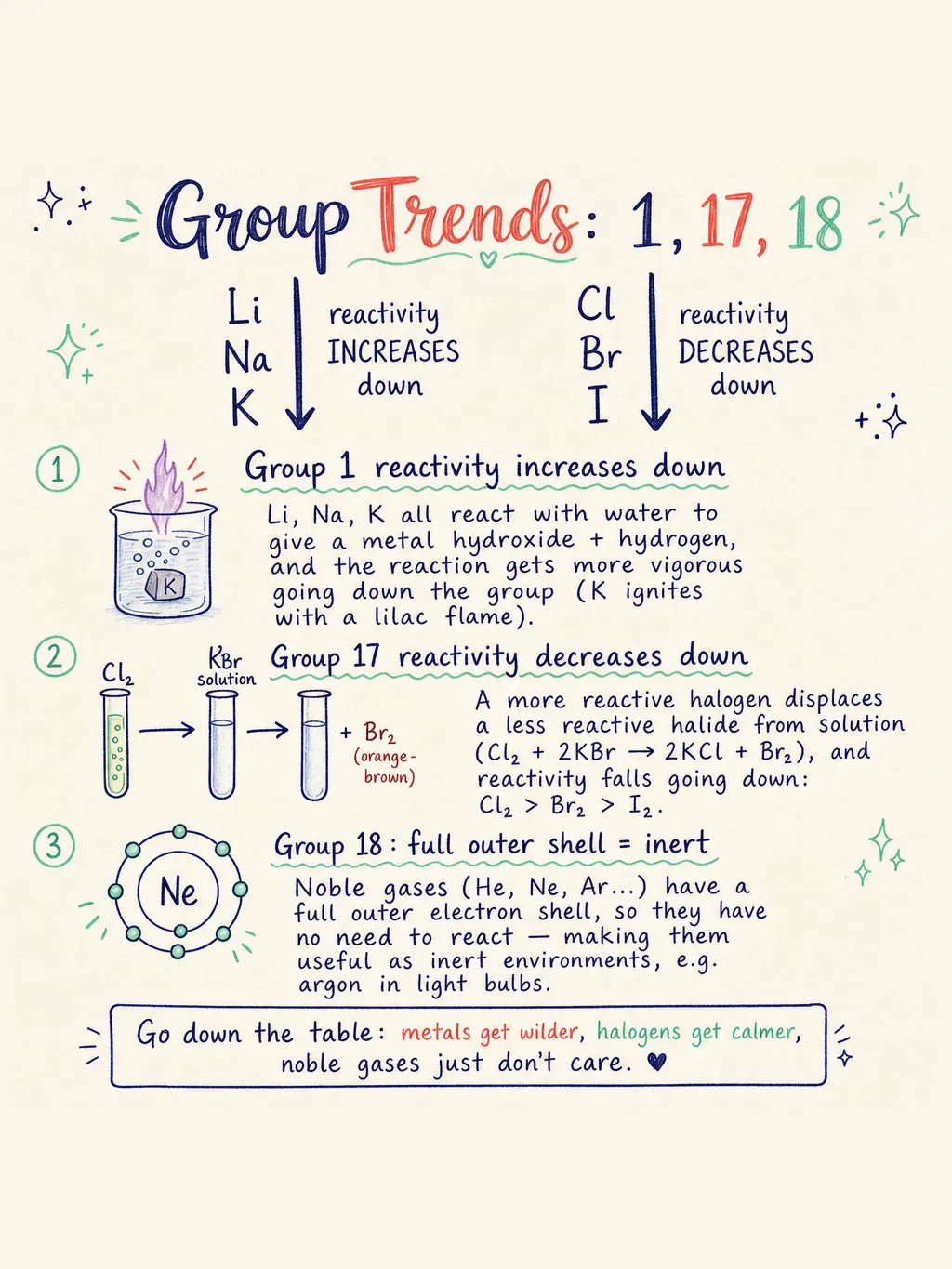
Line up three columns of the periodic table and each one marches in its own predictable direction the further down you look — how fiercely a metal reacts, what colour a gas turns, how hot something needs to get before it melts. Learn the direction once, and you can call the answer for an element you've never actually seen in a lab.
How a Group's Trend Actually Works
Elements in the same column share a family resemblance because of how their outer electrons are arranged, and that resemblance shifts in a steady direction as the atoms get bigger going down the column. In Group 1, the metals get more eager to react with water the further down you go, even though their melting points drop at the same time — two separate trends running in opposite directions, so don't let one bleed into the other. In Group 17, it's the reverse: the elements calm down and react less as you descend, while turning darker and needing more heat to melt. Group 18 barely reacts at all, at any point in the column, because every member starts out with an already-complete outer shell and simply has no incentive to swap electrons with anything. Once you can name which direction a property moves, you can extend the pattern to elements the syllabus never mentions by name.
Worked Example — Predicting a Halogen Displacement
- Chlorine sits above iodine in Group 17, and reactivity falls the further down the column you go, so chlorine is the stronger of the two halogens here.
- A stronger halogen always forces a weaker one out of a solution containing its ions, so bubbling chlorine gas through potassium iodide solution frees iodine while chloride ions take the iodide's place.
- Write the word statement first — chlorine plus potassium iodide gives iodine plus potassium chloride — then convert it: Cl₂ + 2KI → 2KCl + I₂. Counting atoms confirms 2 Cl, 2 K and 2 I sit on each side, so nothing further needs adjusting.
Try running that same logic backwards — adding iodine to a potassium chloride solution — and you'll find nothing happens at all, because the weaker halogen simply cannot dislodge the stronger one.
The full lesson below covers every trend across all three groups with a listen-along audio walkthrough, a printable worksheet, and the remaining worked examples — including how the alkali-metal water equation balances and why each noble gas's electron arrangement explains its lack of reactivity.
Keep going — unlock the whole topic
Notes, audio and the worksheet for this topic, plus every other topic in the subject.
Claim a free seat →