Hormonal Control — Study Notes
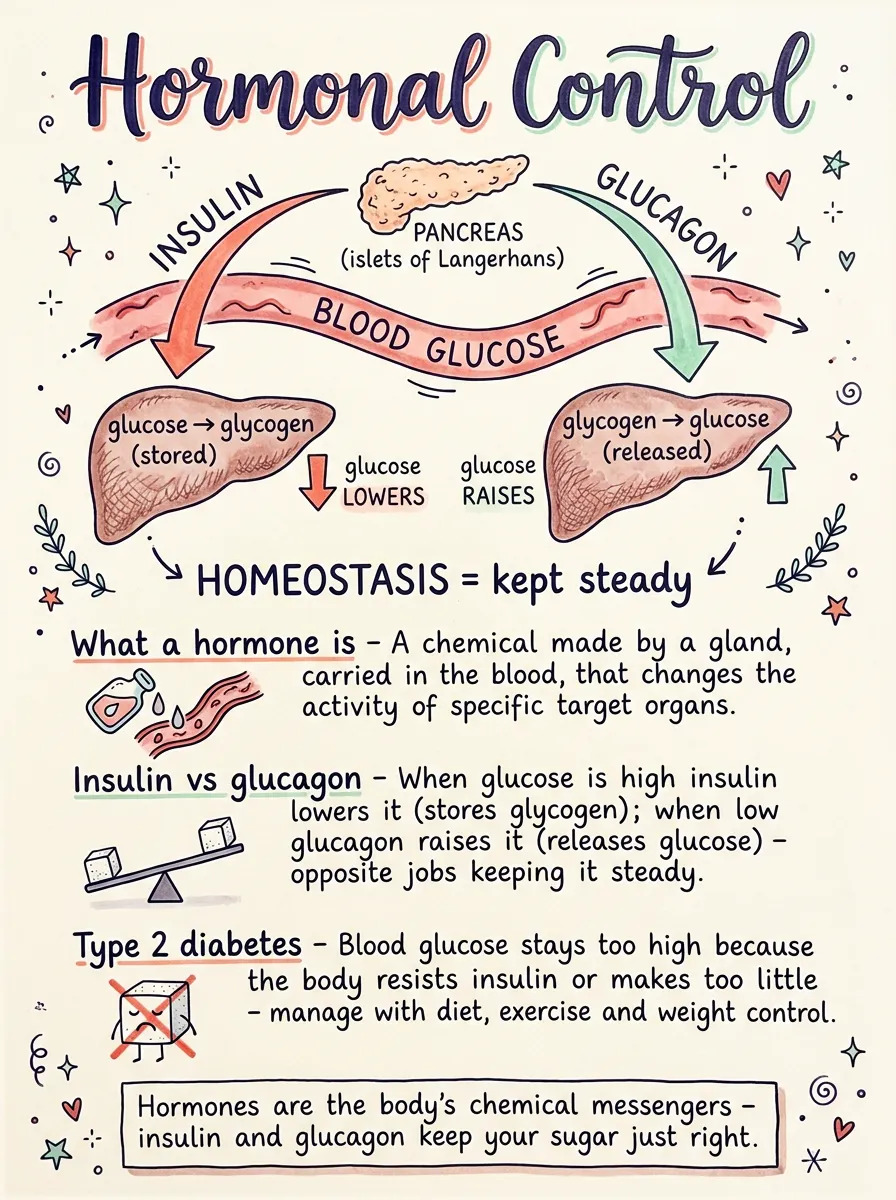
Every few minutes, without you noticing, your pancreas checks how much sugar is dissolved in your blood and quietly steps in if the number drifts off course. That correction is hormonal control at work — and it's one of the most heavily tested ideas in O-Level Biology.
Why Blood Glucose Needs Two Opposite Hormones
A hormone is a chemical signal released by a gland directly into the bloodstream, changing how a particular target organ behaves. Because blood reaches every organ in the body, a hormone can't be aimed at one destination the way a nerve signal is — it circulates everywhere, and only cells built with a matching receptor actually respond to it.
Blood glucose has to stay inside a narrow band: too high, over time, damages blood vessels; too low starves the brain of fuel. The pancreas manages this using two hormones that pull in opposite directions. Insulin switches on when glucose climbs too high, prompting liver and muscle cells to pull the surplus out of circulation and lock it away as glycogen. Glucagon does the opposite job when glucose falls too low, turning stored glycogen back into usable glucose. This constant sensing-and-adjusting is a feedback loop, and the same pattern reappears elsewhere in the body — for example, controlling water balance through ADH.
Worked Example — Reading a Blood-Glucose Scenario
- A blood test taken thirty minutes after breakfast reads 7.4 mmol/L, above the resting range of roughly 4–6 mmol/L, so the level has swung too high.
- Because the reading is high rather than low, the pancreas responds by releasing insulin rather than glucagon.
- Insulin signals liver and muscle cells to draw the surplus glucose out of the blood and convert it into glycogen for storage.
- A repeat test an hour later reads 5.1 mmol/L — the correction has worked, and insulin secretion eases back down.
Notice the shortcut: decide whether the reading sits above or below normal, then name the hormone that pushes it back the other way — that logic answers most exam questions on this topic.
The rest of the system — adrenaline's fight-or-flight role, what goes wrong in Type 1 versus Type 2 diabetes, ADH and osmoregulation, plus an audio walkthrough and worksheet — is covered in the full lesson below.
Keep going — unlock the whole topic
Notes, audio and the worksheet for this topic, plus every other topic in the subject.
Claim a free seat →