Human Gas Exchange — Study Notes
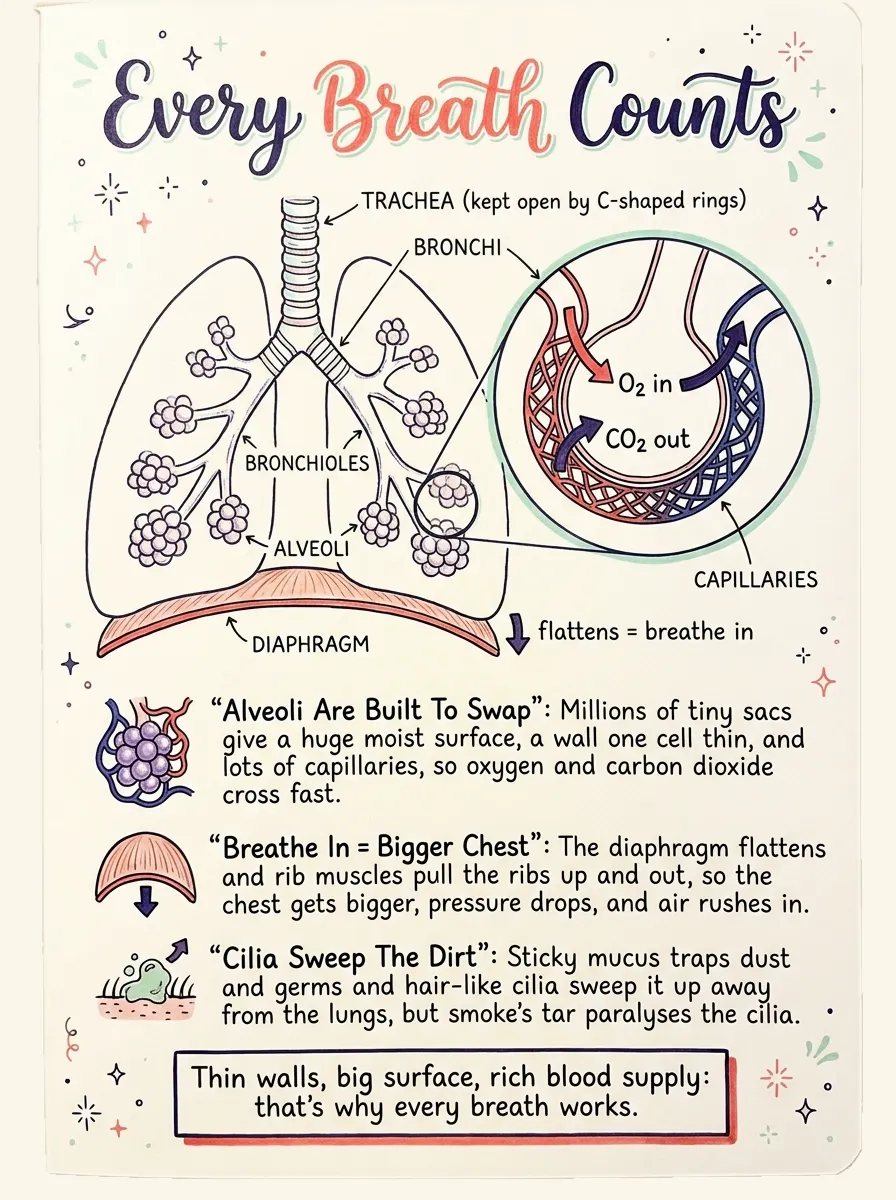
Ask an O-Level examiner what separates a top mark from a middling one on a gas-exchange question, and they won't say "more facts." They'll say the answer never finishes the job — it names a body part, then stops, instead of following that part all the way through to why it matters for breathing.
Turning a body part into a full explanation
Biology "explain" questions reward a chain, not a label. Start by naming the structure you're asked about. Then describe, in physical terms, what that structure actually does — is it a barrier, a tube, a covering, a pump? Finally, close the loop: say how that physical action helps the body take in oxygen or get rid of carbon dioxide faster or more reliably. Miss the last link and an examiner reads a fact with no payoff; include it and the same fact earns marks. This three-step habit — name it, describe it, connect it — turns a list of parts you've memorised into marks you can bank on almost any structure the paper throws at you.
Worked Example — Explaining Why Capillaries Help Gas Exchange
- Name it. Fine capillaries surround every air sac in the lung, pressed close against its outer wall.
- Describe it. Blood keeps flowing through them without pausing, so the blood arriving at any moment is always freshly low in oxygen and high in carbon dioxide compared with the air sac beside it.
- Connect it. Because that blood is constantly swapped for more low-oxygen blood, the oxygen difference between air sac and blood never shrinks — and a bigger difference means gas molecules keep spreading across faster, for as long as breathing continues.
Notice the pattern repeats for almost any exam structure — a covering, a lining, a muscle — once you force yourself through all three steps instead of stopping at "name it."
The full lesson below walks through this same three-step method for every remaining structure in the breathing system, with an audio walkthrough you can listen to on the go and a worksheet to practise the technique yourself.
Keep going — unlock the whole topic
Notes, audio and the worksheet for this topic, plus every other topic in the subject.
Claim a free seat →