Human Impact on the Ecosystem and Conservation — Study Notes
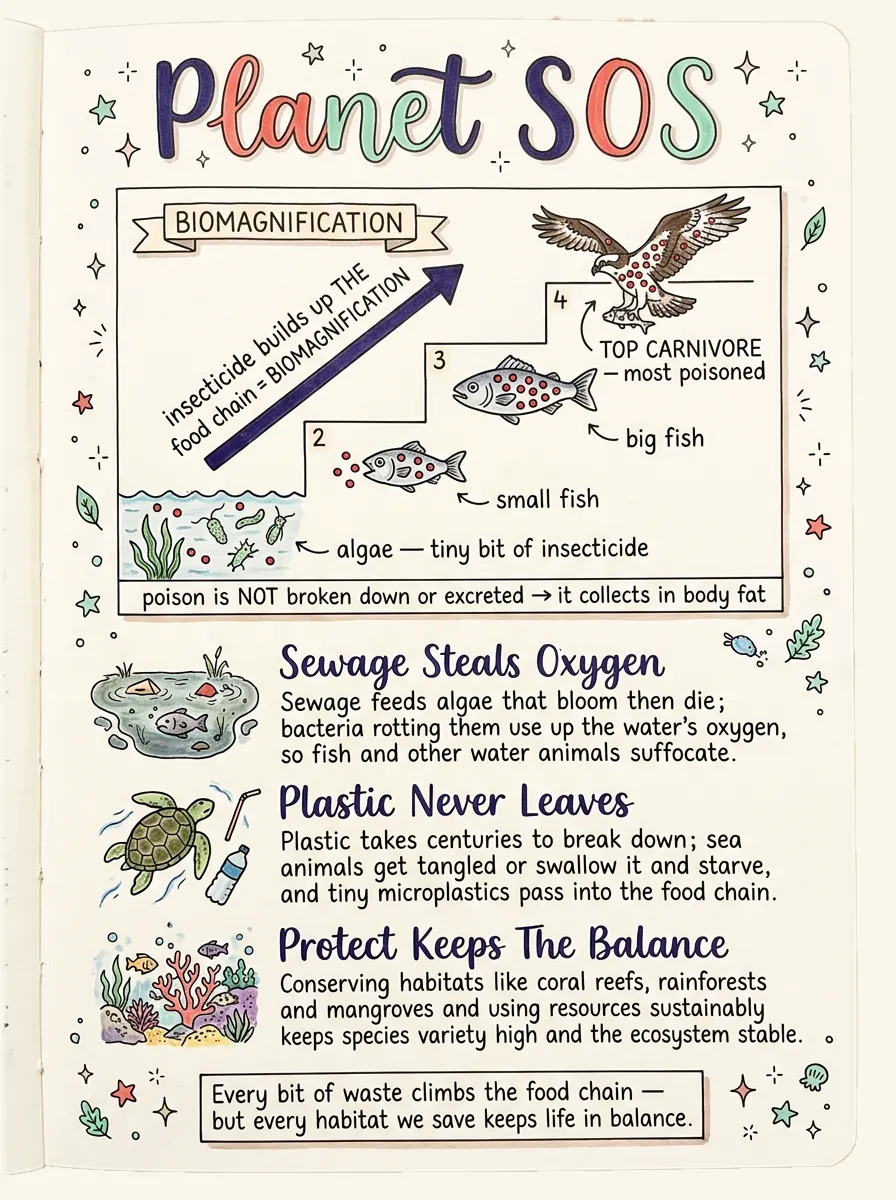
A hawk that has never gone near a farm can still carry the highest dose of pesticide of any animal in its habitat — higher than the crop it was sprayed on. That paradox sits at the centre of one of O-Level Biology's trickiest ideas, and once you see the mechanism behind it, the "trick" disappears.
Why a Stored Chemical Behaves the Opposite of Energy in a Food Chain
You already know that energy shrinks at every step of a food chain — most of it escapes as heat, so predators near the top only ever get a small share. It's tempting to assume a stored chemical such as an insecticide thins out the same way going up the chain. It does not. Bioaccumulation is what happens inside one animal: if it absorbs a chemical faster than its body can remove it, the chemical simply piles up inside that individual across its lifetime. Biomagnification is what happens next, across the whole chain: because a predator swallows dozens or hundreds of prey during its life, it inherits every one of their stored chemical loads in a single body. None of it is lost as heat along the way, so the concentration does not shrink further up — it stacks, and grows, at every link.
Worked Example — Pesticide Levels in a Rice-Paddy Chain
- Pond algae in a flooded paddy soak up a faint trace of pesticide washed off nearby fields.
- A tadpole grazes on that algae throughout its whole larval stage, so its body ends up holding the combined trace from many separate mouthfuls, not just one.
- A frog eats dozens of tadpoles over its lifetime, inheriting the stored pesticide load carried by every single one of them.
- A heron then eats several such frogs, so its own body accumulates the stacked total from all of them — leaving the heron, sitting at the very top, with the heaviest concentration anywhere in the chain.
Notice the concentration kept climbing at every link even though the paddy water itself was only faintly contaminated to begin with — that gap between a tiny input and a dangerous final output is exactly what exam questions are built to test.
Deforestation's chain-reaction damage, the two separate routes by which water pollution starves fish of oxygen, and why protecting biodiversity keeps a whole ecosystem from collapsing are each walked through in full, with audio narration and a practice worksheet, in the complete lesson below.
Keep going — unlock the whole topic
Notes, audio and the worksheet for this topic, plus every other topic in the subject.
Claim a free seat →