Alkanes vs Alkenes — study notes
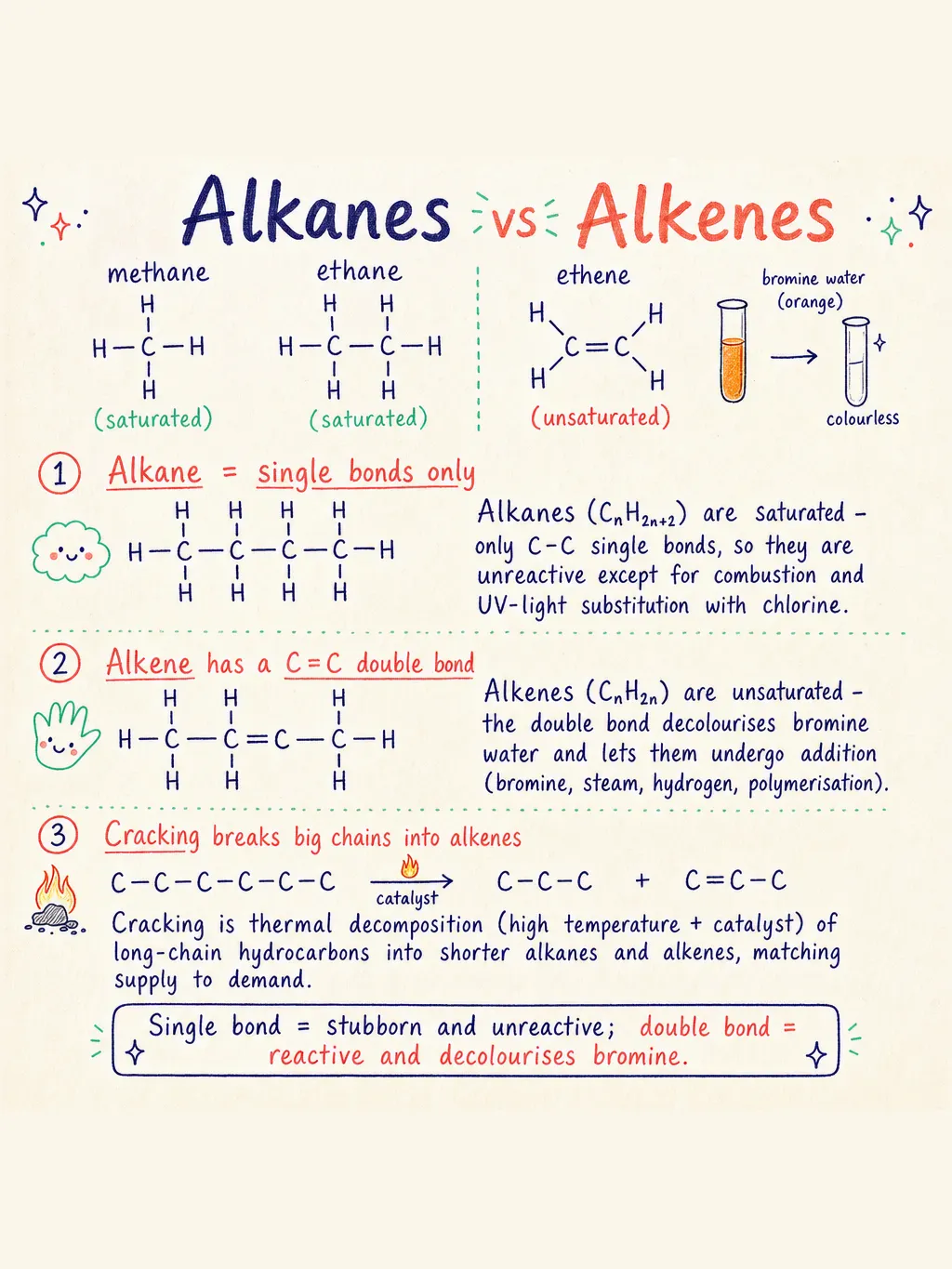
Petrol in a car tank, the wax of a candle, and the plastic casing on your phone charger all start from the same two ingredients: carbon and hydrogen, joined into a chain. Chemists sort these chains into families, and once you know which family a molecule belongs to, you can predict almost everything about how it behaves.
Sorting Carbon Chains by How "Full" They Are
Picture a carbon atom as a passenger van with exactly four seats. If every seat is filled with a hydrogen or another carbon and there's no room left, chemists call that molecule saturated — it only has single bonds joining its carbons. A family of saturated chains that all follow one shared rule is a homologous series: master the rule just once and you can generate every member of the family without memorising them individually.
For the saturated family, that shared rule is a general formula: however many carbon atoms a molecule has, double that number and add two more to get the hydrogen count. The pair of carbons sitting right at the two tips of the chain each grab an extra passenger, because each one only links to a single neighbouring carbon instead of two, so a seat opens up. That's the whole reason the "+2" exists — it isn't an arbitrary constant, it falls straight out of counting bonds.
Worked Example — Finding Pentane's Molecular Formula
- Pentane has five carbon atoms in its chain, so the carbon count is 5.
- Double the carbon count for the "middle" hydrogens: 5 × 2 = 10.
- Add two more for the pair of end carbons, each with a spare seat: 10 + 2 = 12.
- Pentane's molecular formula is therefore C₅H₁₂.
Every saturated chain works this same way, no matter how long it gets — swap in a different carbon count and the same two steps hand you the hydrogen total instantly.
That "+2" pattern is only half the story — once a chain loses a pair of hydrogens and gains a double bond instead, the reactions it undergoes change completely, and that's exactly what a listen-along audio walkthrough, a practice worksheet, and the rest of the worked examples cover in the full lesson below.
Keep going — unlock the whole topic
Notes, audio and the worksheet for this topic, plus every other topic in the subject.
Claim a free seat →