Infectious Diseases — Study Notes
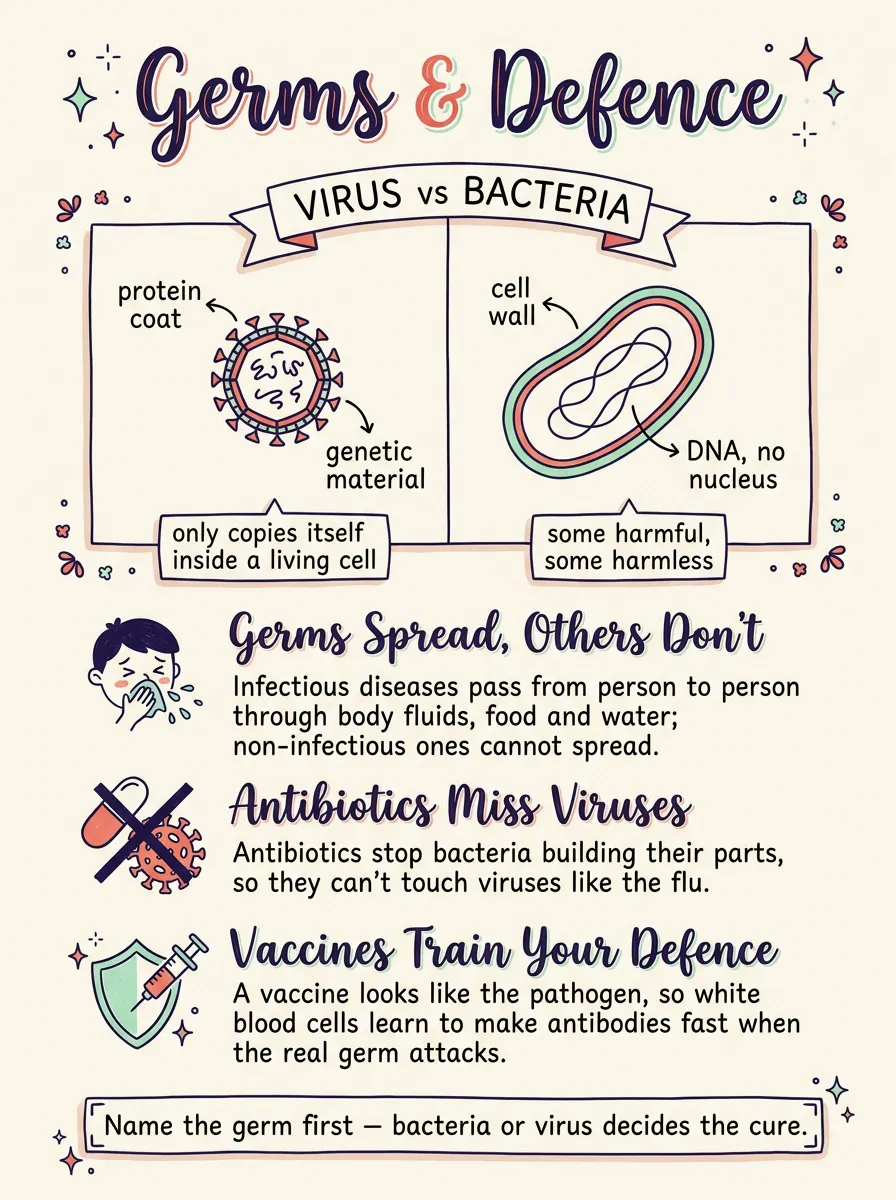
A doctor happily prescribes antibiotics for a bacterial chest infection but refuses them for an ordinary cold — same doctor, same medicine cabinet, wildly different outcome. That split has nothing to do with how rough the illness feels; it comes down entirely to what the pathogen is made of.
Reading a Pathogen's Build to Predict How It Behaves
A pathogen is simply any organism capable of causing illness, and the two groups you're tested on most — bacteria and viruses — are put together in completely different ways. A bacterium is a complete, self-running cell: it owns an outer wall and keeps its genetic material floating freely inside, since it has no nucleus to package it into. Running its own equipment lets a bacterium grow and divide on its own, and most kinds never bother a human at all — only a minority are disease-causing.
A virus is built far more sparsely: essentially genetic instructions sealed inside a protein shell, with no outer wall and no equipment for feeding or dividing. That gap is exactly why it must break into a living cell and borrow that cell's own machinery just to make more copies of itself.
This build gap is what decides whether antibiotics can help at all. Antibiotics work by disrupting something a bacterial cell must construct to survive — often its outer wall — so the bacterium stops multiplying while the patient's own cells stay untouched. A virus never owns a wall, or any of the equipment antibiotics interfere with, so the drug simply has nothing to grab onto. It's the build, never how unwell someone feels, that settles whether treatment will work.
Worked Example — Predicting Whether an Antibiotic Will Help
- A throat swab from a patient reveals a pathogen made of genetic instructions sealed in a protein shell, with no outer wall and no way to divide outside a living cell.
- Match these clues against the two builds above: lacking a wall and unable to divide alone rules out a bacterium, leaving the virus build as the only fit.
- Antibiotics act on structures such as a bacterial wall — and this pathogen carries none — so giving one would achieve nothing; the drug has no target to disrupt.
- Conclusion: the pathogen is viral, so the doctor manages the symptoms (or relies on a vaccine beforehand) rather than reaching for an antibiotic.
That's the reasoning chain examiners reward — build first, treatment decision second. The full lesson below works through the remaining named diseases, a listen-along audio walkthrough, and a self-check worksheet.
Keep going — unlock the whole topic
Notes, audio and the worksheet for this topic, plus every other topic in the subject.
Claim a free seat →