Kinematics — study notes
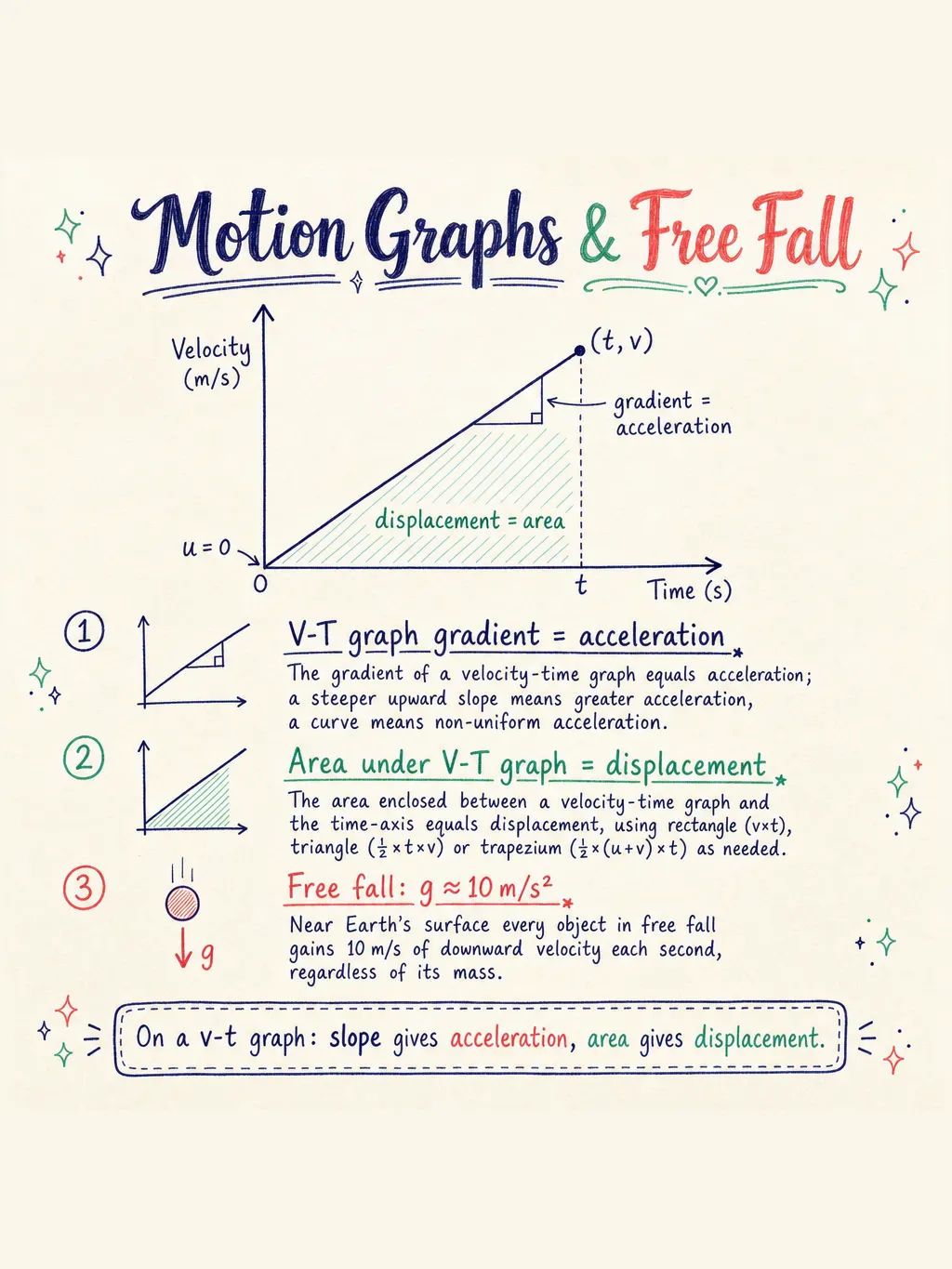
Every motion problem starts with the same question: how fast, and in what direction? Get that distinction wrong in kinematics and everything built on top of it — acceleration, displacement, graphs — falls apart before it starts.
Speed vs Velocity: Why Direction Matters
Picture two buses that both leave your stop "at 40 km/h." One heads to school, the other heads back toward town. Same number on the speedometer, completely different outcome for you. That's the gap plain "speed" can't describe.
Speed tells you only how fast — a size with no direction. We call a quantity like this a scalar. Velocity tells you how fast and which way — a vector. A car doing 60 km/h has a speed of 60 km/h; the same car doing 60 km/h heading east has a velocity of 60 km/h east. Change the direction and the velocity changes, even if the number on the dial hasn't moved at all.
To put a single number on "how fast" over a whole journey, we use average speed — built the same way any average is, total amount ÷ total time:
v_avg = d ÷ t, where v_avg = average speed (m/s), d = total distance travelled (m), t = total time taken (s).
Units must match before you divide — metres and seconds give m/s; mixing units (say, metres over hours) is like adding apples and oranges and expecting a sensible answer.
Worked Example
A dog runs 150 m in 30 s. What's its average speed?
- Identify what you're given: d = 150 m, t = 30 s — both already in SI units, so no conversion is needed.
- Apply the formula: v_avg = d ÷ t = 150 ÷ 30 = 5 m/s.
The rest of the method — every worked example, a listen-along audio walkthrough and a practice worksheet — is in the full lesson below.
Keep going — unlock the whole topic
Notes, audio and the worksheet for this topic, plus every other topic in the subject.
Claim a free seat →