Kinetic Particle Theory — study notes
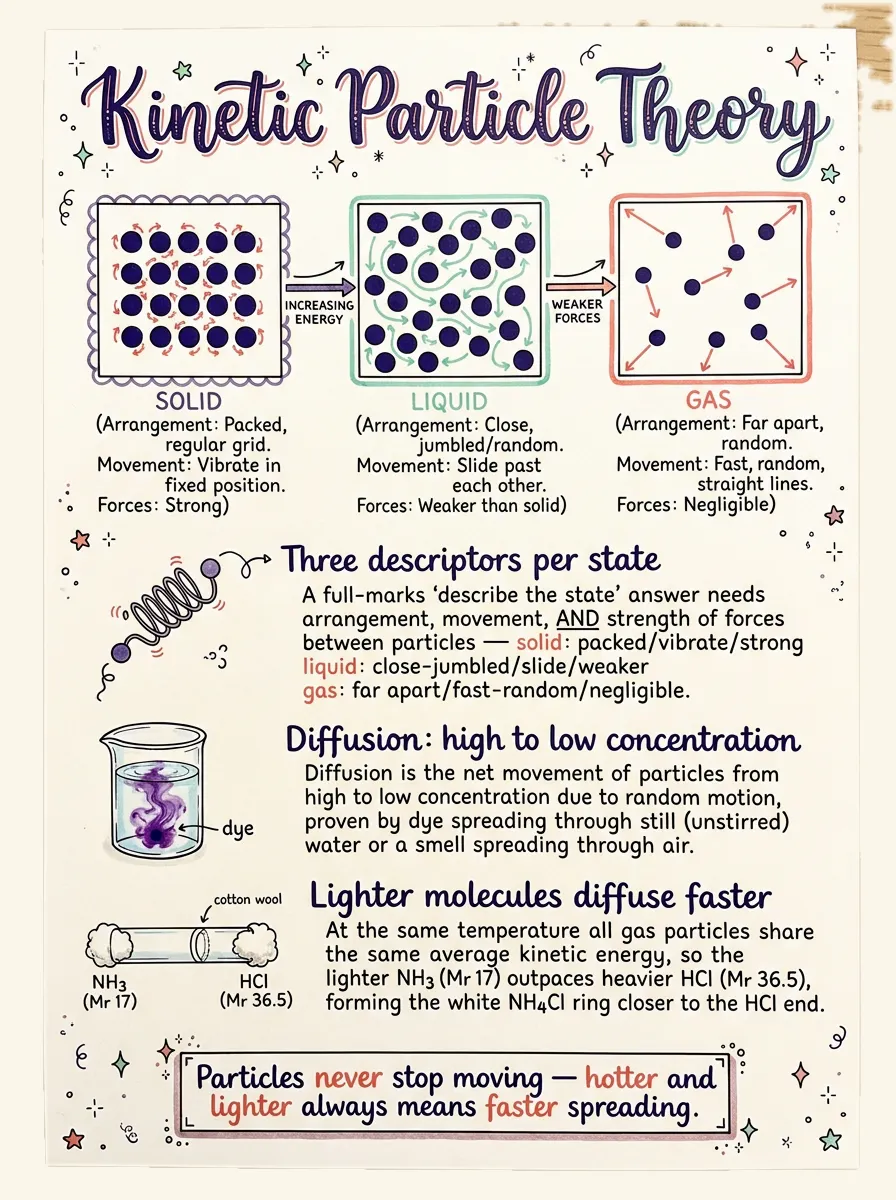
Open a bag of crisps in one corner of a quiet room, and a friend across the room catches the smell before you've even finished the packet — nobody fanned the air toward them. What actually carried that scent all the way over there?
The Core Idea: Particles Never Stop Moving
Kinetic particle theory says every substance is built from tiny particles that are constantly in motion, and how much they move depends on how much energy each one carries. In a solid, strong pulling forces lock the particles in place so they can only wobble on the spot. In a liquid those forces loosen just enough for particles to slip past their neighbours while staying bunched together. In a gas the forces are so weak they barely register, so particles shoot around freely with huge gaps between them. That single picture — stronger forces meaning less freedom to roam — explains why a solid holds its shape, a liquid pours yet keeps its amount, and a gas spreads out to fill wherever it's placed.
Diffusion is this same restless, random motion showing up on a large scale: particles naturally drift from a crowded patch toward a thinner one, simply because far more of them are available to wander outward than to wander back in. Two things speed that spreading up — warming the substance, which hands every particle more energy, and using a lighter particle, since less mass needs less of a push to reach the same energy, so it ends up travelling quicker.
Worked Example — Which Gas Wins the Race?
Bleach fumes (chlorine gas, Cl₂) and rotten-egg gas (hydrogen sulfide, H₂S) are released together from opposite ends of a long, sealed corridor. Which one reaches the halfway mark first?
- Add up the atomic masses to find each relative molecular mass: Cl₂ = 35.5 + 35.5 = 71; H₂S = 1 + 1 + 32 = 34.
- At a shared temperature, every gas particle carries roughly the same average movement-energy, so a lighter particle has to zip along faster to hold onto that same amount.
- H₂S has the smaller relative molecular mass (34, against Cl₂'s 71), so its particles travel faster and cover more corridor within the same stretch of time.
- H₂S reaches the halfway point first — between two gases, the lighter one always outruns the heavier one.
That settles the mass side of diffusion — the full lesson below works through the temperature side with its own numbers, plus a listen-along audio walkthrough and a worksheet to lock in the changes-of-state vocabulary examiners mark closely.
Keep going — unlock the whole topic
Notes, audio and the worksheet for this topic, plus every other topic in the subject.
Claim a free seat →